

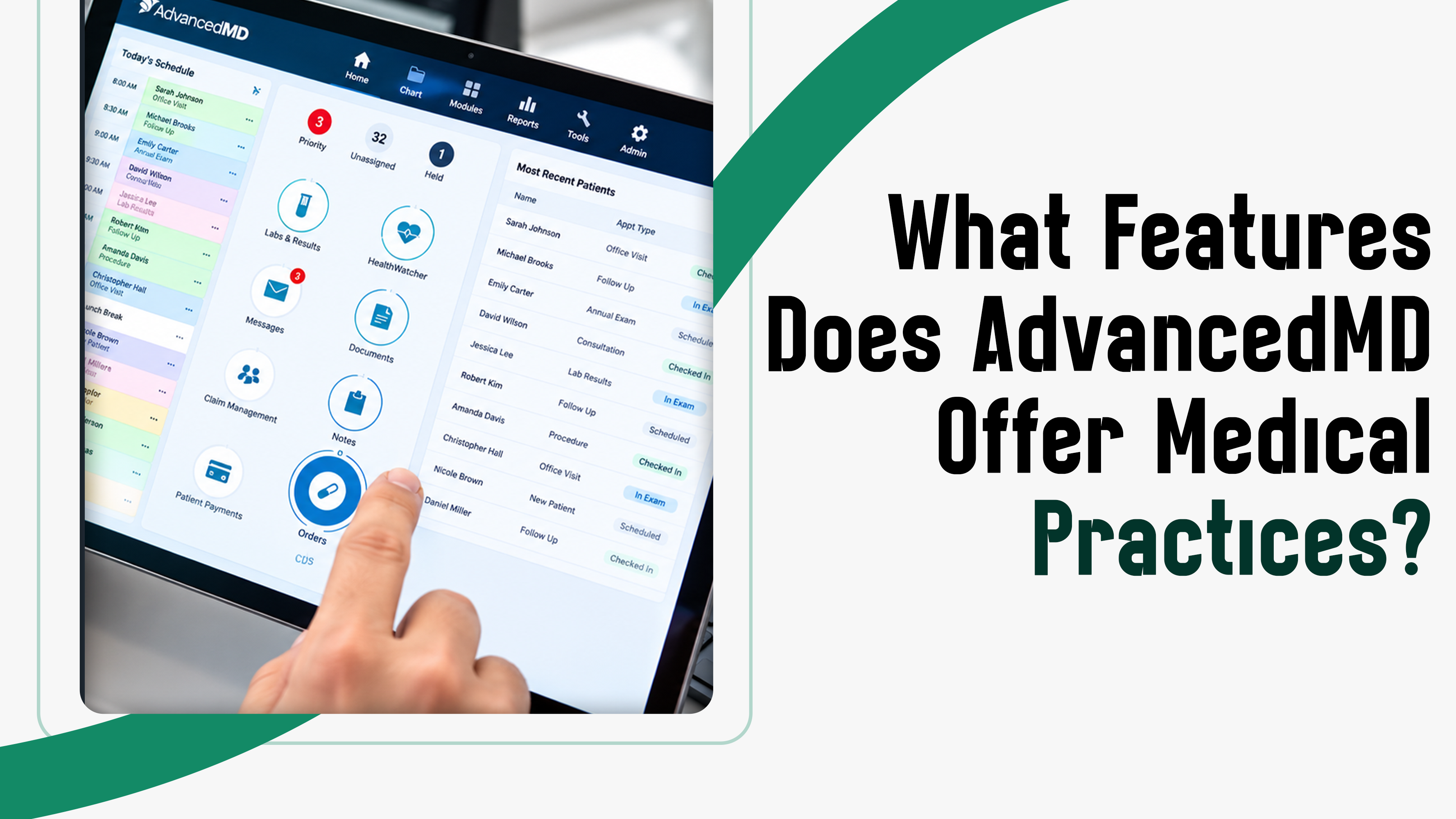

Choosing healthcare software is not simply about finding an electronic health record or appointment scheduler. Medical practices need a technology environment that can support clinical documentation, front-office operations, billing, patient communication, reporting, and other everyday responsibilities.
AdvancedMD is designed as a unified healthcare platform that combines several of these functions. Its current platform includes EHR, practice management, patient engagement, revenue cycle management, AI-enabled tools, telemedicine, and reporting capabilities. AdvancedMD states that its platform supports independent practices across dozens of specialties.
But which features actually matter to a medical practice? Understanding how each capability fits into daily operations can help practices determine whether the platform matches their needs.
What Is AdvancedMD?
AdvancedMD is a cloud-based healthcare technology platform built for independent medical practices. It combines clinical and administrative capabilities in one environment instead of requiring practices to manage every function through separate systems.
The platform includes AdvancedMD software for areas such as electronic health records, scheduling, billing, patient engagement, revenue cycle management, telemedicine, and reporting.
Its unified approach is particularly relevant for practices that want clinical and administrative information to move between departments without relying heavily on manual processes.
1. Electronic Health Records and Clinical Documentation
One of the core capabilities is its electronic health record functionality. The AdvancedMD EHR supports digital charting and clinical workflows while providing tools designed around different medical specialties.
AdvancedMD highlights specialty-specific workflows, customizable templates, electronic prescribing, patient information, and clinical documentation tools. Its EHR can also be accessed through supported mobile applications, allowing users to work with patient information beyond a traditional desktop environment.
For providers, the value of an EHR is not just replacing paper charts. The system needs to fit naturally into the way clinicians document visits, review information, prescribe medications, and complete outstanding tasks.
2. Practice Management Tools
Practice management covers many of the operational activities that happen before and after a patient sees a provider.
AdvancedMD's AdvancedMD practice management capabilities include scheduling, front-office workflows, insurance eligibility verification, patient check-in, and other administrative processes.
For example, staff can use scheduling tools to manage provider calendars and appointment availability. Insurance eligibility verification can also be incorporated into the process before a visit, helping staff identify coverage information earlier in the patient journey.
This makes practice management more than a calendar. It becomes part of the operational infrastructure connecting the front desk with clinical and financial teams.
3. Advanced Scheduling and Appointment Management
Appointment scheduling affects almost every part of a medical practice. Poor scheduling can create long wait times, unused appointment slots, administrative pressure, and communication problems.
AdvancedMD scheduling includes features for appointment management, patient self-scheduling, reminders, and insurance-related workflows. AdvancedMD also describes intelligent scheduling tools designed around provider preferences.
Patient self-scheduling can give patients more control over appointment booking while reducing some routine work for front-office staff.
Automated reminders can also help practices communicate appointment information without requiring staff to manually contact every patient.
4. Medical Billing and Claims Management
Financial workflows are another major component of AdvancedMD.
With AdvancedMD medical billing, practices can manage claims, billing activities, electronic remittance processes, claim scrubbing, and related revenue-cycle tasks. AdvancedMD states that its billing tools are integrated with the broader platform rather than operating as an entirely separate system.
Claim scrubbing can identify potential problems before claims are submitted, while electronic remittance functionality can reduce some manual posting and reconciliation work.
For practices, the important consideration is how billing connects with clinical documentation and charge capture. When these processes are connected, billing teams may have less need to repeatedly request or copy information from other systems.
5. Revenue Cycle Management
Revenue cycle management extends beyond basic billing. It includes the financial processes that occur from patient registration and insurance verification through claims, payments, denials, and account management.
AdvancedMD provides RCM technology as well as managed revenue cycle services. Its platform includes financial reporting and tools designed to help practices monitor revenue-related activity.
Practices that already have an internal billing team may use the technology to manage their own processes, while organizations looking for outsourced support can evaluate managed RCM services separately.
6. Patient Engagement and Patient Portal
Patients increasingly expect digital options for interacting with healthcare providers.
AdvancedMD includes AdvancedMD patient engagement capabilities such as patient portals, online scheduling, digital intake forms, reminders, secure messaging, and payment-related tools.
These features can move several routine activities away from manual phone calls and paper forms.
For example, patients may be able to schedule appointments online, complete forms digitally, communicate through secure messaging, and access relevant information through the patient portal.
This can make the experience more convenient for patients while reducing repetitive administrative work for staff.
7. Telemedicine
Telemedicine is another capability built into the AdvancedMD ecosystem.
AdvancedMD describes telehealth functionality that connects with scheduling, EHR, billing, and patient engagement workflows.
This integrated approach matters because virtual visits still require many of the same processes as in-person appointments. A practice needs to schedule the visit, collect patient information, document the encounter, manage billing, and communicate with the patient afterward.
Having these activities connected can help practices manage virtual and in-person care through a more consistent workflow.
8. AI-Powered Clinical Documentation
AI is becoming an increasingly important part of healthcare software, particularly for documentation.
AdvancedMD offers an AI Clinical Assistant that uses ambient listening and transcription to help generate clinical notes. The company also describes AI-supported capabilities for tasks such as prior authorization and coding assistance.
The potential value of this type of technology is reducing some repetitive documentation work. However, practices should still evaluate AI tools based on accuracy, workflow fit, review requirements, privacy considerations, and how much control providers have over generated content.
AI should support clinical workflows rather than replace professional review and decision-making.
9. Reporting and Analytics
Medical practices generate large amounts of operational and financial data. Without useful reporting, that information can be difficult to turn into actionable insights.
AdvancedMD provides reporting and analytics capabilities that include financial and clinical dashboards. Its current platform also highlights real-time analytics across providers and locations.
Practice managers can use reporting to examine areas such as financial performance, operational activity, claims, and other practice metrics.
This is particularly useful for organizations managing multiple providers or locations because managers need visibility beyond individual patient records.
10. Electronic Prescribing
Electronic prescribing is another important clinical capability. AdvancedMD supports electronic prescribing, including electronic prescribing for controlled substances where applicable.
Having prescribing tools within the EHR means providers can manage medication-related tasks within their broader clinical workflow instead of depending on an entirely separate application.
For practices, the exact prescribing requirements can vary by specialty and location, so organizations should verify current regulatory and workflow requirements before implementation.
11. Specialty-Specific Workflows
Not every medical practice works in the same way. A primary care office, behavioral health practice, physical therapy clinic, and specialty practice can have very different documentation and scheduling requirements.
AdvancedMD states that its platform supports numerous specialties and provides specialty-specific workflows and templates.
Customizable templates can allow practices to adapt documentation and workflows to their specific needs instead of forcing every provider to use an identical process.
This is an important consideration when comparing EMR and EHR software, because feature availability alone does not determine whether a platform will fit a particular specialty.
12. Cloud-Based Access and Integration
AdvancedMD operates as a cloud-based platform, meaning practices do not need to maintain traditional local servers for the core software environment. The company also describes its platform as a unified ecosystem with interoperability and integration capabilities.
Cloud-based access can be useful for organizations that need staff and providers to access information from different locations.
However, practices should still evaluate the integrations they specifically require, including laboratories, payment services, external applications, and other healthcare systems.
How These Features Work Together
The biggest point to understand about AdvancedMD is that these features are not necessarily intended to operate independently.
Consider a typical patient journey:
Online Scheduling → Insurance Verification → Digital Intake → Check-In → EHR Documentation → Prescription/Charge Capture → Claim Submission → Payment → Patient Follow-Up
Different members of the practice can interact with different parts of this process.
The front desk may handle scheduling and eligibility. The provider may use the EHR and prescribing tools. Billing staff can work with claims and payments. Patients can use engagement tools for scheduling, forms, communication, and payments.
This connected approach is one reason practices may evaluate AdvancedMD as a broader platform rather than simply as an EHR.
What Should Practices Consider Before Choosing AdvancedMD?
A long feature list does not automatically mean a platform is right for every organization.
Before selecting AdvancedMD, practices should consider:
-
Their medical specialty and workflow requirements
-
Number of providers and locations
-
Existing billing processes
-
Required third-party integrations
-
Patient communication preferences
-
Telehealth requirements
-
AI and automation needs
-
Reporting requirements
-
Data migration and implementation
-
Staff training and adoption
-
Overall software and service costs
Practices researching medical practice management software should compare actual workflows rather than looking only at the number of features offered.
Final Thoughts
AdvancedMD offers a broad collection of tools covering clinical documentation, practice management, scheduling, billing, RCM, patient engagement, telemedicine, AI, reporting, and electronic prescribing.
The main value of these capabilities comes from how they work together. A practice can evaluate each feature individually, but it is equally important to consider how information moves from the front desk to the provider, billing team, and patient.
For organizations comparing healthcare technology, the right choice depends on specialty, workflow complexity, staff requirements, integrations, and budget. A detailed evaluation or product demonstration can help determine whether AdvancedMD's feature set matches the practice's operational needs.
Frequently Asked Questions
Is AdvancedMD an EHR or practice management system?
It provides both EHR and practice management capabilities, along with billing, patient engagement, RCM, telemedicine, reporting, and other tools.
Does AdvancedMD offer medical billing?
Yes. Its platform includes billing and claims-management capabilities, including claim scrubbing and electronic remittance workflows.
Does AdvancedMD have a patient portal?
Yes. AdvancedMD provides a patient portal with capabilities such as scheduling, digital intake, secure messaging, and payments.
Does AdvancedMD support telemedicine?
Yes. Telemedicine is integrated with other areas of the platform, including scheduling, EHR, billing, and patient engagement.
Does AdvancedMD use artificial intelligence?
Yes. AdvancedMD currently offers AI-enabled clinical documentation and other AI-supported workflow tools.
