


Active Pharmaceutical Ingredients (API) Market Size, Share, Latest Insights and Forecast 2026-2034
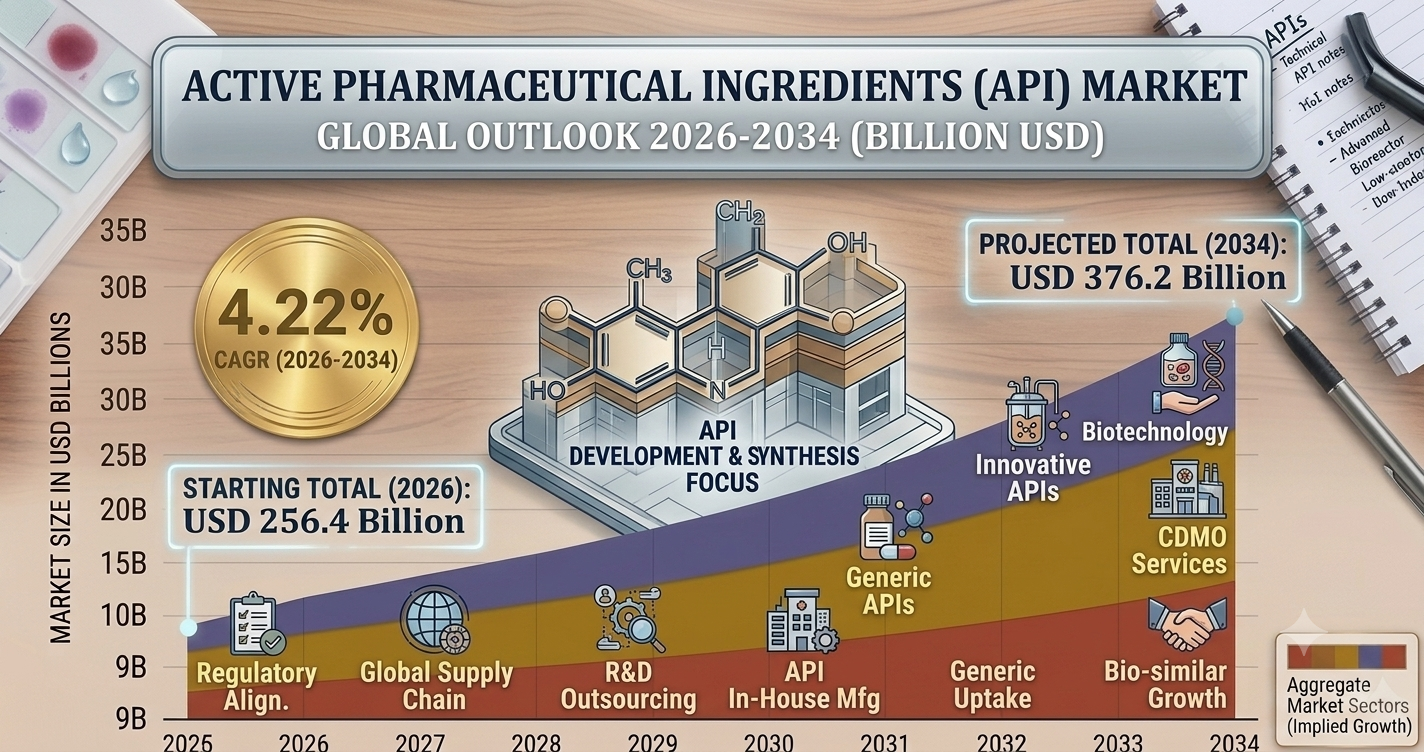
According to IMARC Group, the global active pharmaceutical ingredients (API) market size reached USD 256.4 Billion in 2025 and is projected to reach USD 376.2 Billion by 2034, expanding at a CAGR of 4.22% during 2026–2034. This steady growth, an incremental addition of USD 119.8 Billion over nine years, reflects rising R&D investment in biologics and targeted therapies, sustained generic and biosimilar volume growth, and the continued build-out of CDMO/CMO outsourcing capacity across India, China, and Europe.
Active Pharmaceutical Ingredients (API) Industry Overview
Active pharmaceutical ingredients are the biologically or pharmacologically active substances within a drug formulation that are responsible for producing its intended therapeutic effect. The global API ecosystem spans raw chemical and biological precursor supply, synthesis and fermentation manufacturing, analytical quality control, Drug Master File (DMF) regulatory submission, and distribution to downstream drug product formulators worldwide.
APIs are manufactured and deployed across a broad continuum of use cases:
- Innovative small-molecule and biologic APIs: Monoclonal antibodies, ADCs, gene therapy vectors, and novel targeted chemical entities supporting branded drug pipelines
- Generic APIs: High-volume chemical synthesis supporting global healthcare cost-containment and genericization of blockbuster drug franchises
- Biosimilar APIs: Follow-on biologic manufacturing for adalimumab, trastuzumab, bevacizumab, and rituximab biosimilars as patents expire
- Contract manufacturing (CMO/CDMO): Outsourced synthesis, fermentation, and fill-finish services for both innovator and generic pharmaceutical companies
- High-potent API (HPAPI) and oncology specialty manufacturing: Contained synthesis for ADC payloads and hormone antagonists requiring OEB4/OEB5-grade infrastructure
Global Active Pharmaceutical Ingredients (API) Market Size & Key Statistics
Below are the key active pharmaceutical ingredients (API) market size statistics drawn from IMARC Group's comprehensive market analysis:
|
Report Attribute |
Key Statistics |
|
Base Year |
2025 |
|
Historical Period |
2020–2025 |
|
Forecast Period |
2026–2034 |
|
API Market Size in 2025 |
USD 256.4 Billion |
|
Market Forecast in 2034 |
USD 376.2 Billion |
|
Market Growth Rate (2026–2034) |
4.22% CAGR |
|
Largest Region |
North America (38.0% share, 2025) |
|
Fastest Growing Region |
Asia Pacific (~6.4% CAGR) |
|
Leading Drug Type |
Innovative APIs (63.2% share, 2025) |
|
Leading Manufacturer Type |
Captive API Manufacturers (50.6% share, 2025) |
|
Leading Synthesis Type |
Synthetic APIs (71.8% share, 2025) |
|
Leading Therapeutic Application |
Oncology (~21–22% share, 2025) |
Request for a Sample Report for Detailed Active Pharmaceutical Ingredients (API) Market Analysis: https://www.imarcgroup.com/active-pharmaceutical-ingredients-market/requestsample
Key Market Drivers & Active Pharmaceutical Ingredients (API) Market Trends in 2026
Several powerful forces are shaping active pharmaceutical ingredients (API) market trends and fuelling sustained growth expectations across the global pharmaceutical manufacturing landscape:
1. Rising Chronic Disease Prevalence
Cardiovascular disease, diabetes, oncology, and central nervous system disorders collectively account for a significant share of the global disease burden. Global diabetes cases are projected to reach 783 million by 2045, representing an enormous downstream API demand engine as expanding patient populations across all geographies sustain pharmaceutical procurement volumes.
2. Biosimilar and Generic Drug Demand
The FDA's February 2024 approval of SIMLANDI® (adalimumab-ryvk), the first high-concentration, citrate-free interchangeable biosimilar to Humira®, exemplifies the accelerating biosimilar approval wave. Patent expirations on biologics worth over USD 200 Billion in annual revenues are creating large-scale biosimilar API manufacturing opportunities, while generic volume growth in emerging economies continues to sustain chemical API demand.
3. CMO/CDMO Sector Expansion
The global CDMO sector has grown significantly, with the India CDMO market expanding at roughly 7% annually and absorbing API manufacturing outsourcing from both innovator and generic pharmaceutical companies. CDMOs provide variable-cost manufacturing, specialized synthesis capabilities, and regulatory expertise that internal captive manufacturing cannot always cost-effectively replicate at small-batch scale.
4. Biopharmaceutical R&D Surge
The global pharmaceutical pipeline contained over 8,000 drugs in clinical development as of 2024, with biologics representing roughly half of all late-stage candidates. Each IND-to-approval cycle generates sustained demand for both development-stage and commercial-scale innovative API manufacturing, reinforcing long-run active pharmaceutical ingredients (API) market growth.
5. Biologic and ADC API Complexity Surge
Antibody-drug conjugates (ADCs), which combine a monoclonal antibody with a cytotoxic small-molecule payload, represent the fastest-growing API complexity category, with over 400 ADCs in clinical development as of 2025. Each ADC requires both biologic (antibody) and highly potent small-molecule (payload) manufacturing capability, driving investment in dedicated containment and bioconjugation facilities.
6. AI-Accelerated Drug Discovery and API Synthesis
Generative AI platforms, including AlphaFold, Insilico Medicine, and Recursion Pharmaceuticals, are identifying novel molecular targets and optimizing synthesis routes faster than traditional computational methods. AI-designed APIs with optimized molecular properties are reducing the time from target identification to GMP batch synthesis by an estimated 30–40%.
7. Supply Chain Reshoring and China+1 Strategy
The U.S. BIOSECURE Act's provisions targeting Chinese CDMOs, combined with EU supply chain resilience mandates, are accelerating sourcing diversification toward India, South Korea, Ireland, and Singapore. Eli Lilly and Company's announced plan to build a USD 5 Billion manufacturing facility in Goochland County, Virginia, illustrates the scale of this reshoring investment wave.
8. Green Chemistry and Sustainable API Production
Biocatalysis, flow chemistry, solvent-free reactions, and enzymatic synthesis are replacing multi-step chemical processes with lower waste-per-product (E-factor) equivalents. AstraZeneca and Pfizer have both committed to green chemistry API synthesis targets tied to their broader carbon neutrality goals.
Key Market Segmentation
By Drug Type
Innovative APIs — Largest Segment: Innovative APIs account for 63.2% of total market revenues in 2025, driven by strong R&D investment in biologics, monoclonal antibodies, ADCs, and gene therapy vectors.
Generic APIs: Generic APIs represent 36.8% of the market, continuing to serve global healthcare cost-containment objectives through high-volume, patent-expired chemical synthesis.
By Type of Manufacturer
Captive Manufacturers — Largest Segment: Captive API manufacturers, producing APIs exclusively for internal drug product use, hold a 50.6% share, reflecting large integrated pharmaceutical companies' strategic preference to control proprietary API synthesis, quality, and supply security.
Merchant Manufacturers: Merchant manufacturers, selling APIs externally to pharmaceutical clients including through CDMO models, account for the remaining 49.4% of the market.
By Type of Synthesis
Synthetic APIs — Largest Segment: Synthetic (small-molecule chemical) APIs lead the synthesis-type segment with a 71.8% share in 2025, reflecting the continued scale of commodity and specialty chemical API manufacturing.
Biotech APIs: Biotech APIs, comprising monoclonal antibodies, vaccines, cytokines, fusion proteins, therapeutic enzymes, and blood factors, represent the fastest-growing synthesis category as biologics and biosimilar pipelines expand.
By Therapeutic Application
Oncology — Largest Application: Oncology leads therapeutic application demand at roughly 21–22% share, driven by the proliferation of targeted cancer therapies, ADCs, and immuno-oncology monoclonal antibodies that require highly complex, high-value API synthesis.
Cardiovascular and Respiratory, Diabetes, CNS and Neurological Disorders, and Others: These application areas collectively sustain high-volume API demand, reflecting the breadth of chronic disease management across global healthcare systems.
Regional Active Pharmaceutical Ingredients (API) Market Analysis
|
Region |
Key Highlights |
|
North America – Largest (38.0%, 2025) |
United States & Canada; advanced pharmaceutical infrastructure, high R&D intensity, supportive FDA regulatory frameworks, and a concentration of global innovator biopharmaceutical R&D. The U.S. holds approximately 90.8% of North American market value |
|
Europe (24.2%, 2025) |
Germany, France, UK, Italy, Spain, Russia; EU Pharmaceutical Strategy and Critical Medicines Act driving domestic production incentives, mature innovative and generic API manufacturing base |
|
Asia Pacific (21.8%, 2025) – Fastest Growing (~6.4% CAGR) |
China, Japan, India, South Korea, Australia, Indonesia; India's position as the world's largest generic drug exporter, China's continued scale despite diversification pressure, South Korea's rapidly growing biosimilar CDMO ecosystem |
|
Latin America |
Brazil, Mexico; growing private hospital and generic pharmaceutical demand supporting routine API consumption |
|
Middle East & Africa |
UAE, Saudi Arabia, South Africa; healthcare modernization programmes and rising chronic and infectious disease testing and treatment demand |
North America dominates the global active pharmaceutical ingredients (API) market share, underpinned by the United States' advanced pharmaceutical R&D infrastructure, high biopharmaceutical consumption, and strong FDA regulatory support.
Asia Pacific represents the fastest-growing regional market, driven by India's expansion beyond generic API into biosimilar and specialty API capabilities, China's continued domestic manufacturing scale, and South Korea's Samsung Biologics and Celltrion cementing top-tier global biologic CDMO positions.
Connect for Detailed Active Pharmaceutical Ingredients (API) Market Analysis Segmentation — Speak to an Analyst: https://www.imarcgroup.com/request?type=report&id=1142&flag=C
Leading Players in the Global Active Pharmaceutical Ingredients (API) Industry
The global API market is moderately fragmented, combining large vertically integrated pharmaceutical companies operating captive API facilities with specialized merchant API manufacturers and CDMOs. No single company controls more than 5–6% of global API revenues. Key companies covered in the IMARC Group report include:
|
Company |
Position & Strategy |
|
Pfizer Inc. (New York, USA) |
Leader – Innovative & Generic; biologic API captive production, mRNA API investment, generic API divestiture strategy |
|
Teva Pharmaceutical (Tel Aviv, Israel) |
Leader – Generic API; world's largest generic manufacturer, API vertical integration, biosimilar pipeline |
|
Dr. Reddy's Laboratories (Hyderabad, India) |
Leader – Merchant API; global generic API supply through its PSAI division, biosimilar API development |
|
Sun Pharmaceutical (Mumbai, India) |
Leader – Specialty API; complex generics, dermatology/CNS focus, U.S. and EU market presence |
|
Lonza Group (Basel, Switzerland) |
Leader – CDMO/Biologics; mammalian cell culture API, HPAPI containment, gene therapy vectors |
|
Aurobindo Pharma (Hyderabad, India) |
Established – Generic API; high-volume global supply, cephalosporin specialist |
|
Divi's Laboratories (Hyderabad, India) |
Established – Merchant API; custom synthesis, nutraceuticals, high-purity intermediates |
|
Boehringer Ingelheim (Ingelheim, Germany) |
Challenger – Biologic CDMO; mammalian and microbial API, viral vector manufacturing |
|
Cipla Ltd. (Mumbai, India) |
Established – Generic API; respiratory API specialty, anti-retroviral global supply |
|
WuXi AppTec (Shanghai, China) |
Challenger – CDMO; end-to-end small molecule and biologic API, BIOSECURE Act risk exposure |
Latest Active Pharmaceutical Ingredients (API) Market Industry Developments
2024 – Pfizer Inc.
Pfizer continued scaling mRNA API manufacturing capabilities (nucleoside synthesis, lipid nanoparticle components), commercial-scale API production for Paxlovid, and partnerships supporting Humira® follow-on biosimilar supply through its Pfizer CentreOne unit.
2024 – Dr. Reddy's Laboratories
Dr. Reddy's expanded API manufacturing for biosimilar adalimumab, launched a dedicated oncology HPAPI facility in Hyderabad, and filed multiple CEP/DMF submissions across EU and FDA jurisdictions during 2023–2024.
2024 – Lonza Group
Lonza expanded its Ibex® Solutions large-scale mammalian cell culture capacity in Switzerland, launched a new viral vector manufacturing facility in Houston, Texas, and won multiple cell and gene therapy CDMO contracts.
2024 – Eli Lilly and Company
Eli Lilly announced plans to build a USD 5 Billion manufacturing facility west of Richmond, Virginia, in Goochland County, reflecting the broader industry shift toward reshoring API and drug product manufacturing capacity.
About Us
IMARC Group is a leading global market research company providing data-driven insights and expert consulting services to businesses seeking to achieve their strategic objectives. With a multi-disciplinary team of industry experts, IMARC delivers thorough, reliable market intelligence across sectors including Healthcare, Technology, Chemicals, Energy, Food & Beverages, and more.
Contact Us
IMARC Group
United States: +1-201-971-6302
India: +91-120-433-0800
United Kingdom: +44-753-714-6104

 Bangla