

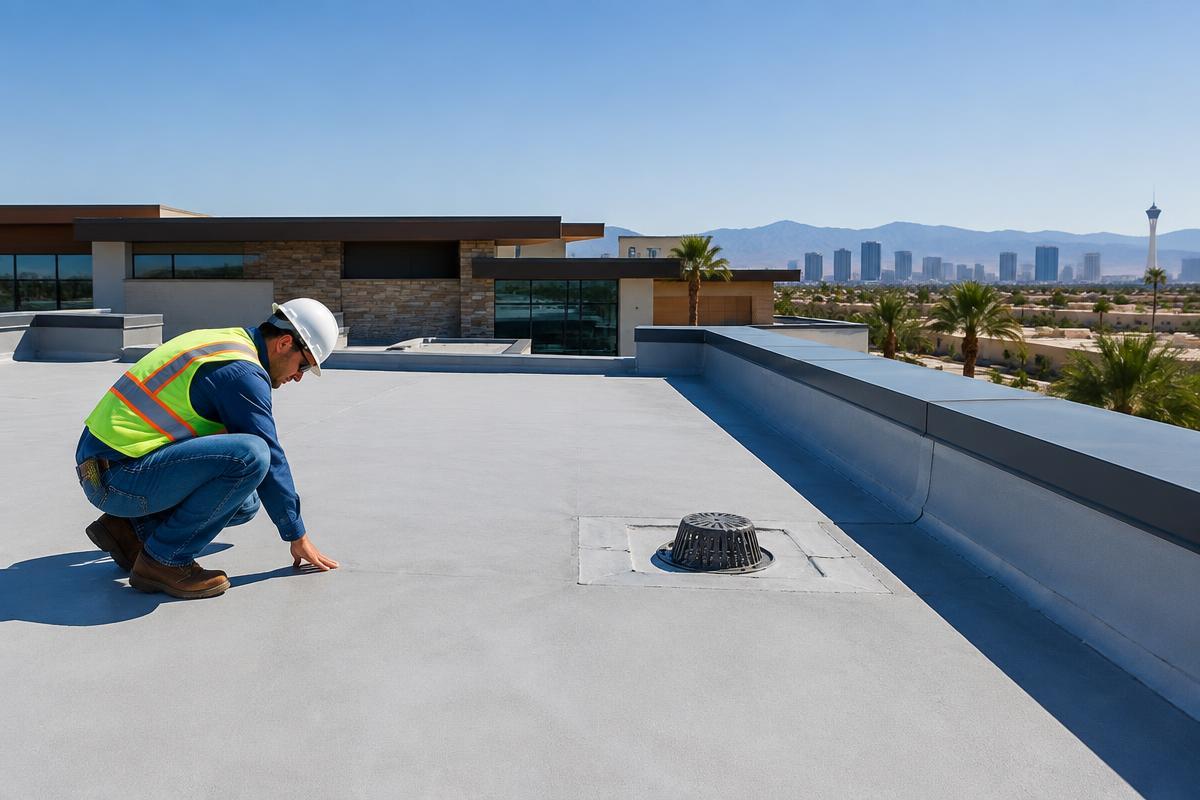

Flat roofs are everywhere across North Las Vegas — on commercial buildings, apartment complexes, and a growing number of residential properties. They're efficient to build and easy to work on, but the high-desert climate puts them through a specific kind of stress that flat surfaces in other parts of the country rarely face. Intense sun, triple-digit surface temperatures, sudden monsoon storms, and constant thermal expansion and contraction all take a toll on membranes, seams, and flashing over time.
Unlike a sloped roof, a flat roof doesn't rely on gravity alone to shed water. Drainage has to be engineered into the system — through slight tapering, properly placed drains, scuppers, and clear paths for water to travel off the roof. When any of these elements are blocked, damaged, or poorly designed, ponding water becomes a slow but serious threat. Standing water accelerates membrane breakdown, adds unnecessary weight, and creates the exact conditions that lead to leaks.
A thorough flat roof installation and inspection service starts by mapping out how water actually moves across the roof. Technicians check every low spot, every transition, every parapet wall, and every penetration where vents, pipes, or HVAC units pass through the membrane. These penetration points are consistently the most common failure areas on any flat roof, since they require a perfect seal in a spot where the membrane has already been interrupted.
Material choice matters too. Depending on the building's use, budget, and roof age, a flat roof might call for a full membrane replacement, a restorative coating, or simply a series of targeted repairs. None of these decisions should be made from a quick visual glance — they depend on how much life is left in the substrate, how the roof has been maintained, and how the building is used day to day. A restaurant with heavy rooftop equipment has different needs than a self-storage facility with a bare roof deck.
For property owners who've noticed a soft spot underfoot, a slow drain, or the first signs of a ceiling stain, waiting rarely helps. Flat roof problems tend to get more expensive the longer they go unaddressed, since water finds new paths once it starts moving through insulation and decking. A property manager searching for reliable flat roofing contractors near North Las Vegas is usually better served by scheduling an inspection at the first sign of trouble rather than after a storm has already caused interior damage.
It's also worth noting that flat roofs are not a one-size-fits-all category. Built-up roofing, modified bitumen, TPO, and silicone-coated systems all fall under the "flat roof" umbrella, and each behaves differently under desert conditions. A membrane that performs well in a humid coastal climate might not hold up the same way under Nevada's sun exposure and rapid temperature swings. This is why a general contractor without specific low-slope experience can sometimes miss issues that a specialist would catch immediately.
Routine maintenance plays a bigger role in flat roof longevity than most owners realize. Because these roofs don't shed debris the way a sloped roof does, leaves, dust, and sediment can accumulate around drains and low points, quietly restricting water flow until a storm exposes the problem all at once. A seasonal check — even a simple walk-through — can catch a clogged drain or a small membrane tear long before it becomes a ceiling leak.
Commercial property owners in particular should think about flat roof care as part of routine building upkeep, not an occasional emergency response. Rooftop HVAC servicing, solar panel installations, and even foot traffic from maintenance crews can all introduce small punctures or stress points that go unnoticed until a repair team specifically looks for them. Coordinating these activities with periodic roof inspections helps prevent avoidable damage.
For anyone comparing options for a North Las Vegas flat roof repair or replacement, the right starting point is always an honest, detailed assessment — one that looks at drainage, penetrations, membrane condition, and the roof's overall service history before recommending a path forward. A flat roof that's properly maintained and correctly repaired when needed can perform reliably for well over a decade, even under the demanding conditions of the high desert. The key is catching small issues early, choosing materials suited to the local climate, and working with a team that treats the roof as a complete system rather than a single surface to patch.
For more information: Rank Business Listings
