


Automotive Fuel Tank Market Size, Growth, Key Players, Latest Insights and Forecast 2026-2034
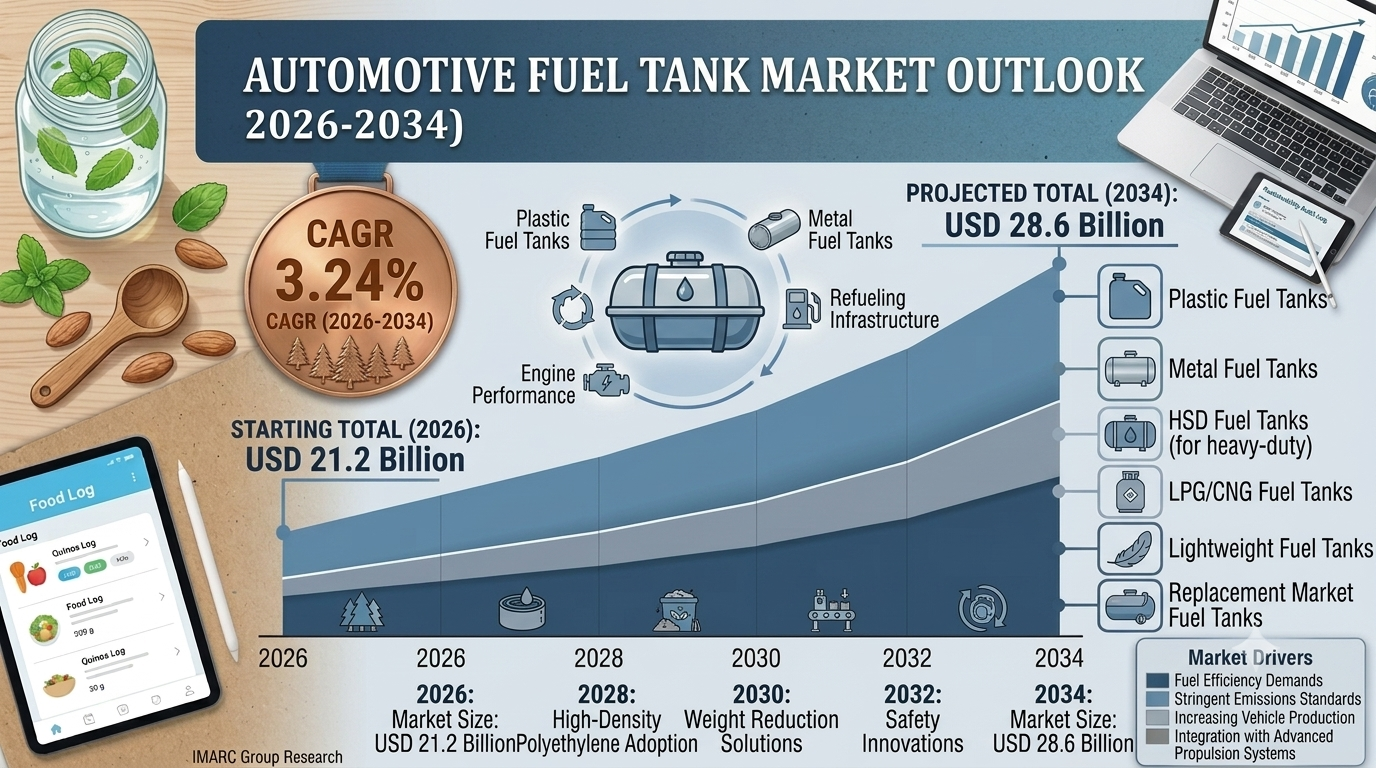
According to IMARC Group, the global automotive fuel tank market size reached USD 21.2 Billion in 2025 and is projected to reach USD 28.6 Billion by 2034, expanding at a CAGR of 3.24% during 2026-2034. This steady automotive fuel tank market growth is being shaped by rising vehicle ownership worldwide, tightening environmental regulations aimed at curbing fuel vapor emissions, and continued investment in lightweight tank materials and designs across both OEM and aftermarket channels.
Automotive Fuel Tank Industry Overview
An automotive fuel tank is engineered to safely store liquid or gaseous fuel and supply it to the engine under varying pressure, temperature, and vibration conditions, while meeting stringent crash-safety and emission-control standards. Modern fuel tank systems integrate vapor recovery components, anti-slosh baffles, and corrosion- and impact-resistant materials, making them a critical safety and performance component across every vehicle category.
Fuel tanks are deployed across a broad range of use cases:
• Passenger vehicles: Compact, subcompact, sedan, and SUV platforms requiring space-efficient, lightweight tank designs
• Light commercial vehicles (LCVs): Vans, pickups, and light trucks requiring mid-capacity tanks balancing payload and range
• Heavy commercial vehicles (HCVs): Trucks and buses requiring high-capacity, heavy-duty steel or reinforced tank systems
• OEM supply: Tanks engineered to automaker specifications for direct integration during vehicle manufacturing
• Aftermarket supply: Replacement and retrofit tanks for vehicles in service
• Alternative-fuel platforms: Hydrogen storage tanks and specialized containment systems for fuel-cell and hybrid vehicles
Global Automotive Fuel Tank Market Size & Key Statistics
Below are the key automotive fuel tank market statistics drawn from IMARC Group's comprehensive market analysis:
|
Report Attribute |
Key Statistics |
|
Base Year |
2025 |
|
Historical Period |
2020-2025 |
|
Forecast Period |
2026-2034 |
|
Automotive Fuel Tank Market Size in 2025 |
USD 21.2 Billion |
|
Market Forecast in 2034 |
USD 28.6 Billion |
|
Market Growth Rate (2026-2034) |
3.24% CAGR |
|
Largest Region |
Asia Pacific (over 52.6% share in 2025) |
|
Leading Material Type |
Plastic (around 67.5% share in 2025) |
|
Leading Capacity Segment |
Less Than 45 Liter (around 47.2% share in 2025) |
|
Leading Vehicle Type |
Passenger Vehicles (around 65.8% share in 2025) |
|
Leading Distribution Channel |
OEM (around 62.5% share in 2025) |
Request for a Sample Report for Detailed Automotive Fuel Tank Market Share Evaluation: https://www.imarcgroup.com/automotive-fuel-tank-market/requestsample
Key Market Drivers & Automotive Fuel Tank Market Trends in 2026
Several powerful forces are shaping automotive fuel tank market trends and fuelling sustained growth expectations across global automotive manufacturing:
1. Rising Global Vehicle Production and Ownership
Global motor vehicle production climbed to 85.4 million units in 2022, up 5.7% over 2021, according to the European Automobile Manufacturers' Association (ACEA). Every additional vehicle produced requires a dedicated fuel storage solution, keeping fuel tank demand closely tied to overall automotive output, particularly in high-growth manufacturing hubs across Asia Pacific.
2. Stringent Emission and Fuel-Vapor Regulations
Regulatory bodies worldwide are tightening standards governing vehicle emissions and fuel vapor leakage. In March 2024, the U.S. EPA finalized more protective emission standards for passenger cars and light trucks, building on existing greenhouse-gas rules. Such regulations are pushing manufacturers to adopt improved sealing systems, vapor-recovery components, and lower-permeability materials, directly influencing Automotive Fuel Tank Market Growth in regulated markets.
3. Rising Demand for Fuel-Efficient, Lightweight Vehicles
Automakers are prioritizing lightweight materials and aerodynamic designs to reduce fuel consumption and emissions. Industry estimates suggest a 10% reduction in drag coefficient can improve highway fuel efficiency by 5-7%, reinforcing the shift toward plastic and composite fuel tanks that are lighter and more design-flexible than traditional metal tanks.
4. Advancements in Plastic and Composite Tank Technology
Innovations in high-density polyethylene (HDPE) and specialized polymer formulations are improving the chemical resistance, corrosion resistance, and moldability of plastic fuel tanks. These advances allow manufacturers to design tanks that better utilize available vehicle space while maintaining structural integrity, reinforcing plastic's position as the leading material segment.
5. Growth of Alternative-Fuel and Hybrid Vehicle Platforms
The gradual rise of hydrogen fuel-cell and hybrid vehicles is reshaping fuel tank requirements. As of November 2024, over 18,428 fuel-cell electric vehicles had been leased or sold in the United States, supported by a growing hydrogen refuelling network. This shift is prompting suppliers to develop specialized high-pressure hydrogen storage tanks alongside conventional liquid-fuel tanks.
6. Expanding OEM-Automaker Collaboration
Strategic collaborations between component suppliers and automakers are accelerating innovation. In August 2024, Toyota and BMW expanded their partnership to include the supply of critical components such as hydrogen tanks, underscoring the growing cross-industry focus on next-generation fuel storage solutions as part of broader Automotive Fuel Tank Market Trends.
Key Market Segmentation
By Material Type
• Plastic
• Aluminum
• Steel
Plastic leads the material segment with around 67.5% share in 2025, owing to its lightweight profile, corrosion and chemical resistance, and the design flexibility it offers for fitting tanks into constrained vehicle spaces. Continued advances in HDPE and specialized polymer formulations are expected to sustain plastic's dominance as automakers prioritize weight reduction and cost efficiency.
By Capacity
• Less Than 45 Liter
• 45 - 70 Liter
• Above 70 Liter
The Less Than 45 Liter segment leads with around 47.2% share in 2025, driven by the growing popularity of compact and subcompact vehicles designed for fuel efficiency and manoeuvrability in congested urban environments. Advancements in engine technology are allowing smaller tanks to maintain adequate driving range without compromising performance.
By Vehicle Type
• Passenger Vehicles
• LCVs
• HCVs
Passenger vehicles dominate with around 65.8% share in 2025, reflecting rising global demand for personal transportation amid growing urbanization. Automakers continue to refine fuel tank performance and safety in this segment while adapting designs to accommodate electric and hybrid powertrain integration.
By Distribution Channel
• OEM
• Aftermarket
OEM leads the distribution channel segment with around 62.5% share in 2025, as original equipment manufacturers collaborate closely with automakers to design fuel tanks that meet precise safety, performance, and regulatory specifications for new vehicle production.
Regional Automotive Fuel Tank Market Analysis
|
Region |
Key Highlights |
|
Asia Pacific — Largest |
China, India, Japan, South Korea; robust automobile production and exports, rising domestic demand, expanding manufacturing hubs, India's growing production and export volumes |
|
North America |
United States & Canada; established automotive manufacturing base, rising EV/hybrid adoption, strong regulatory focus on emissions and safety, zero-emission vehicle targets in Canada |
|
Europe |
Germany, France, Italy; rising new car sales and production, growing demand for fuel-efficient and eco-friendly vehicles, strong regulatory push on emissions |
|
Latin America |
Brazil, Mexico; growing automobile production in both markets, rising OEM manufacturing activity, expanding vehicle fleets |
|
Middle East & Africa |
Saudi Arabia; large and growing passenger vehicle fleet, expanding infrastructure and urbanization, strategic trade positioning |
Asia Pacific leads the global automotive fuel tank market share, accounting for over 52.6% in 2025, underpinned by India's robust automobile production and export volumes, China's expanding domestic manufacturing base, and sustained vehicle demand growth across the region.
The United States represents 82.5% of the North American market share, supported by rising motor vehicle production, growing adoption of electric and hybrid vehicles, and continued investment in advanced, lightweight fuel tank technologies by domestic manufacturers.
Connect for Detailed Automotive Fuel Tank Market Share Segmentation Analysis — Speak to an Analyst: https://www.imarcgroup.com/request?type=report&id=1388&flag=C
Leading Players in the Global Automotive Fuel Tank Industry
The global automotive fuel tank market features a mix of diversified automotive component manufacturers and specialized fuel-system suppliers. Key companies covered in the IMARC Group report include:
• Plastic Omnium
• Kautex Textron
• Yapp Automotive
• TI Automotive
• Yachiyo Industries Co. Limited
• Magna International
• Martinrea International Inc.
• Unipres Corporation
• Continental
• Lyondell Basell
• Allgaier Automotive
• Boyd Welding
• Dali and Samir Engineering
• Posco Co. Ltd
• Baosteel Group Corporation
Latest Automotive Fuel Tank Market Industry Developments
March 2024 — Eaton
Eaton announced the launch of a new fuel tank isolation valve (FTIV) designed specifically for hybrid vehicles, expanding its fuel-system component portfolio for next-generation powertrains.
November 2023 — Robert Bosch GmbH
Bosch unveiled H2 Mobility, an integrated hydrogen solution comprising a tank system, fuel injection system, sensors, and exhaust gas treatment components, aimed at long-haul trucks and extending across LCV, SUV, coach, and heavy-duty bus segments.
October 2020 — ElringKlinger & Plastic Omnium
The two companies formed EKPO Fuel Cell Technologies, a joint venture to advance hydrogen mobility, with ElringKlinger holding a 60% stake and Plastic Omnium 40%, targeting mass production of fuel cell stacks for CO2-neutral mobility.
March 2020 — Martinrea International Inc.
Martinrea completed the acquisition of Metalsa S.A. de C.V.'s Structural Components for Passenger Cars division for USD 19.5 million, adding six plants across Germany, the U.S., Mexico, South Africa, and China, and strengthening its metal-forming and lightweight structures capabilities.
About Us
IMARC Group is a leading global market research company providing data-driven insights and expert consulting services to businesses seeking to achieve their strategic objectives. With a multi-disciplinary team of industry experts, IMARC delivers thorough, reliable market intelligence across sectors including Automotive, Healthcare, Technology, Chemicals, Energy, Food & Beverages, and more.
Contact Us
IMARC Group
United States: +1-201-971-6302
India: +91-120-433-0800
United Kingdom: +44-753-714-6104

 Bangla