


Agricultural Robots Market Trends, Key Drivers, and Industry Outlook
Agricultural Robots Market: Industry Analysis, Growth Drivers, and Future Outlook
Market Overview
The global Agricultural Robots Market comprises autonomous and semi-autonomous robotic systems designed to improve efficiency, accuracy, and productivity across agricultural operations. These technologies support a wide range of activities, including planting, seeding, harvesting, crop monitoring, weeding, spraying, milking, livestock management, and farm logistics. Agricultural robots are becoming an important part of modern farming as producers increasingly adopt automation to address labor shortages, optimize resource utilization, and improve crop management.
The integration of artificial intelligence (AI), machine vision, GPS, sensors, the Internet of Things (IoT), and autonomous navigation is transforming traditional farming practices. These technologies enable agricultural robots to identify weeds, monitor crop conditions, collect field data, and perform repetitive tasks with greater precision. From large commercial farms to specialized crop producers, farmers are exploring robotic solutions to improve operational efficiency and support more sustainable agricultural practices.
Download Free PDF Brochure@https://www.maximizemarketresearch.com/request-sample/34593/
Market Size and Growth
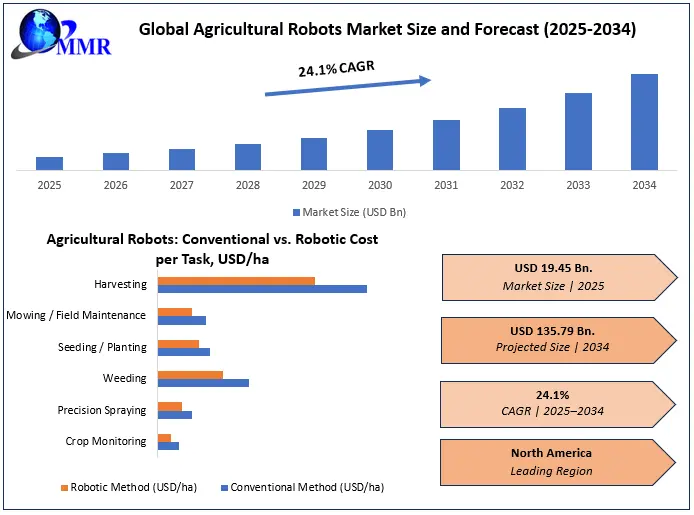
the global Agricultural Robots Market was valued at USD 19.45 billion in 2025 and is projected to reach USD 135.79 billion by 2034, registering a compound annual growth rate (CAGR) of 24.1% from 2025 to 2034.
This expansion reflects increasing investments in precision agriculture, autonomous machinery, and smart farming technologies. Farmers are seeking solutions that can improve productivity while reducing dependence on manual labor and minimizing unnecessary applications of water, fertilizers, and pesticides. Although high initial investment, technical complexity, maintenance requirements, and connectivity limitations can slow adoption, continued technological progress is creating new opportunities for agricultural robotics manufacturers.
Key Market Segmentation
The Agricultural Robots Market can be segmented by robot type, offering, application, farm size, deployment model, and end user.
By robot type, the market includes unmanned aerial vehicles (UAVs) and drones, robotic tractors, automated harvesting systems, weeding robots, planting and seeding robots, dairy robots, and livestock monitoring systems. Drones support aerial crop monitoring and precision spraying, while robotic tractors and field robots automate agricultural operations. Dairy robots assist with milking, and livestock monitoring systems help farmers track animal health and activity.
By offering, the market comprises hardware, software, and services. Hardware includes robots, sensors, cameras, navigation systems, and other physical components. Software supports autonomous control, data analysis, crop identification, and fleet management, while services include installation, maintenance, training, and technical support.
By application, the market covers planting and seeding, harvesting, spraying, weeding, crop monitoring, irrigation management, milking, livestock management, and other farming activities. Large commercial farms, small and medium-sized farms, agricultural cooperatives, and specialized farming businesses represent important end-user groups.
Growth Drivers
Increasing agricultural labor shortages are a major driver of market expansion. Farming requires substantial manual effort, particularly during planting, weeding, harvesting, and livestock management. Agricultural robots can automate repetitive operations, helping farmers maintain productivity when workers are unavailable or labor costs increase.
The rising global demand for food is another significant factor. Farmers are under pressure to improve yields and use available land more efficiently. Robotic systems equipped with sensors and AI can collect detailed field information, identify crop stress, and support timely agricultural decisions.
The growing adoption of precision farming is also encouraging market development. Robots can perform targeted spraying and mechanical weeding, potentially reducing chemical use and limiting unnecessary resource consumption. In addition, advances in computer vision, autonomous navigation, and machine learning are making agricultural robots more capable of operating in complex field environments.
Emerging Trends
Artificial intelligence and machine vision are becoming central to agricultural robotics innovation. These technologies allow robots to distinguish crops from weeds, recognize fruits ready for harvesting, and respond to changing field conditions. Improved sensing capabilities are also helping farmers identify crop diseases and nutrient deficiencies earlier.
Another important trend is the development of smaller, autonomous agricultural machines. Compact robots can operate in orchards, vineyards, greenhouses, and fields where traditional machinery may be difficult to use. Robotic weeding and precision spraying systems are gaining attention because they can support more targeted crop management.
Agricultural drones and connected farm management platforms are also becoming increasingly important. Integrating robotic equipment with cloud-based analytics enables farmers to monitor operations, analyze field conditions, and coordinate machinery more effectively. Meanwhile, electric and energy-efficient robotic systems are attracting interest as agricultural businesses seek to reduce operating costs and environmental impacts.
Regional Analysis
North America holds a leading position in the Agricultural Robots Market, supported by advanced agricultural infrastructure, large commercial farms, and substantial investment in precision farming. The United States is an important market for autonomous tractors, agricultural drones, AI-powered spraying systems, and automated livestock management. The availability of established technology providers also supports regional adoption.
Europe represents another significant market, driven by agricultural modernization, sustainability objectives, and demand for efficient farm operations. Countries such as Germany, France, the Netherlands, and the United Kingdom are exploring automation to improve productivity and address labor availability challenges. Precision spraying and robotic harvesting are particularly relevant to farms seeking more efficient resource management.
Asia Pacific offers considerable growth opportunities due to expanding food demand, agricultural modernization, and increasing investment in smart farming. China, Japan, India, and Australia are important markets with different agricultural requirements. Japan's aging agricultural workforce supports interest in automation, while India offers opportunities for affordable drones, crop-monitoring technologies, and smaller robotic systems. Adoption will depend on farm affordability, infrastructure, and access to technical support.
South America also presents opportunities, particularly in large-scale farming and export-oriented agricultural production in Brazil and Argentina. The Middle East and Africa may benefit from robotic solutions that improve monitoring and resource efficiency, although investment costs and infrastructure limitations remain challenges.
Competitive Landscape
The Agricultural Robots Market includes agricultural machinery manufacturers, robotics developers, automation specialists, and precision agriculture technology providers. Major companies operating in the industry include Deere & Company, AGCO Corporation, CNH Industrial N.V., DJI, Yanmar Holdings Co., Ltd., Trimble Inc., Lely, DeLaval, BouMatic, Naïo Technologies, Harvest Automation, AgEagle Aerial Systems, and Autonomous Solutions Inc.
Companies compete through technological innovation, automation capabilities, equipment reliability, software integration, and distribution networks. Established agricultural machinery manufacturers are developing autonomous equipment and intelligent farming systems, while specialized robotics companies focus on applications such as mechanical weeding, fruit harvesting, and crop monitoring. Partnerships between equipment manufacturers and software developers are also helping expand the capabilities of agricultural robots.
Download Free PDF Brochure@https://www.maximizemarketresearch.com/request-sample/34593/
Recent Developments
Recent industry developments highlight the transition toward AI-enabled and autonomous agricultural machinery. John Deere has continued advancing autonomous farming equipment and its Blue River Technology business has developed AI-powered See & Spray systems designed to identify and target weeds. These technologies illustrate how machine vision and automation can support more precise agricultural operations.
Agricultural technology providers are also developing robotic platforms for weeding, crop monitoring, harvesting, and livestock management. Improvements in sensors, navigation systems, and data analytics are helping manufacturers develop more capable solutions for different farm environments. These developments reflect ongoing innovation across the sector rather than a complete list of recent product launches.
Future Outlook
The Agricultural Robots Market is expected to expand significantly through 2034 as farmers increasingly adopt automation to improve productivity and manage operating costs. The projected growth to USD 135.79 billion reflects opportunities associated with precision agriculture, autonomous tractors, robotic harvesting, intelligent spraying, and automated livestock management.
Future developments are likely to emphasize AI-based decision-making, improved navigation, multifunctional robots, and integration with digital farm management platforms. Growing demand for sustainable farming practices may further encourage the use of targeted spraying, mechanical weeding, and resource-efficient equipment.
However, widespread adoption will depend on reducing equipment costs, improving reliability, training operators, and ensuring compatibility with existing agricultural infrastructure. Flexible financing, equipment-sharing models, and robotics-as-a-service offerings could help make these technologies more accessible to smaller farms.
For full access to the comprehensive strategic report, visit:https://www.maximizemarketresearch.com/market-report/global-agricultural-robots-market/34593/
Conclusion
The global Agricultural Robots Market is transforming farming through automation, precision technologies, and intelligent equipment. Labor shortages, rising food demand, and the need for efficient resource management are creating strong growth opportunities. North America remains a major technology and adoption center, while Asia Pacific offers significant expansion potential. Continued advances in artificial intelligence, machine vision, autonomous machinery, and connected farming systems are expected to shape the industry's development through 2034.
About Maximize Market Research
Maximize Market Research is a multifaceted market research and consulting company with professionals from several industries. Some of the industries we cover include medical devices, pharmaceutical manufacturers, science and engineering, electronic components, industrial equipment, technology and communication, cars and automobiles, chemical products and substances, general merchandise, beverages, personal care, and automated systems. To mention a few, we provide market-verified industry estimations, technical trend analysis, crucial market research, strategic advice, competition analysis, production and demand analysis, and client impact studies.
Contact Maximize Market Research
3rd Floor, Navale IT Park, Phase 2
Pune Bangalore Highway, Narhe,
Pune, Maharashtra 411041, India
[email protected]
+91 96071 95908, +91 9607365656

 Bangla