


India Flat Steel Market Growth Opportunities in Renewable Energy and Housing
Market Overview
According to Market Research Future® (MRFR), the India Flat Steel Market is projected to record sustained growth through 2035 as construction, transportation, machinery, consumer appliances, and energy-related industries create demand for versatile steel products. Flat steel is a foundational material for manufacturing and infrastructure, supporting applications that range from building components and vehicle parts to industrial equipment and finished consumer products.
The market is shaped by the interaction between steel production capabilities and the requirements of downstream industries. Product quality, surface finish, strength, formability, and processing compatibility can influence purchasing decisions. As Indian manufacturing and infrastructure activity develops, steel producers have opportunities to serve a broad customer base while adapting to more specialized product specifications.
Sustainability and technological development are also becoming important considerations for the industry. Producers are under pressure to improve operational efficiency and address environmental priorities while maintaining dependable supply. These factors can influence long-term competitiveness alongside market demand and production costs.
Market Size and Forecast Outlook
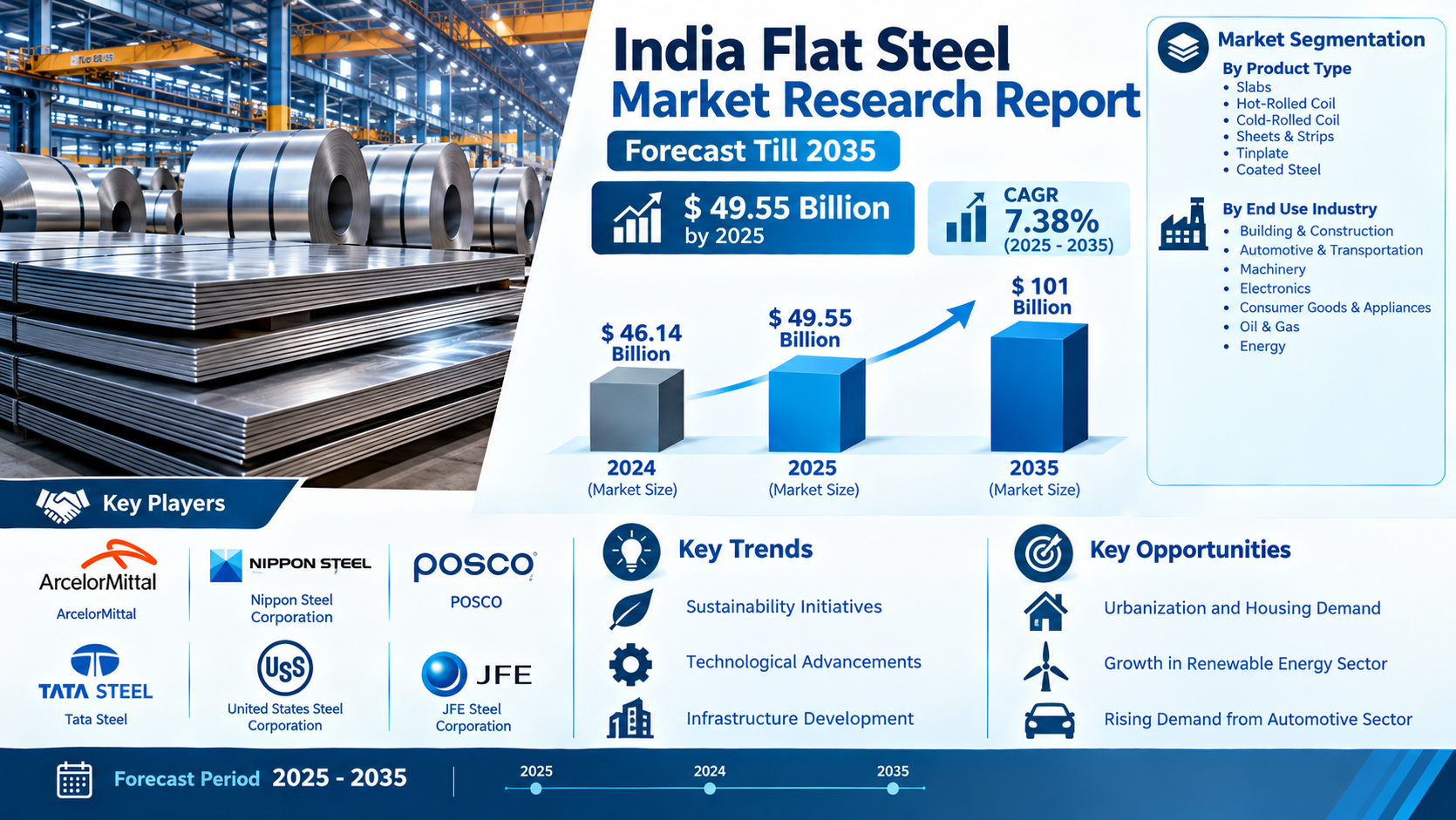
The India Flat Steel Market was valued at $46.14 billion in 2024 and reached $49.55 billion in 2025. It is forecast to reach $101 billion by 2035, expanding at a CAGR of 7.38% from 2025 to 2035. The forecast highlights the potential for increasing flat steel consumption across construction, automotive, industrial manufacturing, and energy applications.
The product landscape includes slabs, hot-rolled coil, cold-rolled coil, sheets and strips, tinplate, and coated steel. These categories support different stages of processing and end-use requirements. Their demand patterns depend on manufacturing activity, customer specifications, and the industries purchasing the finished products.
End-use industries include building and construction, automotive and transportation, machinery, electronics, consumer goods and appliances, oil and gas, and energy. This range provides exposure to several areas of economic activity. However, the relative performance of individual segments will depend on sector-specific investment and production trends.
Growth Opportunities
Urbanization and housing demand create opportunities for flat steel producers serving construction-related markets. Residential buildings, commercial properties, and supporting infrastructure require materials for various fabricated products and building systems. As projects develop, suppliers may benefit from demand for suitable steel grades and finished products. Consistent quality and timely deliveries can be particularly important when construction schedules depend on coordinated procurement.
The renewable-energy sector offers another potential growth avenue. Energy infrastructure and equipment manufacturing can create demand for steel components selected according to project design and operating conditions. Producers may explore opportunities by supplying suitable products to manufacturers and fabricators serving energy projects. The scale of this opportunity will depend on project investment, technical specifications, and the materials used in different applications.
Automotive and transportation manufacturing also provides room for market expansion. Vehicle manufacturers and component suppliers require steel products that satisfy specific performance and production standards. Demand may vary according to vehicle output, design changes, and material selection. Suppliers capable of meeting customer specifications consistently can strengthen their position in this competitive end-use segment.
Regional Analysis
The supplied market information does not provide regional market shares, individual state-level estimates, or a ranking of leading regions. Nevertheless, the market's opportunities can be understood in relation to the distribution of construction projects, manufacturing facilities, transport infrastructure, and energy investments across India.
Regions with active construction and housing development can provide demand for steel used in building-related applications. Industrial manufacturing centers may generate demand from automotive, machinery, electronics, and appliance producers, while energy-related projects can create requirements for specialized steel products. Logistics connectivity and access to processing facilities may also influence supply arrangements.
A detailed regional assessment would require additional data on consumption, production capacity, downstream industries, and infrastructure investment. Without such figures, regional differences should be treated as potential demand patterns rather than definitive market rankings.
Recent Industry Developments
Three broad trends highlighted in the market outlook are sustainability initiatives, technological advancements, and infrastructure development. Together, these themes reflect changing priorities in steel production and consumption.
Sustainability initiatives can influence production processes, resource efficiency, and environmental management. Technological advancements may support improved quality control, more efficient manufacturing, and better alignment with customer specifications. Infrastructure development can create demand for flat steel products across construction and industrial projects.
These trends describe the market's strategic direction rather than specific company announcements. No dated corporate developments, acquisitions, production expansions, or individual project launches were included in the supplied information.
Market Challenges
Flat steel producers must manage production costs, quality requirements, and changing demand across multiple end-use industries. Differences in customer specifications can complicate product planning, while fluctuations in construction and manufacturing activity may affect purchasing patterns. Maintaining reliable delivery schedules and consistent product characteristics remains important for suppliers serving industrial customers.
Sustainability objectives may also require investment in equipment, process improvements, and production practices. Producers must evaluate these changes alongside commercial considerations and operational requirements. Technological upgrades can improve efficiency, but their value depends on implementation, workforce capabilities, and measurable performance benefits.
Competitive Landscape
The competitive landscape includes ArcelorMittal, Nippon Steel Corporation, POSCO, Tata Steel, United States Steel Corporation, and JFE Steel Corporation. Product capabilities, production efficiency, quality management, customer service, and supply reliability are important competitive considerations in the flat steel industry.
As India’s market expands, suppliers may seek growth through product development, technological improvements, and stronger alignment with downstream industries. Infrastructure and housing demand, automotive manufacturing, and renewable-energy investment offer potential opportunities, while sustainability initiatives may shape future production priorities.
Overall, the market forecast points to growing opportunities for flat steel across India's industrial economy. Producers that match their product portfolios to customer needs, maintain consistent quality, and respond effectively to technological and environmental changes may be better positioned to participate in the market’s projected expansion through 2035.

 Bangla