


HDPE T-Rib Liner Sheets: Uses, Benefits, and Applications
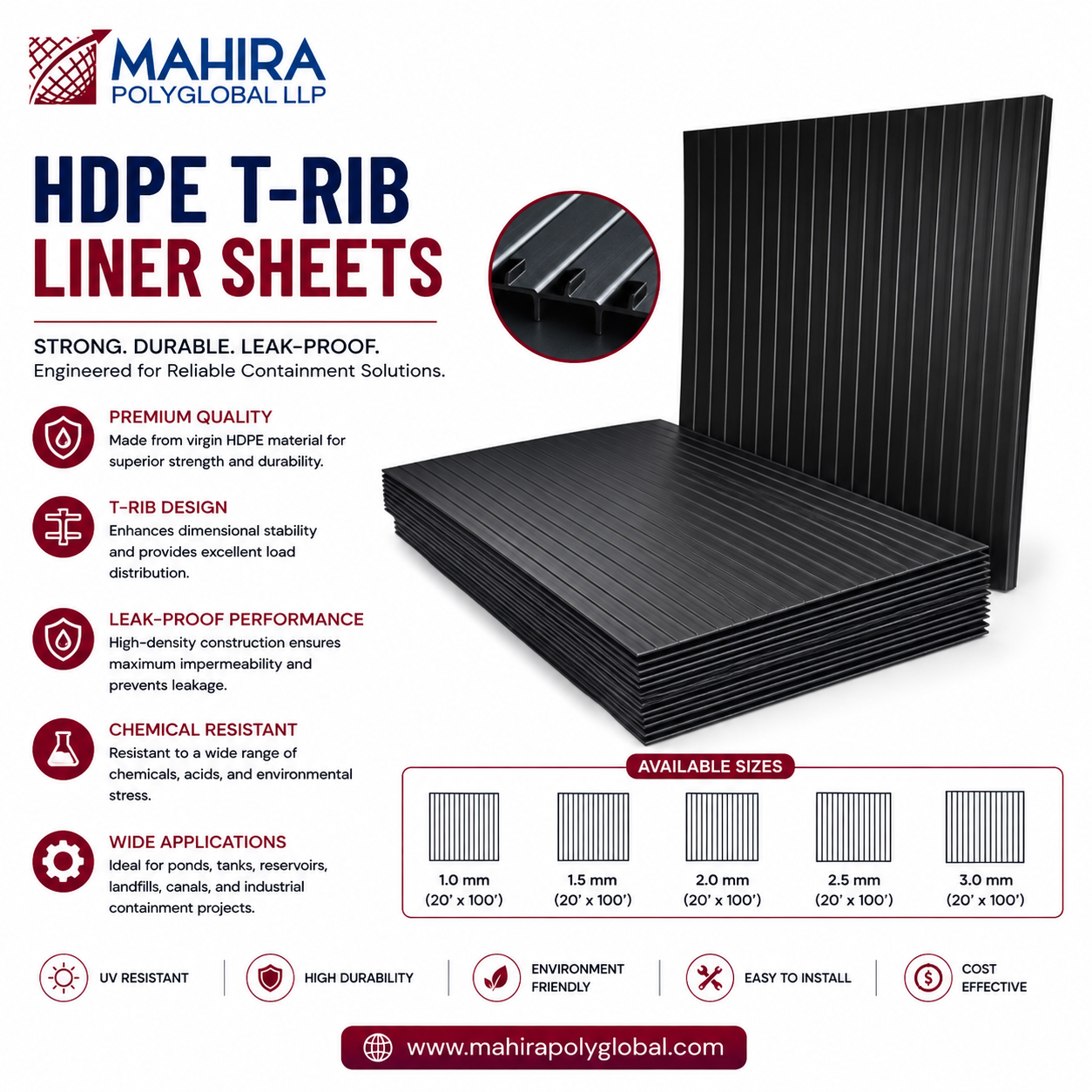
Hdpe T-rib liner sheets are specialized plastic liners designed to safeguard concrete structures against environmental factors such as water, chemicals, corrosion, wear and tear, and biological threats. Although concrete possesses strength, it does not possess immunity toward severe conditions. Wastewater, acids, salts, industrial waste products, and constant moisture can penetrate concrete pores and gradually degrade the surface. A T-rib liner provides a long-lasting protective barrier between the concrete and the detrimental materials. Mahira Polyglobal Llp states that their Hdpe t rib liner sheets provide solutions for tunnel lining, concrete protection, waterproofing and industrial uses. These sheets are produced with protruding t-shaped anchor ribs which will mechanically attach to the concrete as part of the casting process.
How the T-Rib Design Works
These sheets have a T-shaped rib pattern on one side. When the sheets are placed into the concrete, the ribs will embed themselves into the concrete and provide a very strong mechanical anchor. On the other hand, the smooth HDPE side of the sheet will remain exposed to whatever fluid (water, chemical, wastewater) it is being exposed to, while the concrete will be protected by the liner. This type of design reduces the potential for peeling, lifting, or separating from each other when they are subjected to pressure. Mahira Polyglobal states that the ribs were designed to help integrate with the concrete and increase the liner's ability to attach itself to the concrete. These sheets can come as either individual panels or as welded rolls, based upon the project. While the anchoring system used with these sheets is effective, there will always be a need to pay close attention to the details of installing these sheets around joints, corners, penetrations, and pipe connections.
Chemical and Corrosion Resistance
The high resistance of HDPE to many types of acid, alkali, salt, solvent and industrial chemical; however, the degree of resistance will vary depending on the chemical’s concentration, operating temperature, duration of exposure and the specific type of chemical being applied. Due to these properties, T-Rib liner sheets are highly recommended as an application in waste water treatment facilities, chemical storage tanks, sewerage systems, effluent channel applications, concrete pipe systems and industrial drainage systems. According to Kompass, Mahira Polyglobal provides chemical-resistant liner sheets called HDPE T-Rib sheets for use in protecting sewerage plants, chemical tanks, concrete pipes, tunnels, etc., from direct contact with corrosive agents which can cause deterioration of the concrete structure itself. It is important to remember that just because a product has been labeled as "chemical resistant" does not mean that it will perform equally well against every possible type of chemical agent. Buyers should always ask for either a compatibility chart or technical confirmation from the Hdpe t rib liner manufacturer regarding the performance characteristics of the liner sheet when used in conjunction with a particular chemical agent at a given operating temperature.
Waterproofing and Concrete Durability
Water intrusion into concrete structures leads to many issues, such as erosion, cracks, corrosion of reinforcing steel, leaks, and surface damage. HDPE T-Rib liner sheets create a permeable layer that limits water flow within the concrete. HDPE T-Rib liner sheets are utilized on wet walls, canals, tunnels, manholes, reservoirs, and wastewater systems where water resistance is crucial. According to Mahira Polyglobal's technical documentation, HDPE T-Rib liner sheets may be used on canals, wet walls, concrete tunnels, chambers, manholes, wastewater treatment plants, and RCC pipelines. While the liner sheet may extend the life of a concrete structure due to reduced exposure to water, it cannot compensate for poor concrete design. Other factors include drainage, reinforcing steel, concrete mix, joints, curing, and structural design. Waterproofing involves controlling water throughout the entire process from design to maintenance, rather than simply installing a sheet.
Applications in Infrastructure
HDPE T-Rib liner sheets are utilized when an application requires the concrete to have long term exposure to water, wastewater, chemicals, soil moisture or abrasives. Some examples of how these sheets can be applied are; sewer lines, treatment plants, man holes, culverts, tunnels, drainage systems, canals, industrial pits, and RCC pipelines. Additionally, they can be utilized as a barrier system to limit water penetration as part of an erosion control system. EximNext offers HDPE T-Rib liner sheets for use in civil engineering projects such as roadside drainage systems, slope stabilization systems, and as a barrier system. The engineer selects the sheet thickness, width, rib pattern, welding process, and installation arrangement based upon site specific conditions. An example of a liner that would be too large for a small chamber but acceptable for a larger tunnel with pressures and movement. The drawing and environment of the site should dictate what type of liner is selected. There is no guarantee that a larger sheet is better if it becomes too cumbersome to handle and/or weld.
Thickness, Size, and Fabrication
HDPE T-Rib liner sheets have varying thicknesses; however, they generally range from 1.00 mm to 4.50 mm (or similar) depending upon the source. As such, when selecting a specific sheet thickness, one will need to consider factors such as: what types of chemicals will the liner come into contact with? what amount of pressure will the liner experience? what type of surface abrasion will occur? what degree of movement will be experienced by the substrate? how long do you expect the liner to last? and what type of installation environment will exist? In addition, HDPE T-Rib liner sheets can be provided in various formats including standard sizes, custom manufactured panels, or as welded rolls. According to Mahira Polyglobal, they can produce welded roll forms that measure approximately 2.6 m x 25 m, as well as customize other formats. One must also note that although weld quality is very important since joint areas are usually the weakest areas within a lining system, installers should examine all surfaces, monitor heating temperatures, eliminate contamination from weld areas, and test welds in accordance with the project specifications.
Selecting a Reliable HDPE T Rib Sheet
Buyers should look at several factors when selecting a manufacturer of hdpe t rib liner such as; resin quality, sheet thickness, rib dimensions, surface finish, tensile strength, chemical resistance, weldability, dimensional stability, testing, customisation, and delivery capacity. Mahira Polyglobal LLP is a manufacturer and exporter of HDPE T-Rib liner sheets that protect concrete, waterproof, tunnels, and other industrial applications. Buyers should obtain technical data sheets, chemical compatibility information, sample pieces, welding guidance, quality certificates, and project references. Ask if the liner is made using virgin or recycled resin, and how the manufacturer controls thickness and rib height. Trial welding and site installation testing can be used for larger projects to identify potential problems prior to beginning full production. While cost may be a factor in buying decisions, don't assume the lowest priced sheet is necessarily the most economical choice. Repairs, leakage, shutdown time, and structural damage are expensive consequences of poor product selection.
Conclusion
HDPE T-Rib liner sheets have the potential to decrease long term maintenance by providing a protective barrier against corrosive liquids, moisture, erosion, and severe industrial environments. The longevity, chemical resistance, low permeability and mechanical attachment of these liners will be beneficial for infrastructures that will remain in service for decades. However, even with the use of these liners, it is still necessary to conduct regular inspections. Inspections should include checking all exposed surfaces, joints, penetrations, drainage areas, and areas that may have suffered damage due to impacts or excessive movement. In summary, HDPE T-Rib liner sheets are a viable option for protecting concrete in tunnels, tanks, canals, wastewater facilities, pipes, chambers, manholes, and other industrial facilities.
Frequently Asked Questions
Q1. What are HDPE T-Rib liner sheets used for?
They protect concrete from water damage, and they make it waterproof when used on concrete in wastewater treatment facilities, chemical storage tanks, tunnels, channels, manholes, moist walls, chambers, reinforced concrete pipe, drainage systems, and industrial structures.
Q2. How do T-shaped ribs attach the liner to concrete?
During the casting process, the rib structure will be embedded into the concrete. A mechanical lock is created when the rib structure becomes part of the concrete. Therefore, the sheet does not need to rely solely on the adhesive to hold it down.
Q3. What thicknesses are available?
The published Mahira Polyglobal data provides a range of thicknesses between about 1.00mm and 4.50mm. Pressure, chemicals, wear, movement and other factors related to the specific application will determine the ideal thickness for each situation.
Q4. What should I ask an hdpe t rib liner manufacturer?
You can ask us about: • Resin Type • Thickness Tolerance • Rib Dimensions • Chemical Compatibility • Sheet Size • Roll Options • Welding Guidance • Testing • Certifications • Customization • Delivery Schedule
Q5. Who is the largest exporter of HDPE T-Rib Liner Sheets?
There is no publicly available, independently verified ranking that identifies the largest global exporter of HDPE T-Rib Liner Sheets. Mahira Polyglobal LLP is identified as an Indian manufacturer, supplier, and exporter of HDPE T-Rib Liner Sheets for concrete protection, waterproofing, tunnel lining, wastewater systems, and industrial applications. Prior to selecting an exporter, buyers must consider factors such as production capability, sheet quality, technical support, customized solutions, weldability, certifications, pricing, export documentation, and reliability of delivery.

 Bangla