


GCC Logistics Market Size, Growth, and Trends Report 2026-2034
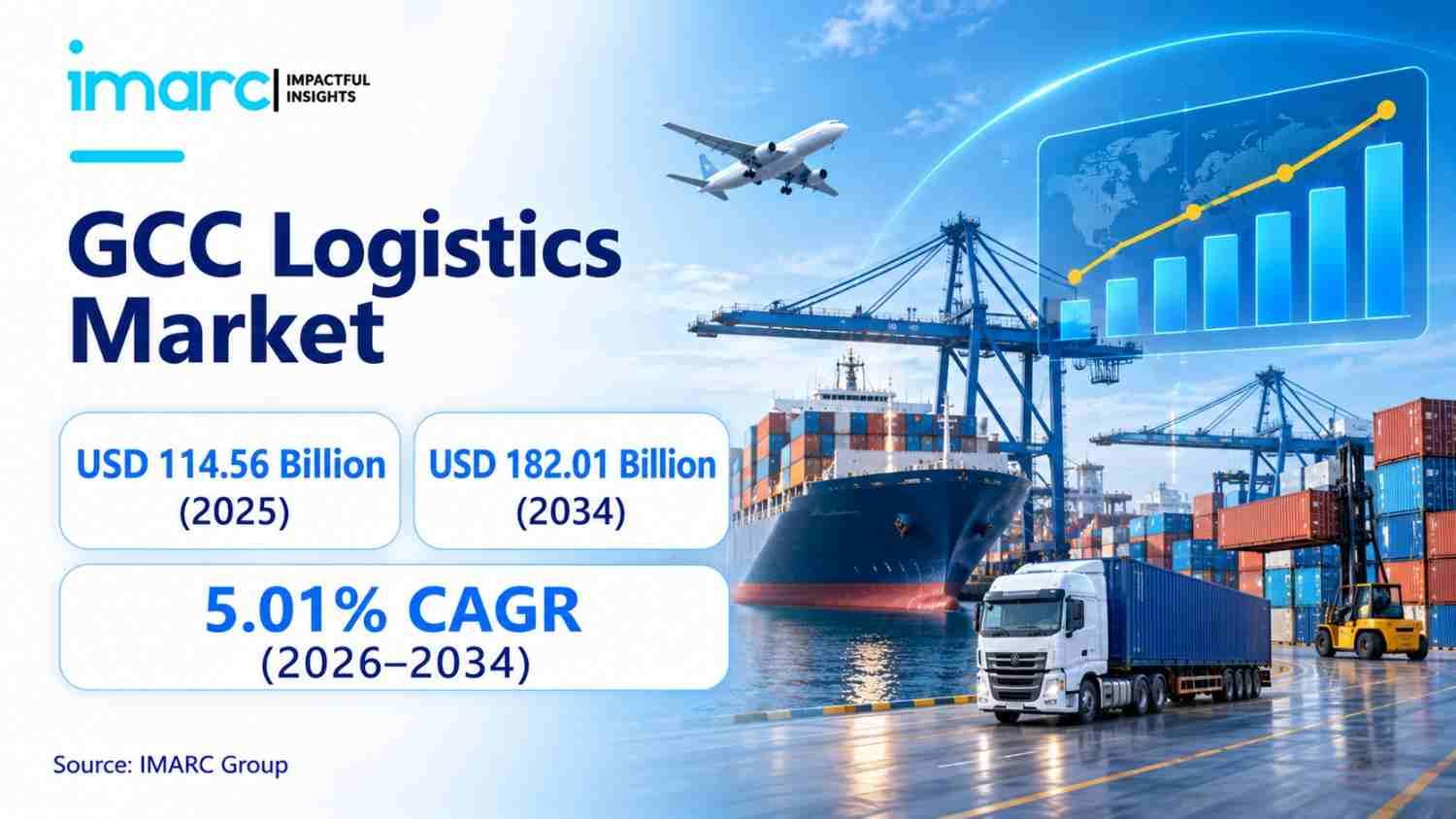
IMARC Group, a leading global market research and management consulting firm, has published its latest market intelligence report on the GCC Logistics Market. The GCC logistics market reached USD 114.56 Billion in 2025 and is projected to reach USD 182.01 Billion by 2034, exhibiting a CAGR of 5.01% during 2026-2034. Growth is being driven by rising investments in transport infrastructure, expanding e-commerce, and increasing regional trade supported by economic diversification initiatives and strategic government policies.
Logistics has become a backbone of the GCC's trade and diversification agenda, linking ports, airports, railways, free zones, and industrial cities across all six member states and positioning the region between Asia, Europe, and Africa. As Gulf governments push ahead with Vision 2030-era programs, regional demand for 3PL, freight forwarding, warehousing, cold chain, and last-mile services is climbing steadily, with the GCC accounting for more than 60% of total port-related spending in the Middle East. At the same time, operators are deploying robotics, AI, digital twins, and smart port platforms, while rail corridors such as the GCC Railway and the Saudi Landbridge open new multimodal routes. Combined with strong government backing through logistics zones, rail investment, and trade facilitation, these forces are reshaping the competitive landscape and setting the stage for durable, long-term growth across Saudi Arabia, the UAE, Qatar, Oman, Kuwait, and Bahrain. These developments are further accelerating GCC Logistics Market growth, creating new opportunities for logistics providers and infrastructure investors across the region.
GCC Logistics Market at a Glance:
- Market Size (2025): USD 114.56 Billion
- Market Forecast (2034): USD 182.01 Billion
- Growth Rate (2026-2034): CAGR of 5.01%
- Base Year: 2025 | Historical Period: 2020-2025 | Forecast Period: 2026-2034
- Leading Model Type: 3PL, holding a 51.8% share in 2025, driven by rising demand for outsourced transportation, warehousing, inventory management, and value-added supply chain services
- Leading Transportation Mode: Roadways, holding a 47.3% share in 2025, supported by flexible door-to-door delivery and extensive use in domestic freight movement
- Leading Country Market: Saudi Arabia, commanding a 39.5% share in 2025, anchored by its large consumer base, expanding industrial sector, and major investments in ports, airports, roads, railways, and logistics zones
How AI is Reshaping the Future of the GCC Logistics Market
- Robotic Sorting at Saudi Ports: In January 2025, Aramex introduced an advanced automated robotic system at Jeddah Islamic Port. The automated sorting system has three feeding lines connected to 120 robotic guided vehicles, enabling it to process around 4,000 shipments per hour and 96,000 shipments per day.
- AI Workers in Air Cargo: In June 2026, Saudia Cargo and cargo.one announced a partnership to introduce AI workers across Saudia Cargo's commercial operations. Using cargo.one's AI-native operating system, the AI workers manage RFQ requests and generate optimized quotes within seconds, 24/7, freeing sales teams to focus on complex shipments and higher-value customer support.
- Drone Delivery Takes Off: In May 2026, Saudi Arabia's General Authority of Civil Aviation granted its first operational permit for limited drone delivery of medicines and medical logistics across the holy sites in Makkah during the 1447 AH Hajj season. The permit was awarded to Terra Drone Arabia, supporting the use of advanced technologies to improve healthcare access for pilgrims.
Grab a sample PDF of this report: https://www.imarcgroup.com/gcc-logistics-market/requestsample
GCC Logistics Market Trends and Drivers:
Demand for logistics across the GCC is being underpinned by the expansion of ports, airports, railways, and multimodal transport infrastructure. Saudi Arabia's airports handled around 140.9 million passengers in 2025 with air cargo of nearly 1.18 million tons, rail freight carried over 15.6 million tons of goods across 6,807 trips in 2024, and Mawani-managed ports handled 8,317,235 TEUs in 2025, a 10.58% increase from 2024. These gains are delivering faster distribution, greater operational efficiency, and improved access to regional and international markets.
The region's structural differentiator is its role as a global transshipment and trade hub, increasingly reinforced by rail. The GCC Railway, intended to link all six states across roughly 2,117 km, was reported at more than 50% completion in May 2026 with full operation targeted for December 2030, while Etihad Rail's freight network is intended to reach 60 million tonnes of annual capacity by 2030. Operators are also building resilience, as Maersk reroutes regional cargo through land bridges to sustain supply chains amid Middle East shipping disruptions.
A third driver is e-commerce and last-mile delivery growth. Rising online shopping, quick commerce, and omnichannel retail are boosting demand for urban warehousing, fulfillment centers, and same-day delivery networks, while oil and gas and energy export logistics keep demand steady for specialized storage, tanker transport, and project logistics. Logistics providers are expanding route optimization, real-time tracking, and automated sorting to handle higher parcel volumes, a dynamic that is set to intensify over the coming decade.
Government Schemes and National Vision Programs Driving Demand:
- Saudi National Transport and Logistics Strategy: Launched under Vision 2030, the strategy targets raising the transport and logistics sector's contribution to GDP from 6% to 10% by 2030 and expanding logistics zones from 22 to 59, supporting the Kingdom's ambition to become a global logistics hub.
- Saudi Landbridge: The planned 1,500 km rail corridor connecting Red Sea and Gulf coasts has moved from a long-standing proposal toward construction during 2026, with the main Riyadh Rail Link contract reported as expected to be awarded soon in September 2026 and facilities including seven logistics centers and intermodal terminals.
- GCC Railway: The regional network intended to connect all six GCC states across roughly 2,117 km was reported at more than 50% completion in May 2026, with full operation targeted for December 2030, and Saudi Arabia Railways is advancing design procurement for its section.
- UAE Etihad Rail and Hafeet Rail: Etihad Rail's freight network is intended to reach 60 million tonnes of annual capacity by 2030, and the 238 km Hafeet Rail link between Sohar in Oman and the UAE network, developed by Etihad Rail, Oman Rail, and Mubadala, was 40% complete with track laying under way in June 2026.
- Special Integrated Logistics Zone: Saudi Arabia's first special logistics zone in Riyadh attracts global operators through a 50-year tax holiday and 4-hour customs clearance, with DHL anchoring the zone as its first major tenant.
GCC Logistics Market Industry Segmentation:
The report has segmented the market into the following categories:
Breakup By Model Type:
- 2PL
- 3PL
- 4PL
3PL leads the model type segment at 51.8% share in 2025 through integrated outsourced logistics for GCC shippers across oil and gas, retail, pharma, and construction sectors. 2PL follows at 31.6%, reflecting asset-based truck carriers, shipping lines, and airline cargo operators, while 4PL, at 16.6%, grows fastest at about 6.8% CAGR through Vision 2030 mega-project supply chain orchestration and AI-driven transport management platforms.
Breakup By Transportation Mode:
- Roadways
- Seaways
- Railways
- Airways
Roadways lead the transportation mode segment at 47.3% share in 2025 through the GCC-wide truck network, urban last-mile delivery, cross-border trucking, and intra-city distribution. Seaways follow at 28.4%, supporting large-scale movement of containers, bulk cargo, oil, LNG, petrochemicals, and re-export goods, while airways at 15.2% grow at about 6.2% CAGR through e-commerce express freight, and railways at 9.1% grow at about 5.8% CAGR through GCC rail corridor investment and the Saudi Landbridge.
Breakup By End Use:
- Manufacturing
- Consumer Goods
- Retail
- Food and Beverages
- IT Hardware
- Healthcare
- Chemicals
- Construction
- Automotive
- Telecom
- Oil and Gas
- Others
The report provides a detailed breakup and analysis of the market by end use, spanning manufacturing, consumer goods, retail, food and beverages, IT hardware, healthcare, chemicals, construction, automotive, telecom, oil and gas, and others. Cold chain and pharmaceutical logistics are an emerging growth area, driven by demand for temperature-controlled storage and transport of vaccines, biologics, medicines, and fresh food.
Breakup By Country:
- Saudi Arabia
- UAE
- Qatar
- Kuwait
- Oman
- Bahrain
Saudi Arabia holds the largest country share at 39.5% in 2025, followed by the UAE at 28.7%, Qatar at 10.4%, Oman at 8.3%, Kuwait at 7.2%, and Bahrain at 5.9%. Saudi Arabia's lead reflects its extensive transport infrastructure and Vision 2030 investments, while the UAE is a major international trade and transshipment center supported by world-class ports, airports, and free zones.
Competitive Landscape:
The GCC logistics market is moderately consolidated, with a mix of global logistics providers, regional transportation companies, and national postal and freight operators competing across freight forwarding, warehousing, contract logistics, and express delivery. Key players include:
- Deutsche Post AG (DHL Supply Chain)
- Kuehne+Nagel
- P. Moller - Maersk
- Al-Futtaim (Al-Futtaim Logistics)
- GAC (GAC Logistics)
Deutsche Post AG, operating as DHL Group, is positioned as the market leader, driving cross-border e-commerce, supply chain resilience, and local infrastructure and sustainability investment across the region. Kuehne+Nagel and A.P. Moller - Maersk are strong challengers, with Kuehne+Nagel operating major hubs in the UAE and Saudi Arabia and Maersk transitioning from an ocean carrier into an end-to-end supply chain manager anchored by terminals and customs-bonded parks, while Al-Futtaim and GAC are established players offering end-to-end logistics, 4PL solutions, and pioneering third-party contract logistics.
Market Concentration Analysis:
- The GCC logistics market is moderately consolidated, with global logistics companies, regional freight operators, and government-backed logistics providers competing across transportation, warehousing, freight forwarding, and contract logistics.
- International players leverage extensive global networks, advanced digital capabilities, and integrated end-to-end supply chain solutions, while regional companies compete through local market expertise and strong domestic distribution networks.
- Competition is increasingly centered on investments in automation, AI, smart warehousing, multimodal transportation, and e-commerce fulfillment capabilities, and as demand for integrated 3PL, cold chain, and value-added logistics grows, the market is expected to see continued consolidation among leading players.
What Does The Full Report Cover?
- Historical, current, and forecast market size for the GCC logistics market from 2020 to 2034
- Market breakup by model type, transportation mode, end use, and country
- Country-level analysis covering Saudi Arabia, UAE, Qatar, Kuwait, Oman, and Bahrain
- Industry catalysts, challenges, and opportunities shaping the GCC logistics market
- Industry value chain analysis and technology landscape
- Porter's Five Forces analysis assessing new entrants, competitive rivalry, supplier power, buyer power, and threat of substitution
- Competitive landscape, market concentration, and detailed profiles of major companies
Recent News and Developments in the GCC Logistics Market
- November 2025: DHL Supply Chain signed a land lease agreement with Saudi Arabia's Special Integrated Logistics Zone to invest EUR 130 million in a new regional logistics and distribution hub in Riyadh. The 78,000 square meter site, which includes 53,000 square meters of multi-user warehouse space, forms part of DHL Group's EUR 500 million investment across the Middle East through 2030.
- June 2026: Hafeet Rail announced that the 238 km Oman-UAE railway was 40% complete and that track laying had started, as the GCC Railway was reported more than 50% complete and Etihad Rail began passenger services on June 30.
- July 2026: Saudi Arabia's Ports Authority (Mawani) signed seven agreements worth close to SAR 1 billion to establish and expand logistics centers at Jeddah Islamic Port and the Al-Khumra Logistics Zone, lifting the number of logistics centers at Saudi ports to 34 and including a SAR 40 million Maersk expansion adding 60,000 square meters of container and storage yards.
- September 2026: The main contract for the Saudi Landbridge Riyadh Rail Link was reported as expected to be awarded soon, after the tender was issued on January 29, 2026 and the bid deadline was extended to June 30.
- October 2026: MEED reported on October 12 that a frontrunner had emerged for the design consultancy contract for the Saudi section of the GCC Railway, a 672 km corridor within the wider regional network that has an estimated initial investment of USD 15 billion.
Note: If you require specific details, data, or insights that are not currently included in the scope of this report, we are happy to accommodate your request. As part of our customization service, we will gather and provide the additional information you need, tailored to your specific requirements. Please let us know your exact needs, and we will ensure the report is updated accordingly to meet your expectations.
Key Questions This Report Answers
- How big is the GCC logistics market and what is its growth outlook through 2034?
- What are the key growth drivers, challenges, and opportunities in the GCC logistics market?
- Which model type and transportation mode segments hold the largest share of the market?
- Which country leads the GCC logistics market, and why?
- What is the GCC logistics market forecast for 2030?
- Who are the leading companies in the GCC logistics market, and how is the competitive landscape evolving?
- What role are rail corridors, e-commerce, and AI-driven technologies playing in the future of GCC logistics?
About Us
IMARC Group is a global management consulting firm that helps the world's most ambitious changemakers to create a lasting impact. The company provides a comprehensive suite of market entry and expansion services. IMARC offerings include thorough market assessment, feasibility studies, company incorporation assistance, factory setup support, regulatory approvals and licensing navigation, branding, marketing and sales strategies, competitive landscape and benchmarking analyses, pricing and cost research, and procurement research.
Media and Sales Contact
IMARC Group
Email: [email protected]
United States: +1-201-971-6302
India: +91-120-433-0800
United Kingdom: +44-753-714-6104

 Bangla