


Weather Information Technologies Market Size, Share, Latest Insights and Forecast 2026-2034
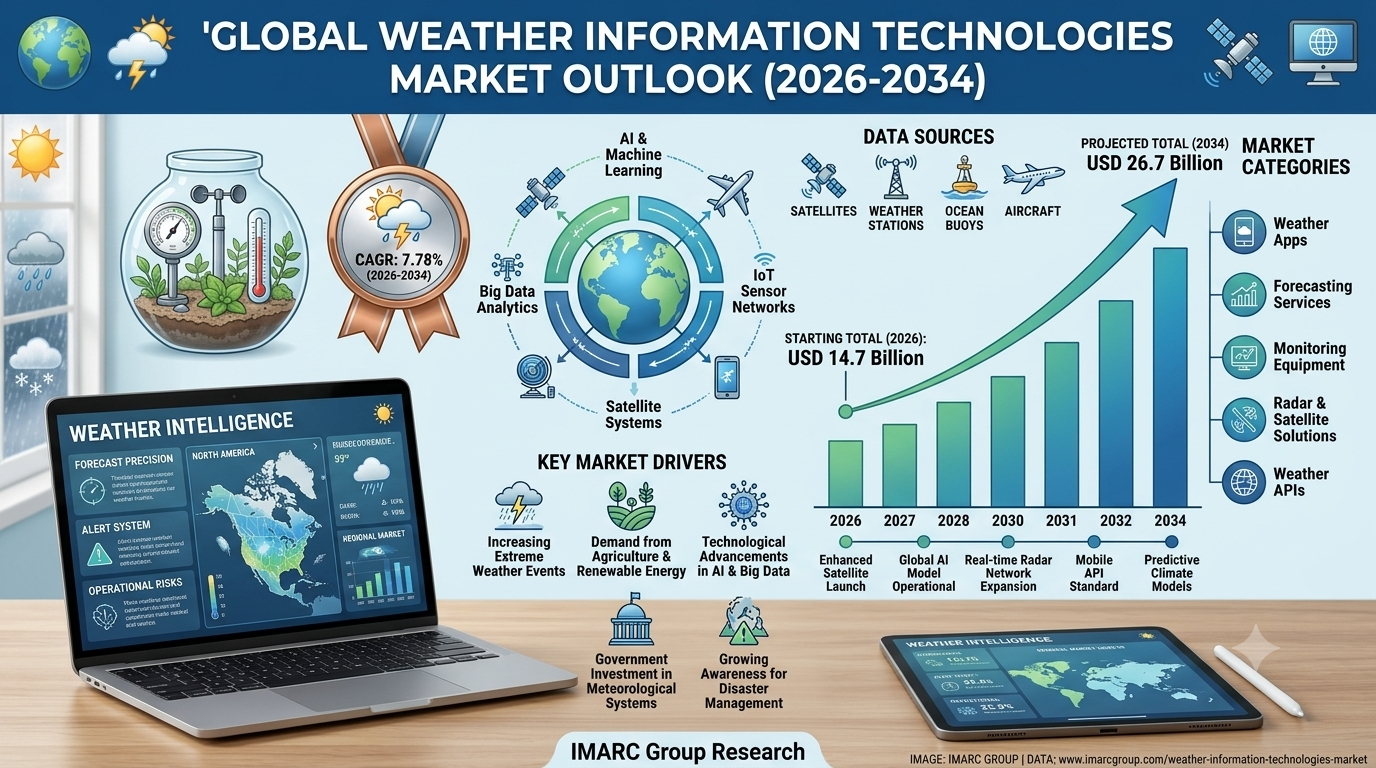
According to IMARC Group, the global weather information technologies market size grew from USD 13.3 Billion in 2025 to USD 14.7 Billion in 2026, and is projected to reach USD 26.7 Billion by 2034, expanding at a CAGR of 7.78% during 2026–2034. This robust weather information technologies market growth reflects rising demand for accurate and timely forecasts and warnings, the growing use of big data and artificial intelligence, expanding access to satellite imagery and radar systems, and continuous advancements in sensor and communication technology.
Weather Information Technologies Industry Overview
Weather information technologies encompass the tools, systems, and methodologies used to collect, process, analyze, and disseminate weather-related data. These technologies include weather monitoring instruments, satellite imagery, radar systems, and computer-based forecasting models that allow meteorologists to observe atmospheric conditions, track weather patterns, and generate reliable forecasts. Real-time measurement of temperature, humidity, wind speed, and precipitation feeds into advanced algorithms and data visualization tools that help the public and industry stakeholders make informed decisions around safety, planning, and operations.
Weather information technologies support a broad continuum of use cases:
• Agriculture: Crop planning, irrigation scheduling, and pest and disease risk forecasting based on localized weather data
• Aerospace and defense: Flight planning, airport weather observation, and mission-critical atmospheric monitoring
• Transportation: Route planning, public transit scheduling, and safety systems for autonomous vehicles
• Power and energy, and oil and gas: Operational planning and risk mitigation for weather-sensitive infrastructure
• Meteorology and weather service providers: Core forecasting, early warning systems, and severe weather advisories
Global Weather Information Technologies Market Size & Key Statistics
Below are the key weather information technologies market statistics drawn from IMARC Group's comprehensive market analysis:
|
Report Attribute |
Key Statistics |
|
Base Year |
2025 |
|
Historical Period |
2020–2025 |
|
Forecast Period |
2026–2034 |
|
Weather Information Technologies Market Size in 2025 |
USD 13.3 Billion |
|
Market Size in 2026 |
USD 14.7 Billion |
|
Market Forecast in 2034 |
USD 26.7 Billion |
|
Market Growth Rate (2026–2034) |
7.78% CAGR |
|
Largest Region |
Asia Pacific |
|
Leading Component Segment |
Monitoring Devices |
|
Leading Forecast Range Segment |
Medium-range Forecast |
|
Leading Application |
Weather Monitoring and Forecasting |
|
Leading End-Use Segment |
Transportation |
Request for a Sample Report for Detailed Weather Information Technologies Market Share Evaluation: https://www.imarcgroup.com/weather-information-technologies-market/requestsample
Key Market Drivers & Weather Information Technologies Market Trends in 2026
Several powerful forces are shaping weather information technologies market trends and fuelling sustained growth expectations across global meteorology, agriculture, transportation, and energy markets:
1. The Rise of Big Data and Artificial Intelligence
Big data allows for the collection, storage, and analysis of large volumes of weather-related data from diverse sources, while AI algorithms process this data to identify patterns and generate more accurate forecasts and predictions. These technologies help meteorologists better understand complex weather patterns, improve the accuracy and lead time of severe weather warnings, and support decision-making across sectors. AI-driven data visualization tools are also making weather information more user-friendly and actionable, reinforcing sustained Weather Information Technologies Market Growth.
2. Constant Technological Advancements
Sophisticated weather satellites equipped with high-resolution sensors provide comprehensive data on cloud cover, precipitation patterns, and atmospheric conditions, while supercomputers process vast datasets to generate precise weather models. The expanding Internet of Things (IoT) ecosystem enables deployment of weather sensors across more locations, and mobile applications and websites increasingly offer personalized, geolocation-based weather updates. Integration between modern technology and traditional monitoring instruments is enabling seamless data sharing and interoperability across the industry.
3. Increasing Availability and Accessibility of Satellite Imagery and Radar Systems
Satellite imagery provides a global perspective on weather patterns, enabling meteorologists to monitor storms, track cloud cover, and analyze atmospheric conditions in unprecedented detail, while radar systems offer localized information on precipitation, storm intensity, and wind patterns. The growing accessibility of this data is fostering innovation across agriculture, transportation, and disaster management, and is a key factor driving the expansion of the weather information technologies market.
4. Expanding Role in Transportation and Autonomous Systems
Weather information technologies provide essential data for route planning, safety measures, and efficiency improvements across the transportation sector, helping public transit systems adjust schedules based on weather conditions. As autonomous vehicles become more prevalent, real-time weather data integration is becoming increasingly critical, since adverse weather can interfere with the sensors and AI systems these vehicles depend on to make informed decisions about speed, route, and safe operation.
5. Rising Demand for Early Warning and Disaster Management Systems
With growing exposure to severe weather events such as typhoons, floods, and landslides, governments and agencies are investing heavily in modernized weather forecasting and early warning infrastructure. This is especially visible in disaster-prone regions, where accurate, timely weather information is critical for mitigating impact and protecting lives, further reinforcing weather information technologies market growth at a regional level.
Key Market Segmentation
By Component
Monitoring Devices — Largest Segment: Weather stations, sensors, and instruments that collect and measure meteorological parameters such as temperature, humidity, pressure, wind speed, and precipitation account for the largest Weather Information Technologies Market Share. Automated weather stations equipped with multiple sensors provide continuous, real-time measurements, while remote sensing technologies such as weather satellites and radar systems enable comprehensive monitoring over vast areas.
Communication Devices: Systems that transmit weather data between monitoring instruments, forecasting centers, and end users, supporting timely dissemination of alerts and advisories.
Software: Forecasting models, data assimilation platforms, and visualization tools that convert raw meteorological data into actionable insights.
Others: Additional supporting hardware and services that complement core weather monitoring and forecasting infrastructure.
By Forecast Range
Medium-range Forecast — Largest Segment: Covering approximately 3 to 10 days, medium-range forecasts bridge the gap between short- and long-range forecasts and are crucial for strategic planning, resource management, and long-term decision-making. Sophisticated numerical weather prediction models and ensemble forecasting techniques continue to improve accuracy and skill in this range, with agriculture, energy, and tourism among the heaviest users.
Short-range Forecast: Forecasts typically covering up to 48–72 hours, used for immediate operational and safety decisions.
Long-range Forecast: Extended outlooks supporting seasonal planning across agriculture, energy, and infrastructure sectors.
By Application
Weather Monitoring and Forecasting — Largest Segment: This segment forms the foundation of the Weather Information Technologies Market, driven by continuous advancements in monitoring devices, satellite systems, and data processing algorithms. Real-time data on temperature, humidity, pressure, wind patterns, and precipitation feeds into forecasting models that use complex mathematical algorithms to predict weather conditions, supporting agriculture, aviation, energy, transportation, and emergency management.
Air Quality Monitoring: Tracking of pollutants and atmospheric conditions to support public health, environmental compliance, and policy decisions.
By End Use
Transportation — Largest Segment: Weather information technologies provide essential data for route planning, safety measures, and efficiency improvements in the transportation sector, including public transit scheduling and, increasingly, autonomous vehicle navigation.
Agriculture: Supports irrigation planning, crop protection, and yield optimization through localized forecasting.
Aerospace and Defense: Enables flight planning, mission-critical atmospheric monitoring, and airport weather observation systems.
Power and Energy, and Oil and Gas: Supports operational planning and risk management for weather-sensitive infrastructure and offshore operations.
Meteorology and Weather Service Providers, and Others: Core forecasting operations, severe weather advisories, and public alert systems.
Regional Weather Information Technologies Market Analysis
|
Region |
Key Highlights |
|
Asia Pacific — Largest |
China, Japan, India, South Korea, Australia, Indonesia; high geographic and climate diversity, frequent exposure to typhoons, earthquakes, tsunamis, floods, and landslides, and government-led modernization of weather satellites and radar systems, including heavy investment by China's meteorological department |
|
North America |
United States and Canada; advanced diagnostic and monitoring infrastructure, strong presence of aerospace, defense, and transportation end users, and early adoption of AI-driven forecasting and earth-observation digital twins |
|
Europe |
Germany, France, UK, Italy, Spain, Russia; mature weather monitoring networks, strong public meteorological agencies, and growing demand from agriculture, energy, and transportation sectors |
|
Latin America |
Brazil, Mexico; expanding investment in weather monitoring infrastructure to support agriculture, aviation, and disaster management |
|
Middle East & Africa |
Growing adoption of weather information technologies to support agriculture, oil and gas operations, and early warning systems amid rising climate variability |
Asia Pacific leads the global Weather Information Technologies Market Share, driven by the region's high geographic and climate diversity — ranging from arid deserts to tropical rainforests and extensive coastlines — along with frequent exposure to typhoons, earthquakes, tsunamis, floods, and landslides. Several governments in the region, including China's meteorological department, have invested heavily in weather satellites and advanced radar systems to modernize forecasting and early warning capabilities.
Connect for Detailed Weather Information Technologies Market Share Segmentation Analysis — Speak to an Analyst: https://www.imarcgroup.com/request?type=report&id=3414&flag=C
Leading Players in the Global Weather Information Technologies Industry
The global Weather Information Technologies Market features a mix of instrumentation specialists, meteorological technology providers, and large technology and defense conglomerates. Key companies covered in the IMARC Group report include:
|
Company |
Notable Focus Area |
|
Vaisala Oyj |
Global leader in weather observation instruments, sensors, and data systems serving meteorological agencies worldwide |
|
International Business Machines Corporation |
AI- and data-driven weather forecasting platforms, including enterprise and cloud-based weather intelligence solutions |
|
Lockheed Martin Corporation |
Earth-observation systems and AI-driven environmental monitoring, including collaboration on digital twin technology for NOAA |
|
Campbell Scientific Inc. |
Environmental monitoring instruments and data-logging systems for weather and climate research |
|
Columbia Weather Systems Inc. |
Automated weather stations and communication devices, including real-time data-logging platforms |
|
Sutron Corporation (Danaher Corporation) |
Remote monitoring and telemetry systems for hydrological and meteorological applications |
|
Gill Instruments Limited |
Ultrasonic wind sensors and meteorological measurement instruments |
|
All Weather Inc. |
Automated weather observation systems (AWOS) serving aviation and airport weather reporting needs |
|
General Acoustics e.K. |
Acoustic and remote-sensing-based weather and ocean monitoring systems |
|
Met One Instruments Inc. |
Air quality and meteorological monitoring instruments |
|
Morcom International Inc. |
Weather monitoring and display systems for aviation and meteorological applications |
|
Skye Instruments Limited |
Environmental and meteorological sensor manufacturing |
Recent Developments
Columbia Weather Systems Inc. updated its Weather MicroServer, a communication device and data logger featuring a web browser user interface with real-time dashboards, configuration, and data export capabilities.
All Weather Inc. (an ADB SAFEGATE company) delivered and installed eight Automated Weather Observation Systems (AWOS) in Alaska to provide weather conditions to pilots before takeoff.
Lockheed Martin Corporation and NVIDIA announced a collaboration to build an AI-driven earth observations digital twin, providing the National Oceanic and Atmospheric Administration (NOAA) with a centralized approach to monitor global environmental conditions, including extreme weather events.
About Us
IMARC Group is a leading global market research company providing data-driven insights and expert consulting services to businesses seeking to achieve their strategic objectives. With a multi-disciplinary team of industry experts, IMARC delivers thorough, reliable market intelligence across sectors including Technology and Media, Healthcare, Chemicals, Energy, Food & Beverages, and more.
Contact Us
IMARC Group
United States: +1-201-971-6302
India: +91-120-433-0800
United Kingdom: +44-753-714-6104

 Bangla