

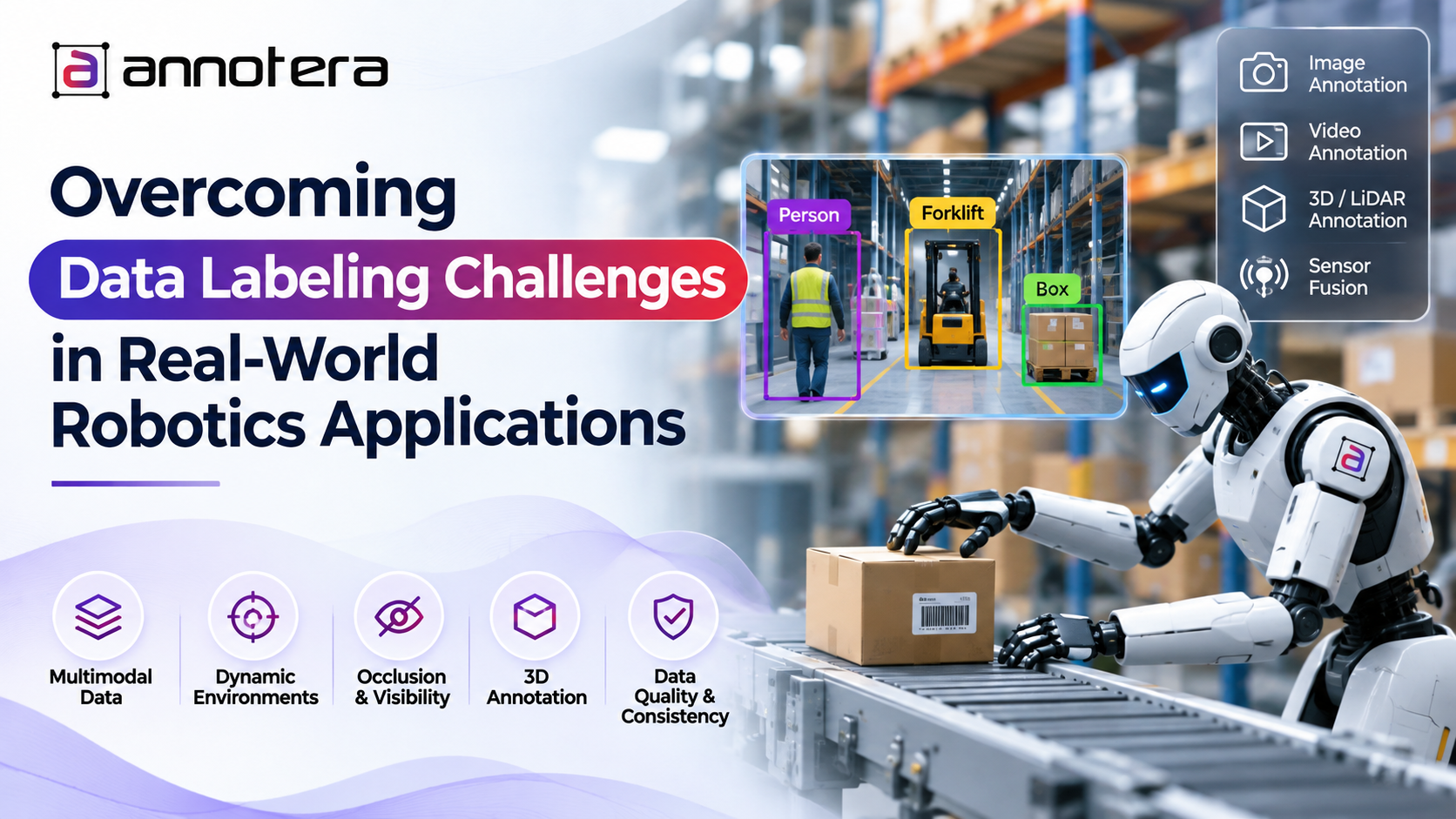

Robotics is rapidly evolving beyond controlled laboratory environments into complex real-world applications. From autonomous mobile robots and warehouse automation to humanoid robots and industrial manipulation systems, intelligent machines must continuously interpret their surroundings, recognize objects, understand spatial relationships, and make decisions in unpredictable conditions.
However, developing reliable robotic systems requires more than advanced sensors and sophisticated AI algorithms. It depends heavily on the quality, consistency, and diversity of training data. This is where data labeling becomes essential.
Unlike conventional machine learning datasets, robotics datasets often contain multiple synchronized data streams, including camera images, LiDAR point clouds, depth maps, motion trajectories, and sensor readings. Labeling this information accurately presents several challenges, particularly when robots operate in dynamic environments.
Overcoming these challenges requires structured annotation workflows, domain expertise, and scalable robotic data annotation services that support reliable Physical AI training.
1. Managing Complex Multimodal Sensor Data
Modern robots rely on multiple sensors to understand their surroundings. Cameras capture visual information, LiDAR systems generate three-dimensional point clouds, and inertial measurement units (IMUs) track movement and orientation.
Combining these different data sources creates a significant labeling challenge. Each sensor produces information in a different format, resolution, and coordinate system. Annotators must ensure that labels remain consistent across all modalities.
For example, an autonomous warehouse robot may use camera images to identify packages while LiDAR sensors estimate their distance and position. If the object boundaries or timestamps do not align, the robot may develop an inaccurate understanding of its environment.
How to overcome it:
-
Establish standardized annotation guidelines across sensor modalities.
-
Synchronize timestamps and coordinate systems before labeling.
-
Use multimodal annotation tools to connect image, video, and 3D point cloud labels.
-
Introduce cross-modal quality checks to identify inconsistencies.
A unified annotation framework helps create coherent datasets that improve robotic perception and decision-making.
2. Handling Dynamic and Unpredictable Environments
Real-world environments are constantly changing. Pedestrians move unpredictably, vehicles change direction, objects get displaced, and lighting conditions vary throughout the day.
Robots must learn to recognize objects and interpret their behavior under these changing circumstances. However, annotating dynamic environments requires more than identifying objects in individual frames.
For instance, a delivery robot navigating a crowded pedestrian area must distinguish between stationary obstacles and moving people while understanding their movement patterns.
How to overcome it:
Temporal annotation is essential for addressing this challenge. Annotators should track objects across video sequences, maintain consistent object identities, and label movement patterns.
Important techniques include:
-
Multi-object tracking across consecutive frames.
-
Temporal segmentation of actions and events.
-
Object identification and trajectory annotation.
-
Motion-state classification, such as stationary, moving, approaching, or turning.
These techniques help robotic systems understand not only what is present in an environment but also how it changes over time.
3. Addressing Occlusion and Incomplete Visual Information
Occlusion occurs when one object partially or completely blocks another object from a sensor's perspective. It is particularly common in crowded warehouses, manufacturing facilities, outdoor environments, and human-robot interaction scenarios.
For example, a robotic arm attempting to pick up a product may encounter objects partially hidden behind packaging or other inventory items. Similarly, pedestrians may temporarily disappear behind vehicles or obstacles.
Incomplete visual information makes accurate object identification and segmentation difficult.
How to overcome it:
Annotation teams should follow clear guidelines for partially visible and temporarily occluded objects.
Recommended practices include:
-
Using consistent visibility and occlusion attributes.
-
Tracking object identities across frames, even when temporarily hidden.
-
Applying 3D bounding boxes where spatial information is available.
-
Combining camera and LiDAR data to improve object localization.
-
Maintaining separate labels for fully visible, partially visible, and heavily occluded objects.
These practices help robots develop more robust perception capabilities in cluttered environments.
4. Maintaining Annotation Accuracy in 3D Environments
Robotic applications increasingly depend on three-dimensional environmental understanding. Autonomous navigation, robotic manipulation, and obstacle avoidance require accurate spatial information.
However, annotating 3D point clouds is more complicated than labeling conventional images. Annotators must identify objects within large collections of spatial points while maintaining accurate dimensions, orientation, and positioning.
Even minor labeling errors can affect object localization, collision avoidance, and robotic movement.
How to overcome it:
Organizations should adopt specialized 3D annotation workflows that support:
-
3D bounding box annotation.
-
Point cloud segmentation.
-
Semantic and instance segmentation.
-
Object classification and spatial positioning.
-
LiDAR-camera sensor fusion annotation.
Experienced annotators and automated pre-labeling tools can work together to improve efficiency. Human reviewers should validate difficult cases, particularly where object boundaries are unclear or point cloud density is inconsistent.
5. Managing Long-Tail Scenarios and Rare Events
Robots frequently encounter situations that are underrepresented in conventional training datasets. These include unusual object configurations, unexpected obstacles, equipment failures, extreme weather, and unfamiliar human behaviors.
Such scenarios are commonly referred to as long-tail events. Although they may occur infrequently, they can significantly affect robotic safety and operational performance.
For example, an autonomous vehicle operating in a warehouse may encounter a fallen package, while a humanoid robot may need to respond to an unexpected change in an object's position.
How to overcome it:
Robotics teams should develop data collection and annotation strategies that prioritize rare and challenging scenarios.
This includes:
-
Identifying underrepresented environmental conditions.
-
Annotating edge cases and unusual interactions.
-
Creating balanced datasets across object categories and scenarios.
-
Incorporating synthetic data where appropriate.
-
Continuously updating datasets using real-world deployment feedback.
A diverse dataset helps reduce model bias and improves generalization across unfamiliar situations.
6. Ensuring Consistency and Quality Across Large Datasets
As robotics projects scale, annotation requirements increase significantly. Large datasets may involve multiple annotation teams, different labeling tools, and complex taxonomies.
Without standardized processes, inconsistent labels can introduce noise into training datasets and reduce model performance.
How to overcome it:
A structured quality assurance framework is essential for maintaining annotation consistency.
Effective quality management practices include:
-
Standardized guidelines: Define clear labeling instructions, object categories, and edge-case handling procedures.
-
Multi-level review: Introduce independent reviews and expert validation for complex annotations.
-
Inter-annotator agreement: Measure consistency between annotators using appropriate quality metrics.
-
Automated validation: Use scripts and annotation tools to identify missing labels, incorrect attributes, and formatting errors.
-
Continuous feedback: Update annotation guidelines based on recurring errors and model evaluation results.
Combining human expertise with automated quality checks creates a more reliable annotation pipeline.
7. Scaling Annotation for Continuous Physical AI Training
Robotics development is an iterative process. Models are trained, deployed, evaluated, and improved using additional real-world data.
Consequently, annotation cannot be treated as a one-time activity. Robotics companies need scalable workflows capable of processing growing volumes of multimodal data while maintaining quality and turnaround times.
Reliable robotic data annotation services help organizations manage complex labeling requirements, including image annotation, video annotation, LiDAR labeling, sensor fusion, semantic segmentation, and object tracking.
For effective Physical AI training, annotation workflows must also support continuous dataset improvement, version control, and consistent labeling standards.
Working with an experienced annotation partner allows robotics developers to focus on model development while ensuring their training datasets remain accurate, diverse, and production-ready.
Conclusion: Building More Reliable Robots Through High-Quality Data
Overcoming data labeling challenges is fundamental to developing intelligent robots that can operate reliably in real-world environments. Multimodal sensor complexity, dynamic surroundings, occlusion, 3D spatial interpretation, rare events, and annotation inconsistencies all influence the quality of robotic training datasets.
Addressing these challenges requires a combination of domain expertise, standardized annotation guidelines, advanced labeling technologies, and rigorous quality assurance.
At Annotera, we understand the importance of high-quality training data in advancing intelligent robotic systems. Our data annotation capabilities support complex AI development requirements through structured labeling workflows, human-in-the-loop validation, and scalable annotation solutions.
Whether robotics teams are developing autonomous navigation systems, intelligent manipulation platforms, or next-generation humanoid robots, Annotera helps transform complex real-world data into structured datasets that support more reliable AI development.
Build smarter robotic systems with high-quality training data. Partner with Annotera to strengthen your robotics AI development journey.
