

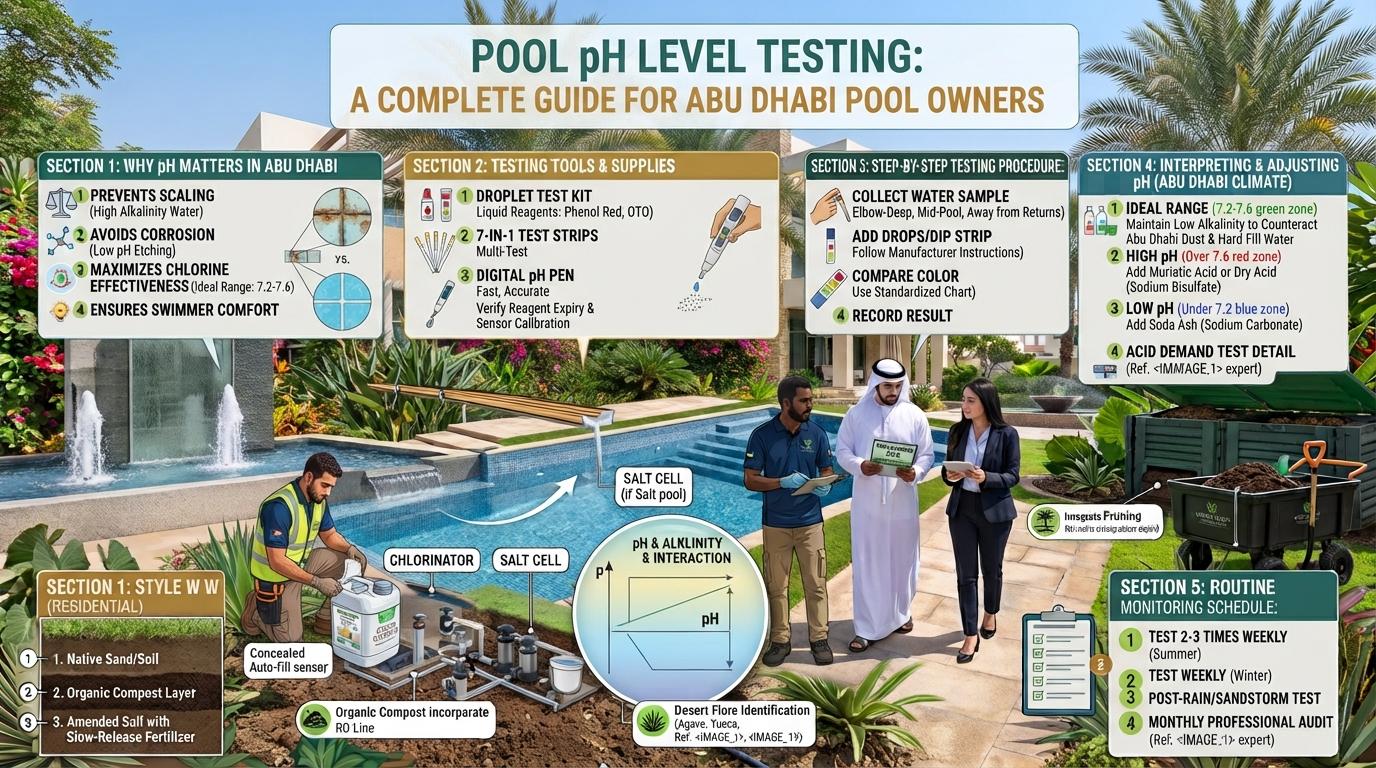

Crystal-clear water, comfortable swimming and equipment that lasts for years all depend on one small number that most pool owners never think about until something goes wrong. That number is pH. When it drifts too high or too low, the water can turn cloudy, sting the eyes, irritate the skin, stain the surface and make even a strong dose of chlorine perform poorly. In Abu Dhabi, where strong sunlight, high temperatures, dust and heavy bather loads constantly disturb the chemistry, pool pH level testing is not an occasional chore. It is the foundation of safe, healthy water.
This guide explains what pH is, how to test it correctly, what the right range looks like, how to fix problems and how often to check. Whether you are a villa owner, a property manager or a facility operator, you will find clear, practical steps you can use straight away. The advice comes from the daily experience of the team at Atlanta Pools, who handle residential and commercial pools across the city. If you would rather leave the routine to specialists, our complete pool maintenance care covers testing, balancing and equipment checks in one organised programme.
Not sure what your water readings mean? Get expert water testing and we will tell you exactly where your pool stands.
What Is Pool pH Level Testing?
The term pH describes how acidic or alkaline a liquid is, measured on a scale from 0 to 14. A reading of 7 is neutral, anything below 7 is acidic and anything above 7 is alkaline, also called basic. Pool pH level testing is simply the process of measuring where your water sits on this scale, so you can make sure it stays in the right zone for comfort, safety and sanitiser performance.
The scale is logarithmic, which means a small change in number represents a large change in chemistry. Moving from 7.4 to 8.4 is not a slight shift. It makes the water ten times more alkaline. That is why even small deviations deserve attention.
Human eyes and skin have a natural pH close to 7.4 to 7.5, and pool water that matches this range feels gentle and comfortable. Water outside that range causes burning eyes, dry skin, itchy scalps and in some cases breathing discomfort around indoor pools.
pH also controls how well your sanitiser works. Chlorine exists in two main forms in water, a fast-acting one that kills bacteria and algae and a slower one that is much less effective. As pH rises, more chlorine shifts into the weaker form. At a pH near 7.5, chlorine is working well. At 8.0 or higher, a big portion of it is doing very little, even though your test shows plenty of chlorine in the water. This is one of the most common reasons owners battle algae despite adding chemicals regularly.
Why Does Pool pH Change So Quickly in the UAE?
Every pool drifts over time, but local conditions speed the process.
Intense heat and sunlight. High temperatures increase evaporation and alter how chemicals behave. Sunlight breaks down chlorine quickly, leading owners to add more, which also affects pH.
Dust and sand. Fine dust carried by wind often has an alkaline nature and raises pH after every storm or windy day.
Source water. Tap and tanker water in the region can be high in minerals and alkalinity, so topping up an evaporating pool slowly pushes pH upward.
Heavy use. Swimmers bring sweat, sunscreen, oils and organic material. Parties and family gatherings can change the chemistry within hours.
Chemical choice. Some sanitisers raise pH when dissolved, while others lower it. Using them without testing can swing the balance.
Plaster and surfaces. New plaster finishes release alkaline material in the first weeks, which can keep pH high until the surface cures.
Because of these factors, a pool that tested perfectly on Sunday can be out of range by Wednesday. Regular testing is the only reliable way to stay ahead.
Types of Pool pH Testing Methods
There are several ways to measure pH, each with strengths and limitations. Choosing the right one depends on how accurate you need to be and how often you test.
Test Strips
These plastic strips have small pads that change colour when dipped in water. You compare the colours to a chart on the bottle. They are cheap, quick and convenient, which makes them popular with homeowners. However, readings can be hard to judge by eye, and humidity or old strips can affect accuracy. They are best for fast checks rather than precise adjustments.
Liquid Drop Test Kits
These kits use a small water sample and a reagent, usually phenol red, that changes colour according to pH. You match the colour to a comparator block. They are far more accurate than strips and are the standard choice for serious pool owners and technicians. They are also inexpensive to run over time.
Digital pH Meters
A digital probe gives a numerical reading on a screen. When properly calibrated, meters are highly accurate and remove the guesswork of colour matching. The downside is that the probe needs regular cleaning, storage in the right solution and calibration with buffer liquids. A neglected probe gives misleading results.
Digital Photometers
These devices shine light through a treated sample and measure the colour electronically. They are popular in commercial settings where accuracy and record keeping are important.
Professional Laboratory or Technician Testing
A trained technician tests pH along with alkalinity, calcium hardness, stabiliser, chlorine and other factors, then interprets the results as a complete picture. This is the best option if your pool has persistent problems or if you want a full water balance review.
Benefits of Regular Pool pH Level Testing
Testing may seem like a small task, but its benefits touch almost every part of pool ownership.
Safer, cleaner water. Balanced pH allows chlorine to kill bacteria and algae efficiently, which protects swimmers from illness and keeps the water sparkling.
Comfortable swimming. Water that matches the body’s natural pH does not sting eyes or dry out skin, so people stay in the pool longer.
Lower chemical costs. When pH is correct, you need less chlorine to achieve the same result. Many owners waste money adding product to water that was never balanced to begin with.
Protection for surfaces. Low pH etches plaster, tiles and grout, while high pH leaves scale. Regular testing prevents expensive damage.
Longer equipment life. Acidic water corrodes heaters, pumps, ladders and metal fittings. Alkaline water builds scale inside pipes and heat exchangers. Balanced water protects the entire system.
Fewer algae problems. Stable pH keeps sanitiser effective and avoids the sudden green outbreaks that follow heat waves and heavy use.
Better planning. Frequent readings reveal trends, so you can fix small shifts before they become big problems.
What Is the Ideal pH Range for a Swimming Pool?
The generally accepted target for pool water is a pH between 7.2 and 7.8, with the sweet spot around 7.4 to 7.6. This range keeps chlorine effective, maintains swimmer comfort and protects surfaces and equipment.
If pH is too low (below 7.2): Water becomes acidic. Swimmers may feel stinging in the eyes and nose, skin can become dry, and chlorine burns off faster. Plaster, grout and metal parts begin to suffer corrosion and etching, and you may notice staining.
If pH is too high (above 7.8): Water becomes alkaline. Chlorine loses much of its strength, calcium can precipitate out and form white scale, filters clog sooner and water often turns cloudy. Skin and eyes can also feel irritated.
Total alkalinity works hand in hand with pH. Alkalinity acts as a buffer that keeps pH from swinging wildly. A typical target is 80 to 120 ppm. If alkalinity is too low, pH bounces around quickly. If it is too high, pH tends to creep upwards and becomes stubborn. Always test both together for a reliable picture.
Other readings matter too. Free chlorine, calcium hardness and stabiliser levels all interact with pH, so a complete test every so often is worth the effort.
How to Test Pool pH Level Step by Step
Getting a reliable result depends as much on technique as on equipment. Follow these steps for accurate readings.
- Wash your hands and the sample container. Sunscreen, oil or leftover chemicals can distort colours.
- Collect a proper sample. Hold the container upside down, push it about 30 cm (elbow depth) beneath the surface, then turn it upright to fill. Avoid areas near return jets, skimmers or where chemicals were just added.
- Test promptly. Do not leave the sample sitting in the sun, as heat can change the reading.
- Add the reagent carefully. For liquid kits, add the exact number of drops, usually phenol red, and swirl gently without shaking.
- Compare colours in good light. Natural daylight in shade is best. Hold the comparator against a white background and avoid direct sun or coloured lighting.
- Record the result. Write down the date, time and reading. A simple log helps you see patterns and know how your pool responds to weather and use.
- Test other parameters. Check alkalinity and chlorine at the same time so adjustments make sense together.
- Retest after adjusting. After adding any chemical, let the water circulate for several hours and test again before making further changes.
If you use a digital meter, calibrate it regularly with fresh buffer solutions and rinse the probe with clean water between tests. Never store it dry.
How Often Should You Test Your Pool’s pH?
Testing frequency depends on climate, usage and pool type. These guidelines suit most Abu Dhabi properties.
Private villa pools: Test two to three times a week during summer and at least weekly in cooler months. Increase frequency during heat waves.
After heavy use: Test the same day if you host a party or have many swimmers.
After dust or rain: Check pH within a day of a storm, strong wind or rainfall, because debris and rainwater can disturb the balance quickly.
After adding chemicals or fresh water: Retest after several hours to confirm the effect.
Commercial and community pools: Test several times per day according to local regulations and operating standards. Many facilities also use automatic controllers that monitor pH continuously.
New or newly resurfaced pools: Test daily at first, because new plaster can raise pH rapidly during curing.
If you travel often or simply prefer not to manage this yourself, a scheduled weekly pool cleaning service often includes water testing and basic balancing, so you never miss a check.
How to Adjust pH After Testing
Testing is only useful if you act on the results. Here is how to correct common problems safely.
Raising Low pH
Use a pH increaser, commonly sodium carbonate (soda ash). Add small amounts according to the product instructions and your pool volume, dissolve it in a bucket of water if the label recommends this, and distribute it around the pool with the pump running. Retest after several hours before adding more.
Lowering High pH
Use a pH reducer such as sodium bisulfate or diluted muriatic acid, following the manufacturer’s instructions. Add slowly, never pour acid into a bucket of water in a rush and never mix different chemicals together. Keep the pump running to circulate the water, and recheck after a few hours.
Dealing With Stubborn pH
If pH keeps climbing back up, total alkalinity is often too high. Lowering alkalinity first, then adjusting pH, usually solves the problem. If pH keeps dropping, alkalinity may be too low or you may be using acidic sanitisers excessively.
Safety First
Pool chemicals can burn skin, damage eyes and release harmful fumes if mishandled. Wear gloves and eye protection, add chemicals one at a time, keep them away from children and store them in a cool, ventilated place in their original containers. If you are unsure, ask a professional rather than guess.
Common Mistakes in Pool pH Level Testing
Even experienced owners slip up occasionally. Watch out for these issues.
Using expired reagents or strips. Old products give inaccurate colours. Replace them yearly and keep them in a cool, dry place.
Testing too soon after adding chemicals. Wait for the water to circulate before taking another sample.
Sampling at the surface. The top layer is not representative. Always take the sample at elbow depth.
Ignoring alkalinity. Treating pH alone often leads to a frustrating cycle of constant adjustments.
Over-correcting. Adding large doses at once can cause the reading to swing too far in the other direction. Make small changes and retest.
Reading colours in poor light. Shade, sunglasses or coloured backgrounds can change how you see the result.
Skipping a record. Without a log, patterns remain hidden and the same problems keep returning.
Neglecting the equipment. A dirty meter probe or a pump that is not circulating water properly will produce misleading results and uneven chemistry.
Applications: Where Pool pH Testing Matters Most
Every pool benefits from balanced water, but certain situations make testing particularly critical.
Private villa pools. Family pools often face irregular schedules and sudden heavy use. Consistent testing keeps the water safe for children and guests.
Hotel and resort pools. High bather loads and strict hygiene expectations demand frequent checks and clear records.
Residential community pools. Shared facilities need dependable routines and documentation to maintain resident satisfaction and meet standards.
Gyms, clubs and schools. Frequent use by large groups makes pH swings common and increases the importance of reliable sanitiser performance.
Spas and jacuzzis. Warm water and small volumes change quickly, so readings should be taken more often.
Newly built pools. After handover, careful monitoring helps the finish cure properly and avoids early staining or scaling. If you are planning to add a pool to your property, our new pool building specialists can design the system with correct circulation and filtration so water balance is easier to maintain from day one.
Holiday homes. Pools that sit idle for weeks can develop serious problems. Scheduled testing and servicing keep them ready for your return.
Signs That Your Pool Water Needs Immediate Attention
Your pool often gives clear warnings that pH has gone off track. Do not ignore them.
- Cloudy or milky water even after filtering
- Green tint or sudden algae growth
- Stinging eyes, itchy skin or a strong chemical smell
- White crusty deposits on tiles, waterline or equipment
- Rust-coloured or dark stains on plaster
- Chlorine that seems to disappear very quickly
- Rough, etched or gritty feeling surfaces
- Corroded ladders, rails or fittings
If you notice any of these signs, test the water immediately and correct the imbalance before it causes lasting damage.
Why Choose Atlanta Pools for Water Testing and Care?
Water chemistry is not a side service for us. It is the heart of what Atlanta Pools does every day. Our technicians understand how local heat, dust and water supply affect pools across Abu Dhabi, and we adjust our approach to each property rather than applying a one-size-fits-all routine.
Here is what clients appreciate about working with us:
- Accurate testing. We use reliable methods and check pH together with alkalinity, chlorine, hardness and stabiliser for a full picture.
- Practical advice. We explain results in plain language and tell you what to do next, so you understand your pool better.
- Consistent schedules. Reliable visits keep your water balanced throughout the year, not only when problems appear.
- Complete pool expertise. From construction to cleaning and equipment care, our knowledge covers the whole system that influences water quality.
- Flexible plans. You can choose occasional support or a full programme, including pool AMC service plans that bundle regular visits, testing and priority response at a predictable cost.
- Honest recommendations. We suggest only what your pool genuinely needs.
Whether you are battling cloudy water, preparing for a gathering or simply want peace of mind, our team can take the guesswork out of pool care.
Conclusion
Pool pH level testing is one of the simplest and most valuable habits a pool owner can build. It keeps swimmers comfortable, allows chlorine to work properly, protects surfaces and equipment and reduces long-term costs. In the demanding Abu Dhabi climate, where heat, dust and heavy use constantly push the chemistry off balance, regular checks are essential.
Remember the core points: aim for a pH between 7.2 and 7.8, test alkalinity alongside it, take samples correctly, record your results and adjust in small, careful steps. Retest after every change and increase your testing frequency during summer, after storms and after busy weekends. When in doubt, get professional help rather than risk damaging your pool or your health.
Ready for balanced, sparkling water all year round? Schedule a water check with our specialists today.
Frequently Asked Questions (FAQs)
What is the best pH level for a swimming pool?
The recommended range is 7.2 to 7.8, with an ideal target of about 7.4 to 7.6. Within this range, chlorine works efficiently and the water feels comfortable on eyes and skin.
Can I use test strips instead of a liquid test kit?
Yes, strips are fine for quick routine checks. For more precise readings, especially when adjusting chemicals or troubleshooting problems, a liquid drop kit or digital meter is more reliable.
Why does my pool pH keep rising?
Common causes include high total alkalinity, dust, alkaline source water, new plaster, aeration from water features and certain chemical products. Testing alkalinity and correcting it first often stops the constant rise.
How long should I wait to swim after adjusting pH?
It depends on the chemical and product instructions, but a safe general approach is to run the pump for several hours, retest the water and swim only once pH and sanitiser levels are back within range.
Does pH affect how well chlorine works?
Yes, very much. As pH rises above the recommended range, a larger share of chlorine becomes less effective at killing bacteria and algae, so the water can still develop problems even when chlorine levels appear high.
