

Distributed Energy Resources Management Market Analysis by Technology, Application and Region

Distributed Energy Resources Management Market
Market Overview
The Global Distributed Energy Resources Management Market is experiencing significant growth as countries increasingly shift toward renewable energy and decentralized power generation. Distributed Energy Resource Management Systems (DERMS) are advanced software platforms designed to monitor, control, and optimize energy resources connected to electricity distribution networks. These resources include solar photovoltaic (PV) systems, wind turbines, battery energy storage systems, electric vehicle (EV) charging stations, and microgrids.
The growing adoption of decentralized energy systems is changing the traditional electricity generation and distribution landscape. Utilities, grid operators, commercial establishments, and residential consumers are increasingly adopting DERMS solutions to improve energy efficiency, reduce operational costs, and maintain grid stability. These systems enable real-time monitoring and coordination of energy generation, storage, and consumption.
Technological advancements in artificial intelligence, Internet of Things (IoT), cloud computing, and smart grid infrastructure are further supporting market development. DERMS platforms help manage fluctuations in renewable energy generation while improving the reliability and flexibility of electricity networks.
Download Free PDF Brochure-https://www.maximizemarketresearch.com/request-sample/67169/
Market Size and Growth
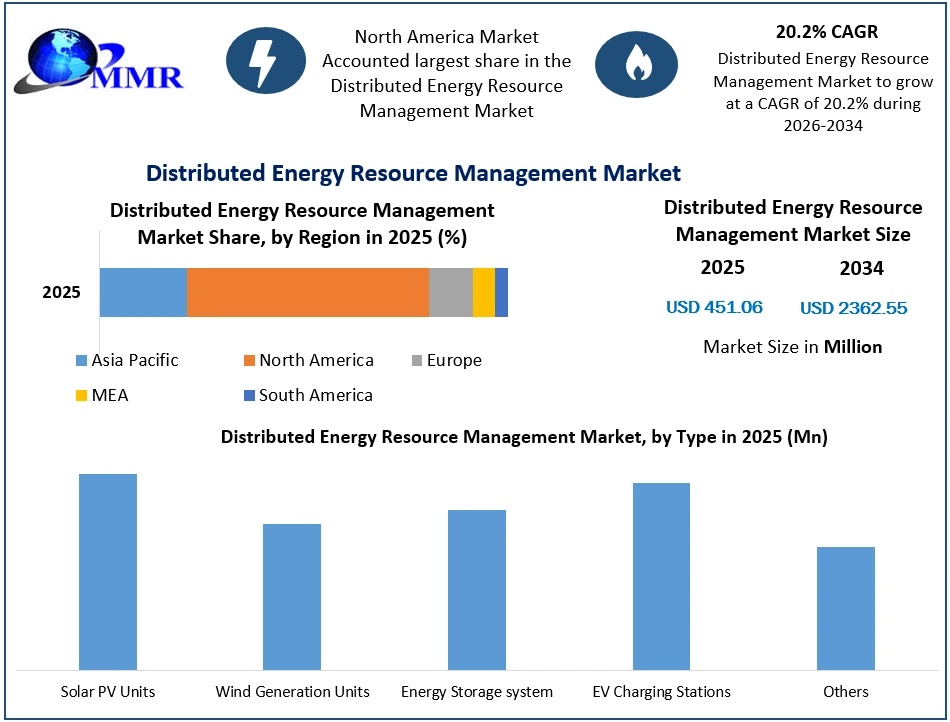
The Global Distributed Energy Resource Management Market was valued at USD 451.06 Million in 2025 and is expected to reach approximately USD 2,362.55 Million by 2034, growing at a CAGR of 20.2% during the forecast period from 2026 to 2034.
The increasing deployment of renewable energy projects is a major factor contributing to market expansion. Governments and energy companies are investing in solar and wind power installations to reduce dependence on conventional energy sources. However, managing intermittent renewable energy generation requires advanced monitoring and control technologies, increasing demand for distributed energy resource management solutions.
Additionally, growing investments in smart grid infrastructure and energy storage systems are creating new opportunities. Utilities are adopting DERMS platforms to balance electricity supply and demand, improve distribution network performance, and strengthen energy security.
Key Market Segmentation
The Distributed Energy Resource Management Market is segmented based on component, application, end user, and region.
Based on component, the market is divided into software and services. The software segment plays an important role by providing centralized monitoring, forecasting, optimization, and control capabilities. Services include consulting, system integration, installation, maintenance, and technical support.
By application, the market includes solar PV units, wind generation units, energy storage systems, EV charging stations, and others. The solar PV segment dominated the application category due to the widespread installation of distributed solar power systems. Declining solar technology costs, supportive government policies, and increasing environmental awareness are encouraging solar adoption.
Energy storage systems are also gaining importance because they help store excess renewable electricity and supply power during periods of high demand. EV charging stations represent another emerging application as electric vehicle adoption increases worldwide.
Based on end user, the market is categorized into industrial, commercial, and residential segments. Industrial facilities use DERMS solutions to optimize energy consumption and reduce electricity expenses. Commercial buildings adopt these systems to improve energy efficiency, while residential users benefit from better management of rooftop solar installations and home battery storage.
Growth Drivers
The transition toward renewable energy is one of the primary factors driving the Distributed Energy Resource Management Market. Increasing investments in solar, wind, and other clean energy technologies are creating demand for advanced systems capable of managing decentralized electricity generation.
Another important growth driver is the modernization of electricity distribution networks. Traditional grids require upgrades to accommodate increasing renewable energy capacity and distributed power generation. DERMS solutions help utilities manage multiple energy assets while maintaining grid reliability.
The growing adoption of smart grid technologies is also supporting market growth. Advanced sensors, connected devices, and real-time analytics allow energy providers to monitor electricity consumption and optimize distribution operations.
Furthermore, increasing electricity demand from industries, commercial buildings, and electric vehicle charging infrastructure is encouraging investments in intelligent energy management systems.
Emerging Trends
Artificial intelligence and machine learning are becoming important technologies in distributed energy resource management. These technologies help predict electricity demand, forecast renewable energy generation, and optimize energy distribution based on changing consumption patterns.
The integration of IoT-enabled devices is another significant trend. Connected sensors and smart meters provide real-time information about energy production and consumption, allowing utilities to make faster operational decisions.
Virtual power plants (VPPs) are also gaining attention. These platforms connect multiple distributed energy resources and coordinate them as a single virtual power generation system. This approach improves grid flexibility and enables more efficient utilization of renewable energy assets.
Additionally, the growing integration of battery storage systems and EV charging infrastructure is encouraging companies to develop advanced DERMS platforms that support flexible electricity management.
Regional Analysis
North America dominated the Global Distributed Energy Resource Management Market in 2025 due to its advanced electricity infrastructure, strong renewable energy investments, and supportive government policies. The United States is a major contributor to regional growth, supported by increasing solar installations, wind energy projects, and smart grid modernization initiatives. Canada is also adopting distributed generation technologies to improve energy security, particularly in remote communities.
Europe represents another important market, supported by renewable energy targets, sustainability initiatives, and investments in decentralized electricity systems. Countries such as Germany, the United Kingdom, France, and Italy are strengthening renewable energy integration and grid modernization.
Asia Pacific is expected to offer significant growth opportunities due to rapid urbanization, increasing electricity consumption, and expanding renewable energy capacity. China, India, Japan, and South Korea are investing in solar power, battery storage, and smart grid infrastructure.
Meanwhile, the Middle East and Africa and South America are gradually adopting distributed energy management technologies to improve electricity accessibility, support renewable energy development, and strengthen power infrastructure.
Competitive Landscape
The Distributed Energy Resource Management Market is characterized by the presence of established technology providers, energy companies, and specialized software developers. Companies are focusing on technological innovation, strategic acquisitions, product development, and partnerships to strengthen their market positions.
Major market players include General Electric (GE), Honeywell International Inc., Lockheed Martin Corporation, Enel X, Advanced Microgrid Solutions, Guidehouse, Spirae Inc., Doosan GridTech, AutoGrid Systems Inc., Opus One Solutions, Sunverge Energy Inc., Blue Pillar Inc., Enbala Power Networks, CleanSpark Inc., FlexGen Power Systems, Siemens AG, ABB Ltd., Schneider Electric SE, Eaton Corporation, and Hitachi Ltd.
These companies are investing in advanced software platforms, grid automation, energy storage integration, and digital monitoring technologies to improve system performance and expand their customer base.
Download Free PDF Brochure-https://www.maximizemarketresearch.com/request-sample/67169/
Recent Developments
The market has witnessed several strategic developments involving acquisitions, product launches, and technology integration.
In August 2026, CLEAResult announced the acquisition of Connected Energy to expand its distributed energy resource management solutions for electric utilities. The development is expected to strengthen grid optimization and peak demand management capabilities.
In June 2026, Siemens Energy completed the strategic acquisition of Camlin Group to expand its digital grid monitoring and distributed energy resource integration capabilities.
In May 2026, Schneider Electric introduced its next-generation integrated Battery Energy Storage System (BESS), combining power infrastructure with advanced digital intelligence to improve energy management and system integration.
In March 2025, EnergyHub completed a product integration with Eguana Technologies to connect residential and commercial energy storage platforms with utility-driven virtual power plants.
Future Outlook
The future of the Distributed Energy Resource Management Market is expected to remain promising as renewable energy adoption and decentralized electricity generation continue to increase. Growing investments in smart grids, battery storage, and electric vehicle infrastructure will create additional opportunities for market participants.
Artificial intelligence, predictive analytics, cloud-based platforms, and IoT technologies are expected to improve energy forecasting and operational efficiency. Utilities and energy providers will increasingly adopt integrated management solutions to coordinate distributed assets and maintain grid stability.
Emerging economies, particularly across Asia Pacific, are expected to contribute significantly to future market expansion through renewable energy investments and electricity infrastructure modernization.
For full access to the comprehensive strategic report, visit:https://www.maximizemarketresearch.com/market-report/distributed-energy-resources-management-market/67169/
Conclusion
The Global Distributed Energy Resource Management Market is becoming an important part of the transition toward intelligent, decentralized, and sustainable energy systems. Increasing renewable energy installations, smart grid modernization, technological advancements, and rising electricity demand are supporting market growth. With continued innovation and investment from leading industry participants, the market is expected to experience substantial expansion through 2034.
About Maximize Market Research
Maximize Market Research is a multifaceted market research and consulting company with professionals from several industries. Some of the industries we cover include medical devices, pharmaceutical manufacturers, science and engineering, electronic components, industrial equipment, technology and communication, cars and automobiles, chemical products and substances, general merchandise, beverages, personal care, and automated systems. To mention a few, we provide market-verified industry estimations, technical trend analysis, crucial market research, strategic advice, competition analysis, production and demand analysis, and client impact studies.
Contact Maximize Market Research
3rd Floor, Navale IT Park, Phase 2
Pune Bangalore Highway, Narhe,
Pune, Maharashtra 411041, India
[email protected]
+91 96071 95908, +91 9607365656
