

Can Interactive Projectors Revolutionize Learning Experiences in India's Universities?

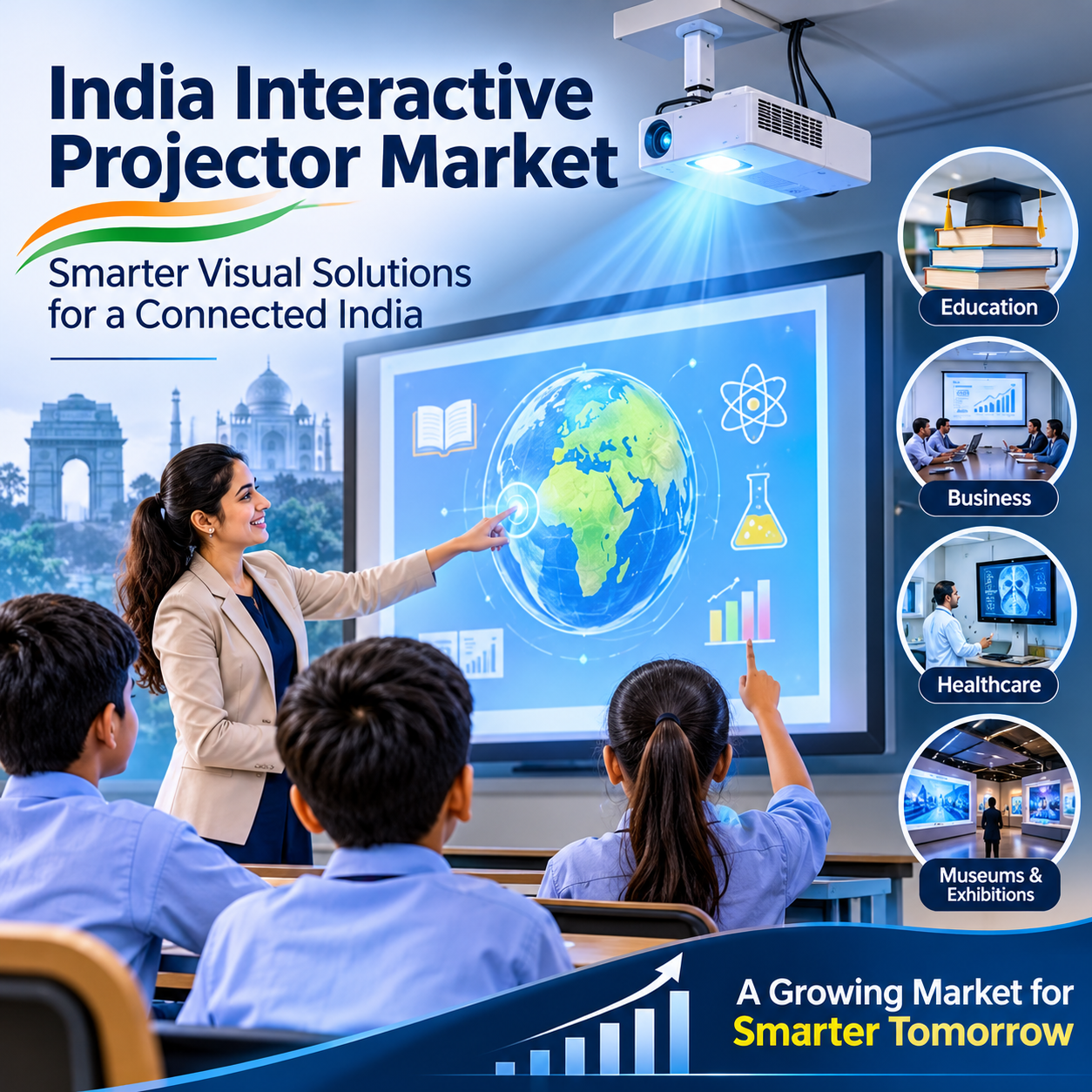
The growing integration of technology into higher education is changing how universities deliver lectures, conduct research and engage with students. The India Interactive Projector Market is benefiting from increasing interest in digital classrooms and advanced presentation solutions. Interactive projectors enable educators to display multimedia content, annotate digital materials and encourage students to participate directly in academic discussions. As universities modernize their teaching infrastructure, these systems are becoming an important option for creating collaborative and technology-enabled learning environments.
How Are Interactive Projectors Improving University Classrooms?
University education involves complex subjects that often require detailed explanations, visual demonstrations and group discussions. Traditional teaching equipment may not always provide the flexibility needed for modern academic activities.
Interactive projectors offer several advantages:
-
Visual learning: Teachers can display diagrams, scientific illustrations, maps and educational videos.
-
Student participation: Students can interact with projected content and contribute to classroom activities.
-
Collaborative discussions: Groups can work together on assignments, presentations and problem-solving exercises.
-
Digital presentations: Faculty members can integrate presentations and online learning resources into lectures.
-
Flexible teaching: Educators can combine traditional explanations with interactive digital demonstrations.
These capabilities can make academic sessions more engaging and support different teaching approaches.
Which University Departments Can Benefit?
Interactive projection technology has applications across multiple academic disciplines.
1. Engineering and Technical Education
Engineering institutions frequently use diagrams, technical drawings and simulations to explain complicated concepts. Interactive projectors allow instructors to highlight specific components and demonstrate processes during lectures.
2. Medical and Healthcare Education
Medical colleges can use interactive projection systems to display anatomical illustrations, educational videos and clinical learning materials. These visual resources can complement conventional teaching methods.
3. Business and Management Schools
Management institutions can conduct interactive case studies, business simulations and group presentations. Students can contribute ideas directly to displayed information, supporting collaborative learning.
4. Science and Research Departments
Science faculties can present experimental procedures, research findings and graphical information through digital displays. Interactive features can also support academic discussions and research presentations.
What Is Encouraging Universities to Invest in Digital Projection?
Several developments are influencing purchasing decisions across India's higher education sector.
-
Digital education initiatives: Increasing attention to technology-supported education is encouraging institutions to modernize their classroom infrastructure.
-
Growing student expectations: Students are becoming familiar with digital learning platforms and interactive educational resources.
-
Expansion of private universities: New academic facilities create opportunities for modern classroom equipment.
-
Hybrid learning requirements: Institutions increasingly need presentation systems that complement both in-person and digital teaching activities.
-
Infrastructure modernization: Universities are exploring improved audiovisual equipment for classrooms, auditoriums and training facilities.
Which Features Influence Purchasing Decisions?
Universities generally evaluate interactive projectors according to academic requirements, classroom size and available budgets.
Important considerations include:
-
Resolution: Full HD and higher-resolution options can provide detailed visuals for academic presentations.
-
Brightness: Suitable brightness levels help maintain image visibility in different classroom lighting conditions.
-
Interactive capabilities: Multi-touch functionality and digital annotation can improve classroom participation.
-
Connectivity: HDMI, USB and wireless compatibility support integration with computers and other digital devices.
-
Projection distance: Short-throw and ultra-short-throw configurations can accommodate different classroom layouts.
Equipment reliability and after-sales service are also important considerations for institutions making long-term investments.
What Challenges Do Educational Institutions Face?
Although interactive projectors provide several benefits, their adoption may be influenced by practical limitations.
Budget constraints: Smaller colleges and institutions may find the initial equipment and installation costs difficult to accommodate.
Technical training: Faculty members may require training to use interactive features confidently and effectively.
Maintenance requirements: Regular servicing and technical support are necessary to maintain equipment performance.
Alternative technologies: Interactive flat-panel displays and other digital classroom solutions provide competing options.
Manufacturers offering affordable products, installation assistance and reliable maintenance services can address some of these concerns.
What Opportunities Could Shape Future Demand?
India's expanding higher education infrastructure provides opportunities for interactive projector manufacturers, distributors and audiovisual solution providers. Universities, engineering colleges, medical institutions, management schools and professional training centres represent potential application areas.
Future purchasing decisions may increasingly consider wireless connectivity, improved image quality, user-friendly software and compatibility with digital educational platforms. Suppliers that understand the specific requirements of academic institutions can develop solutions suited to different teaching environments.
Who We Are
About 6Wresearch: 6Wresearch is a commercial strategy and growth advisory firm founded in 2011 and headquartered in New Delhi, India, with partners across Southeast Asia and the Middle East & Africa. The firm has delivered over 20,000 commercial engagements for over 2,000 organizations, including Fortune 500 companies, government agencies, and multilateral institutions such as the World Bank and the Asian Development Bank. Backed by proprietary market research and advanced analytics, 6Wresearch combines sector expertise with data-driven intelligence to help organizations navigate market complexity and drive sustainable growth. These capabilities explain why organizations trust 6Wresearch Global Market Research & Consulting Firm for reliable commercial insights and confident decision-making.
Our Proprietary Platform: 6W Export GTM
6W Export GTM is 6Wresearch's proprietary trade intelligence and go-to-market platform, built on UN Comtrade data and enhanced with 6Wresearch's in-house analytical and simulation models, including system dynamics-based forecasting. Unlike broad, sector-level market sizing tools, 6W Export GTM operates at the individual product level down to specific HS codes and micro-segments to identify precise, actionable export opportunities by country and product pair, including markets where trade currently does not exist. This granular, simulation-driven approach allows 6W Export GTM to surface opportunities that sector-wide analysis typically misses, positioning it among a small number of platforms globally offering this depth of product-and-country-specific export intelligence.
