

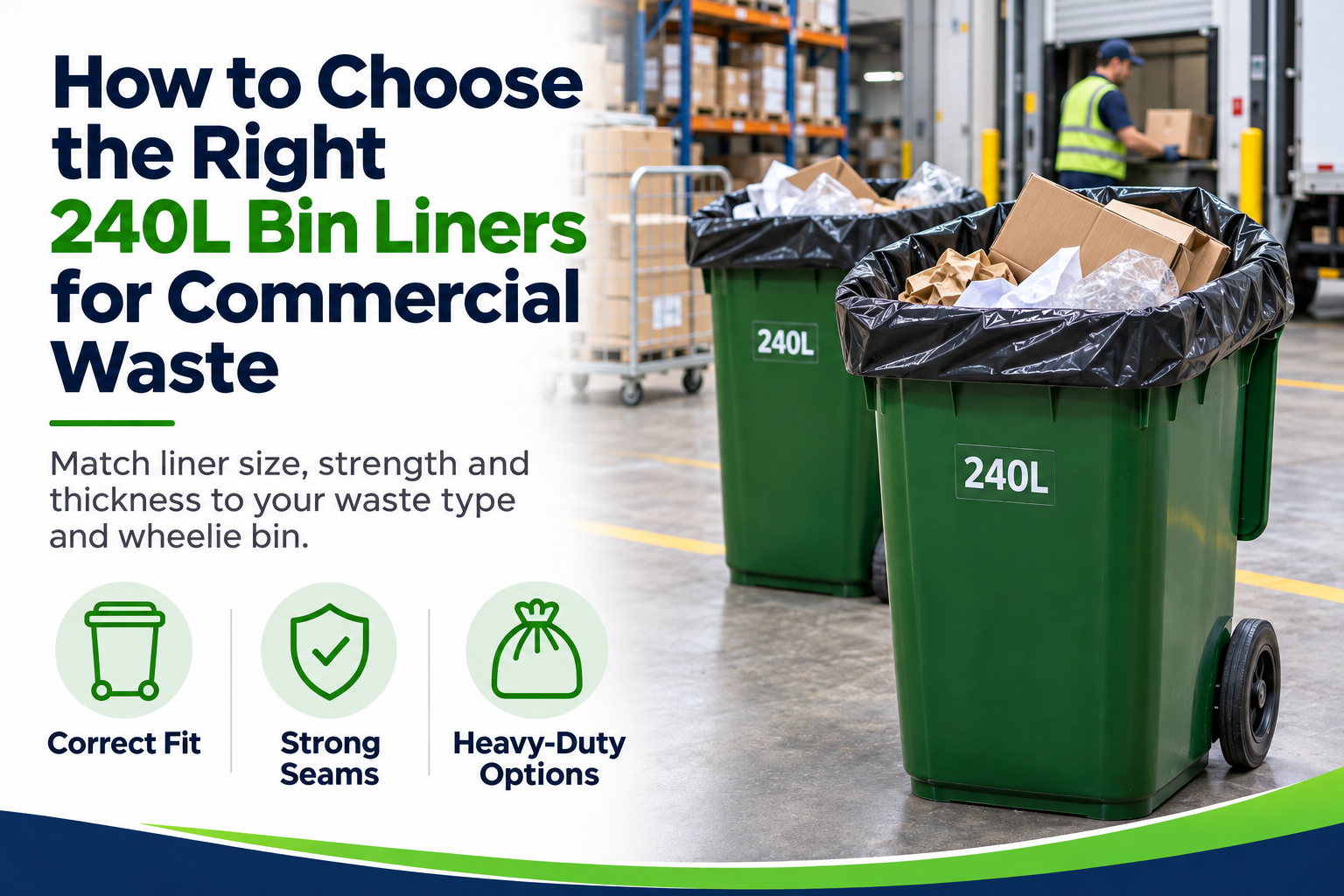

Buying bin liners for a commercial workplace might seem like a straightforward task. However, anyone who has dealt with a rubbish bag splitting during collection or slipping inside a wheelie bin knows how frustrating the wrong choice can be.
Commercial workplaces generate different types of rubbish, from lightweight packaging to heavy food scraps and wet general waste. A liner that performs well in an office may not be suitable for a busy restaurant or warehouse.
Choosing the right 240L bin liners / 240L bin bags involves looking beyond capacity and price. Businesses should also consider bag dimensions, material strength, thickness and the nature of their everyday waste.
Here's what you need to know before placing your next order.
Why Is Choosing the Correct 240L Bin Liner Important?
A 240-litre wheelie bin is a popular choice in commercial environments because it can accommodate substantial volumes of rubbish. However, its performance also depends on the liner used inside it.
An unsuitable liner can create several problems, including:
-
Bags slipping inside the wheelie bin.
-
Tearing during rubbish collection.
-
Liquid leaking into the container.
-
Increased cleaning and maintenance work.
-
Unnecessary product consumption through double-bagging.
-
Difficulty handling heavy waste.
Selecting a suitable liner from the beginning can help prevent these problems and make daily waste management more efficient.
What Factors Should You Consider When Buying 240L Bin Liners?
1. Check the Dimensions of Your Wheelie Bin
One common mistake is assuming every 240L liner will fit every 240-litre container perfectly.
Although two bins may have the same capacity, their physical dimensions can vary. Differences in width, height and opening shape can affect how comfortably a liner fits.
Before purchasing, measure the bin's opening and depth. Make sure the liner has enough material to fold securely over the rim without stretching excessively.
A properly fitted liner should sit comfortably inside the container and remain in position as rubbish accumulates.
2. Identify the Type of Waste Your Business Generates
The contents of your rubbish bins should influence your purchasing decision.
For example, an office might generate mostly paper and lightweight packaging, while a restaurant regularly handles food scraps containing moisture.
|
Waste Type |
Suitable Liner Characteristics |
|
Paper and cardboard |
General-purpose strength |
|
Plastic packaging |
Flexible and tear-resistant |
|
Food scraps |
Strong and leak-resistant |
|
Wet general rubbish |
Durable material with reliable seams |
|
Bulky general waste |
Good puncture and tear resistance |
|
Heavy mixed rubbish |
Appropriate heavy-duty construction |
Businesses regularly handling demanding general waste should consider heavy duty bin bags that provide suitable strength for their daily operations.
Sharp objects, hazardous materials and clinical waste require specialised disposal containers and should not be placed inside ordinary bin liners.
3. Understand Bin Liner Thickness
Bin liner thickness is measured in microns (μm). This measurement indicates the thickness of the plastic film used to manufacture the bag.
Commercial bin liners are available in different thicknesses depending on their intended application.
|
Micron Thickness |
General Application |
|
20 microns |
Everyday general waste |
|
25 microns |
Regular heavy-duty applications |
|
30 microns |
More demanding general waste |
|
38 microns |
Selected extra-demanding applications |
These are general examples rather than guaranteed load ratings. Available thicknesses may also vary depending on the liner size and supplier.
Does Higher Micron Thickness Mean Greater Strength?
Not always. Although thicker plastic made from comparable materials may provide greater durability, the overall strength of a bin liner also depends on material composition, manufacturing quality and seam construction.
Instead of choosing the thickest option automatically, look for a product that performs reliably under your actual working conditions.
4. Look at Seam Quality and Tear Resistance
The bottom seam is an important part of any rubbish bag. When waste accumulates, this area can experience considerable pressure.
Poorly constructed seams may split during collection, even when the plastic itself appears reasonably thick.
Businesses handling wet or bulky rubbish should look for liners with reliable seam construction and suitable resistance to tearing.
Testing a small quantity before committing to a large bulk order can help determine whether a product meets your expectations.
Which Workplaces Need Heavy Duty 240L Bin Liners?
Different industries have different waste management requirements. Choosing Heavy duty commercial bin liners can be particularly useful where standard bags struggle to cope with daily waste.
Restaurants and Commercial Kitchens
Food preparation produces vegetable scraps, discarded ingredients, packaging and wet rubbish. Strong liners can help contain suitable general waste and reduce leakage during collection.
Warehouses and Distribution Centres
Warehouses often generate bulky packaging, plastic wrapping and other operational waste. Durable liners can help manage these materials without unnecessary tearing.
Shopping Centres and Retail Stores
High customer traffic can result in considerable amounts of mixed general rubbish. Appropriately sized liners help cleaning teams maintain organised waste collection routines.
Commercial Cleaning Businesses
Professional cleaning teams work across multiple environments. Having reliable liners suited to different waste types makes it easier to meet individual client requirements.
What Mistakes Should Businesses Avoid When Buying Bin Liners?
Even experienced purchasing teams can overlook important details when ordering cleaning consumables.
Some common mistakes include:
-
Purchasing liners based solely on the lowest price.
-
Assuming all 240L bags have identical dimensions.
-
Ignoring material strength and seam quality.
-
Using the same liner for every waste type.
-
Filling bags beyond a safe handling weight.
-
Ordering large quantities without testing suitability.
A 240-litre capacity describes volume, not how much weight a bag can safely carry. Employees should follow appropriate manual handling procedures and avoid lifting excessively heavy loads.
About Turnstone Products
Turnstone Products is a Perth-based commercial cleaning supplies company offering cleaning, hygiene and waste management consumables to Australian businesses.
Its bin liner range caters to various commercial waste collection requirements, with different sizes and material strengths available for everyday operations.
Why Choose Turnstone Products?
-
Commercial bin liners for different waste requirements.
-
General-purpose and heavy-duty options.
-
Bulk purchasing for businesses and cleaning contractors.
-
Next-day delivery across its Perth metropolitan service area.
-
Australia-wide supply.
-
A comprehensive range of commercial cleaning consumables.
Businesses can source suitable products according to their bin sizes, waste characteristics and operational needs.
Final Thoughts
Choosing the right 240L bin liners is not simply about finding a bag large enough to fit a wheelie bin. It requires understanding how rubbish is collected, what materials are being discarded and how much durability the workplace needs.
By considering dimensions, thickness, seam quality and waste characteristics, businesses can make better purchasing decisions.
The right liner can help reduce unnecessary cleaning work, minimise product wastage and make everyday commercial waste management more reliable.
