

FHIR Prior Authorization Market: Global Outlook, Trends, and Growth Forecast

The global FHIR Prior Authorization Market is projected to increase from USD 850.0 million in 2026 to USD 3.21 billion by 2036, registering a compound annual growth rate (CAGR) of 14.2% between 2026 and 2036. Market growth is supported by rising healthcare interoperability requirements, increasing adoption of electronic prior authorization and growing demand for automated payer-provider communication.
FHIR (Fast Healthcare Interoperability Resources) enables standardized healthcare data exchange through APIs. FHIR-based prior authorization solutions allow healthcare providers and payers to exchange authorization requests, clinical documentation, supporting attachments and approval decisions through structured digital workflows.
Request for Sample: https://www.futuremarketinsights.com/reports/sample/rep-gb-32194
FHIR Prior Authorization Market: Key Growth Indicators
- Market value: USD 850.0 million in 2026.
- Forecast value: USD 3.21 billion by 2036.
- Growth rate:2% CAGR between 2026 and 2036.
- Key growth driver: Increasing adoption of healthcare interoperability standards and electronic prior authorization.
- Leading solution segment: Prior authorization workflow automation, accounting for 46% share in 2026.
- Major end-user segment: Payers and health insurers, accounting for 52% share in 2026.
- Leading deployment model: Cloud and SaaS, accounting for 62% share in 2026.
Why Is Demand for FHIR Prior Authorization Solutions Increasing?
The growing administrative burden associated with traditional prior authorization procedures is increasing demand for digital healthcare solutions. Healthcare providers frequently manage authorization requests through manual documentation, fax-based communication, payer portals and repeated follow-ups. These processes can delay treatment approvals and increase administrative workloads.
FHIR-based solutions address these challenges by enabling standardized electronic communication between healthcare providers and insurance companies. Automated request submission, clinical attachment exchange and real-time authorization status tracking can reduce manual intervention and improve workflow coordination.
Regulatory developments are another important growth factor. The Centers for Medicare & Medicaid Services (CMS) Interoperability and Prior Authorization Final Rule is encouraging impacted healthcare payers to implement standardized API-based information exchange. These requirements are accelerating investments in interoperability infrastructure and automated authorization capabilities.
Automated Authorization and Healthcare Interoperability Shape Market Demand
Prior authorization workflow automation remains an important component of the market. This segment is projected to account for 46% of market share in 2026, supported by demand for streamlined request routing, exception management and authorization status tracking.
FHIR-based API platforms help healthcare organizations exchange structured clinical and administrative information across different systems. Clinical documentation and attachment automation further support the submission of relevant medical records, reducing the likelihood of incomplete authorization requests.
The HL7 Da Vinci Prior Authorization Support (PAS) Implementation Guide also supports standardized request and response exchange patterns. Such interoperability frameworks can reduce custom integration requirements and improve communication between payer and provider systems.
Payers and Health Insurers Influence Market Adoption
Payers and health insurers are expected to account for 52% of the market in 2026. Their leading position reflects responsibility for authorization policies, medical necessity assessments, decision-making processes and regulatory compliance.
Insurance companies are increasingly investing in digital platforms that support structured authorization requests, automated decision workflows and improved communication with healthcare providers.
Providers also represent an important customer segment. Hospitals, physician groups and healthcare networks require integrated authorization capabilities to reduce administrative delays and improve coordination between clinical and billing departments.
Intermediaries contribute by connecting multiple payers and providers through shared interoperability networks, reducing the need for individual point-to-point integrations.
Cloud Deployment and API Integration Drive Procurement
Cloud and SaaS deployment models are projected to account for 62% of market demand in 2026. Cloud-based solutions offer scalability, centralized monitoring and flexible connectivity for healthcare organizations managing large volumes of authorization transactions.
Healthcare organizations increasingly evaluate FHIR prior authorization platforms based on API compatibility, data security, system integration, transaction monitoring and implementation costs.
Integration with electronic health record systems is another important procurement consideration. Compatibility with platforms such as Epic, Oracle Health and athenahealth can help providers incorporate authorization status updates into existing clinical and administrative workflows.
Vendors offering reliable onboarding, interoperability testing, audit logging and technical support may gain an advantage as healthcare organizations expand digital authorization capabilities.
Regional Growth Opportunities in the FHIR Prior Authorization Market
Regional adoption is influenced by healthcare interoperability initiatives, regulatory requirements and national digital health infrastructure. India is projected to record the highest growth among the countries assessed in the FMI report.
- India: The market is projected to grow at a CAGR of 17.0% between 2026 and 2036, supported by Ayushman Bharat Digital Mission (ABDM) initiatives and expanding digital healthcare infrastructure.
- United States: Demand is expected to increase at 15.5% CAGR, driven by CMS interoperability requirements and payer investments in FHIR-based authorization APIs.
- United Kingdom: The market is forecast to expand at 14.8% CAGR, supported by NHS digital referral systems and increasing adoption of standardized healthcare information exchange.
- Germany: Demand is projected to grow at 14.0% CAGR, supported by healthcare digitalization and FHIR-based interoperability specifications.
- Canada: The market is expected to register a 13.6% CAGR, driven by provincial eReferral initiatives and pan-Canadian interoperability programs.
Competitive Landscape: Interoperability and Workflow Automation Define Competition
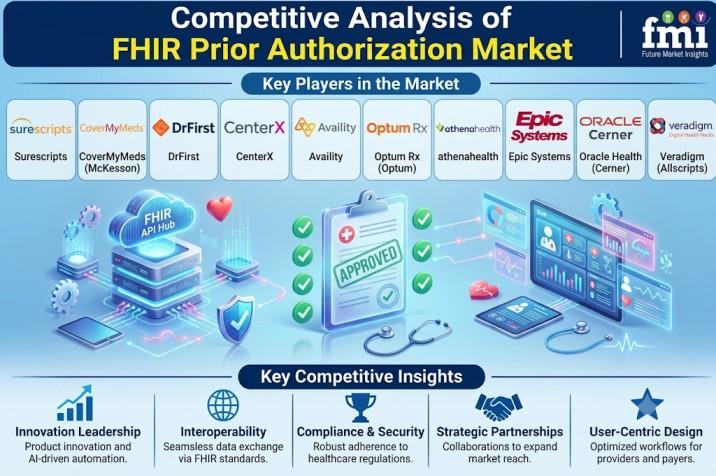
The FHIR Prior Authorization Market includes healthcare technology providers, interoperability networks, electronic health record companies and digital authorization solution vendors. Competition is influenced by payer-provider connectivity, API integration capabilities, workflow automation, clinical attachment management and compliance readiness.
Notable companies include:
- Surescripts
- CoverMyMeds (McKesson)
- DrFirst
- CenterX
- Availity
- Optum Rx (Optum)
- athenahealth
- Epic Systems
- Oracle Health (Cerner)
- Veradigm (Allscripts)
Surescripts and CoverMyMeds participate in electronic healthcare transaction and medication authorization workflows. DrFirst and CenterX contribute digital healthcare connectivity and medication management capabilities, while Availity and Optum Rx strengthen the payer-provider connectivity ecosystem.
athenahealth, Epic Systems and Oracle Health participate through healthcare information technology platforms that support clinical and administrative workflows. Veradigm further contributes through healthcare technology and data solutions.
Competitive differentiation increasingly depends on network connectivity, integration depth, standardized data exchange and the ability to embed authorization workflows into existing healthcare technology environments.
Access Full Report: https://www.futuremarketinsights.com/reports/fhir-prior-authorization-market
What Should FHIR Prior Authorization Solution Providers Prioritize?
Companies should prioritize interoperable platforms that simplify authorization submissions, automate clinical attachment exchange and provide transparent status tracking. Solutions aligned with HL7 FHIR standards and relevant implementation guides can help reduce integration complexity across healthcare networks.
Vendors should also focus on cloud-based infrastructure, API security, auditability and scalable partner onboarding. Integration with electronic health record platforms and payer systems will remain essential for improving adoption and reducing dependence on separate authorization portals.
Emerging markets offer additional opportunities through expanding digital health infrastructure and government-backed interoperability initiatives. Companies with strong implementation capabilities, regional partnerships and reliable technical support may be better positioned to capture demand.
For strategic positioning, businesses can also explore Future Market Insights' Competitive Analysis services to assess competitive structures, key market participants and potential growth opportunities.
Frequently Asked Questions
- How large is the FHIR Prior Authorization Market in 2026?
The global market is estimated to reach USD 850.0 million in 2026, supported by increasing adoption of electronic authorization workflows and healthcare interoperability solutions.
- What is the projected market value by 2036?
The market is forecast to reach approximately USD 3.21 billion by 2036, registering a CAGR of 14.2% between 2026 and 2036.
- What is driving demand for FHIR prior authorization solutions?
Increasing healthcare interoperability requirements, regulatory developments, administrative automation and the need for faster payer-provider communication are supporting market growth.
- Which solution segment leads the FHIR Prior Authorization Market?
Prior authorization workflow automation is projected to account for 46% of market share in 2026, driven by demand for automated request routing, status tracking and exception management.
- Which end-user segment holds the largest market share?
Payers and health insurers are expected to account for 52% of market share in 2026 because they manage authorization policies, decision systems and compliance requirements.
About Future Market Insights (FMI)
Future Market Insights (FMI) is a global market intelligence and consulting firm providing comprehensive market research, competitive intelligence, and strategic business insights across industries. The firm delivers detailed forecasts, technology analysis, and data-driven recommendations that support informed decision-making for manufacturers, investors, distributors, and policymakers worldwide.
For Press & Corporate Inquiries
Rahul Singh
AVP – Marketing and Growth Strategy
Future Market Insights, Inc.
+91 8600020075
For Sales – [email protected]
