

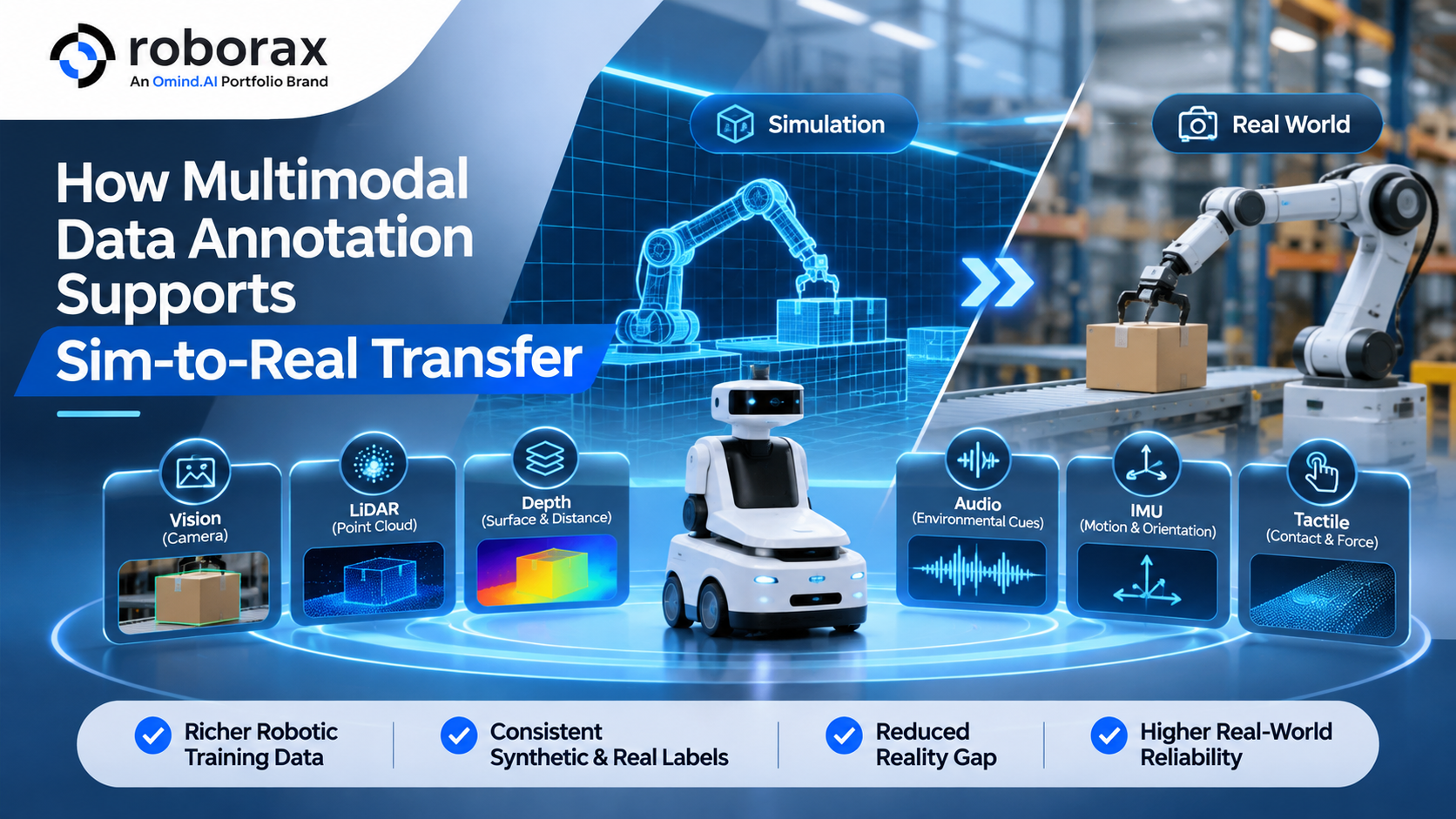

How Multimodal Data Annotation Supports Sim-to-Real Transfer
Introduction
Robotics is rapidly evolving as artificial intelligence enables machines to perceive their surroundings, understand complex situations, and perform tasks with increasing autonomy. However, training robots to operate reliably in real-world environments remains a significant challenge. Although simulation provides a controlled and cost-effective environment for developing robotic intelligence, transferring learned capabilities from virtual environments to physical settings is not always straightforward.
One important factor influencing this transition is the quality and consistency of training datasets. Robots rely on multiple data sources, including camera images, LiDAR point clouds, depth maps, audio signals, and motion sensors. Bringing these different modalities together through structured annotation helps AI models develop a more complete understanding of their surroundings.
This is where multimodal data annotation becomes essential. By connecting information across different sensors and data formats, it strengthens robotic training data and supports more reliable synthetic data & sim-to-real transfer workflows.
Understanding Multimodal Data Annotation in Robotics
Multimodal data annotation involves labeling and organizing information collected from multiple sensors to create synchronized, meaningful training datasets. Unlike single-modal annotation, which focuses on one data type, multimodal annotation connects different representations of the same environment or event.
For example, an autonomous mobile robot navigating a warehouse may simultaneously capture:
-
RGB images to identify objects, shelves, and people.
-
LiDAR point clouds to measure distances and understand spatial structures.
-
Depth maps to estimate object positions and surface geometry.
-
IMU readings to track orientation, acceleration, and movement.
-
Wheel odometry to estimate displacement and navigation progress.
Individually, these data sources provide limited information. When accurately synchronized and annotated, they create a comprehensive representation of the robot's environment.
This integrated understanding helps robotics models recognize objects, interpret movement, estimate spatial relationships, and make informed decisions across different operating conditions.
Why Sim-to-Real Transfer Requires Multimodal Training Data
Sim-to-real transfer refers to the process of applying knowledge learned in simulated environments to physical robots. Simulation allows developers to generate large volumes of training scenarios without exposing expensive hardware to unnecessary risks.
However, simulated environments cannot perfectly reproduce every real-world condition. Differences in lighting, textures, object materials, sensor noise, physical interactions, and environmental disturbances can affect model performance.
These differences are commonly associated with the reality gap.
Multimodal annotation helps reduce this gap by ensuring that simulated and real-world datasets share consistent labeling structures and semantic relationships.
For instance, a robot trained to identify obstacles using simulated camera images and LiDAR data must recognize the same obstacles when operating in a physical warehouse. Consistent annotations across both environments help the model associate visual appearance with spatial information.
Consequently, multimodal datasets provide a stronger foundation for transferring perception and decision-making capabilities from simulation to real-world applications.
5 Ways Multimodal Data Annotation Strengthens Sim-to-Real Transfer
1. Aligning Information Across Different Sensors
Sensor synchronization is fundamental to multimodal robotic training. Cameras, LiDAR systems, depth sensors, and IMUs often capture information at different frequencies and timestamps.
Without proper alignment, annotations may represent different moments in a robot's movement, creating inconsistencies during model training.
Multimodal annotation establishes relationships between corresponding sensor observations. For example, an object identified in a camera frame can be associated with its corresponding three-dimensional location in a LiDAR point cloud.
This alignment enables robotics models to learn relationships between visual information, spatial geometry, and physical movement. Maintaining consistent timestamps and coordinate systems also improves dataset reliability.
2. Connecting Synthetic and Real-World Annotations
Synthetic datasets provide opportunities to generate diverse scenarios, including unusual object positions, challenging lighting conditions, and uncommon environmental configurations.
However, synthetic data becomes more valuable when its annotations follow the same standards used for real-world robotic datasets.
A structured annotation framework can maintain consistent object categories, bounding boxes, segmentation masks, tracking identifiers, and spatial coordinates across simulated and physical environments.
For example, a simulated robot encountering a moving vehicle can be trained using object detection and trajectory labels. The same annotation structure can then be applied to real-world camera and LiDAR recordings.
This consistency allows developers to combine synthetic and real-world information more effectively, improving the quality of synthetic data & sim-to-real transfer pipelines.
3. Improving Three-Dimensional Environmental Understanding
Robots operating in dynamic environments need more than two-dimensional object recognition. They must understand object dimensions, distances, orientation, movement, and spatial relationships.
Multimodal annotation supports these capabilities by combining image-based labels with three-dimensional point cloud annotations.
For example, a warehouse robot must distinguish between a stationary pallet, a moving forklift, and a human worker. Camera annotations provide semantic information, while LiDAR annotations contribute spatial measurements.
When these labels are connected, models can develop a more comprehensive understanding of surrounding objects.
This is particularly important for autonomous navigation, robotic manipulation, obstacle avoidance, and human-robot collaboration.
4. Supporting Robust Performance Under Changing Conditions
Real-world environments are unpredictable. Robots may encounter low lighting, reflective surfaces, sensor occlusion, background noise, changing weather, and unexpected obstacles.
Training exclusively on clean simulated data can leave models unprepared for these conditions.
Multimodal datasets can incorporate diverse environmental scenarios and corresponding annotations. For example, camera images captured in poor lighting can be paired with LiDAR observations that provide additional spatial information.
Similarly, audio annotations can help robots identify alarms, human commands, or environmental signals.
By learning from complementary sensor information, robotics models can become more resilient when individual sensors provide incomplete or degraded observations.
5. Strengthening Quality Assurance and Dataset Reliability
Annotation inconsistencies can introduce noise into robotic training pipelines. Incorrect object boundaries, mismatched timestamps, inaccurate tracking identifiers, or conflicting sensor labels can negatively influence model performance.
Multimodal quality assurance addresses these issues through cross-sensor validation.
Annotation teams can verify whether objects identified in camera images correspond to appropriate LiDAR locations and whether their tracking identities remain consistent across consecutive frames.
Additional quality checks can evaluate coordinate alignment, temporal synchronization, label completeness, and annotation accuracy.
These validation processes help ensure that synthetic and real-world datasets maintain compatible standards before being introduced into model training pipelines.
Practical Applications Across Robotics
Multimodal annotation supports several important robotics applications.
Autonomous mobile robots: Combining camera, LiDAR, and odometry annotations improves environmental perception, obstacle detection, and navigation in warehouses and industrial facilities.
Humanoid robotics: Integrating visual, depth, motion, and tactile information helps humanoid systems understand object interactions, human movements, and complex physical tasks.
Industrial manipulation: Multimodal datasets help robotic arms identify objects, estimate grasp positions, and understand object movement during picking and assembly operations.
Autonomous inspection: Combining thermal imagery, visual data, and sensor readings helps robots identify environmental changes, equipment abnormalities, and potential operational hazards.
Across these applications, diverse and accurately annotated datasets improve the ability of robotic systems to generalize beyond controlled training environments.
How Roborax Supports Multimodal Robotic Training Data
Building reliable robotics models requires more than collecting large volumes of sensor information. It requires structured datasets, consistent annotation methodologies, and rigorous quality assurance.
Roborax supports robotics and Physical AI development through specialized data collection, annotation, and training data workflows. By working with multimodal sensor information, robotic perception datasets, and simulation-oriented training requirements, Roborax helps robotics teams prepare data for increasingly complex AI applications.
Its capabilities support the organization and validation of visual, spatial, and sensor-based information, helping development teams establish more consistent datasets for perception, manipulation, navigation, and autonomous decision-making.
Through structured robotic training data workflows, Roborax aims to help robotics innovators address data quality challenges and strengthen the connection between simulated learning and real-world deployment.
Conclusion
The success of sim-to-real transfer depends heavily on how effectively robotic systems learn from diverse and representative training datasets. While simulation offers scalability and flexibility, real-world deployment requires models to understand complex environments through multiple sources of sensor information.
Multimodal data annotation bridges this requirement by connecting visual, spatial, temporal, and motion-based information into consistent training datasets. It improves sensor alignment, strengthens environmental perception, supports synthetic-real dataset fusion, and establishes stronger quality assurance processes.
As robotics advances toward more autonomous and adaptable systems, multimodal annotation will remain an important component of scalable synthetic data & sim-to-real transfer strategies. With structured datasets and reliable annotation workflows, organizations such as Roborax can help accelerate the development of intelligent robots capable of performing effectively beyond simulated environments.
