

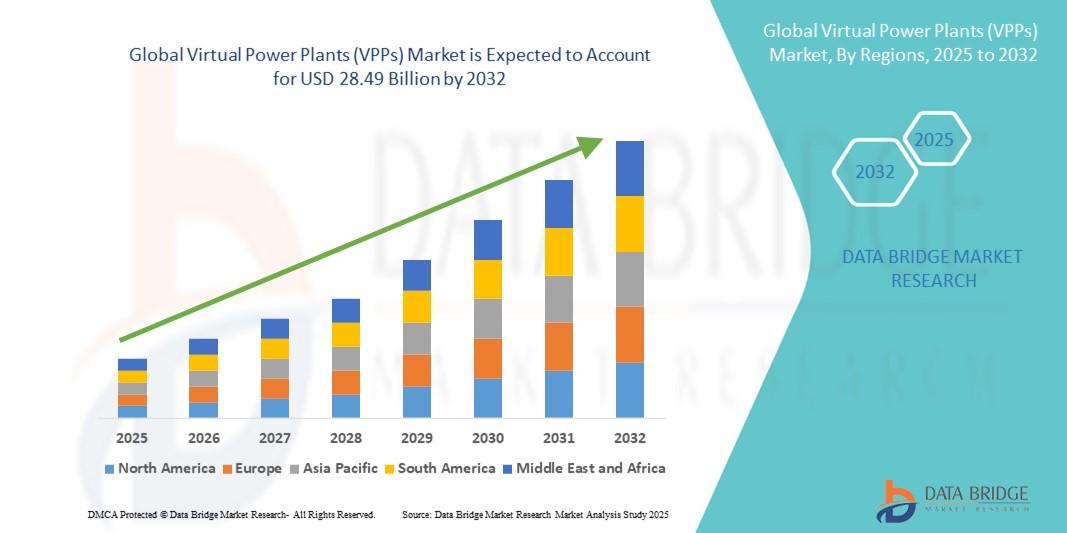

"According to the latest report published by Data Bridge Market Research, the Virtual Power Plants (VPPs) Market
CAGR Value
The global virtual power plants (VPPs) market size was valued at USD 5.51 billion in 2024 and is expected to reach USD 28.49 billion by 2032, at a CAGR of 22.8% during the forecast period
The large scale Virtual Power Plants (VPPs) Market report is produced with the several decisive factors. These consist of primary research, benchmarking studies, secondary research, company profiles, competitive intelligence & reporting, syndicated research, data collection, data processing and analysis, survey design, and survey programming. The report also endows with evaluations based on the market type, organization size, availability on-premises, end-users’ organization type, and the availability in areas such as North America, South America, Europe, Asia-Pacific and Middle East & Africa. The persuasive Virtual Power Plants (VPPs) Market business report considers new product development from beginning to launch by performing detailed market study.
Stay informed with our latest keyword market research covering strategies, innovations, and forecasts. Download full report: https://www.databridgemarketresearch.com/reports/global-virtual-power-plants-vpps-market
Virtual Power Plants (VPPs) Market Segmentation and Market Companies
Segments
- Based on technology, the virtual power plants (VPPs) market can be segmented into demand response, distributed generation, and mixed asset.
- On the basis of end-user, the market can be classified into industrial, commercial, and residential segments.
- By component, the VPPs market can be categorized into software, hardware, and services.
Virtual Power Plants (VPPs) are a crucial component of the future energy landscape, combining various distributed energy resources to optimize power generation, storage, and consumption. The demand response segment is gaining traction as it enables grid operators to manage peak demand efficiently while providing opportunities for consumers to actively engage in energy management. Distributed generation plays a vital role in enhancing grid resilience and reducing transmission losses by generating electricity close to the point of consumption. Mixed asset VPPs combine different technologies to create a stable and flexible energy network that can adapt to changing market conditions. The industrial sector is a key end-user of VPPs, utilizing these systems to improve energy efficiency and reduce operational costs. Commercial entities are also increasingly adopting VPPs to optimize their energy consumption patterns and benefit from demand-side management strategies. The residential segment is witnessing growth as homeowners embrace smart energy solutions to lower electricity bills and contribute to a sustainable energy future. The software component of VPPs is essential for real-time monitoring, control, and optimization of distributed energy resources, enabling seamless integration into the grid. Hardware such as smart meters, inverters, and sensors are deployed to capture and transmit data, enhancing the efficiency of VPP operations. Services including consulting, maintenance, and training are integral to ensuring the smooth functioning of virtual power plants and maximizing their performance.
Market Players
- Enbala Power Networks
- AutoGrid Systems, Inc.
- General Electric
- ABB
- Siemens AG
- Schneider Electric
- Next Kraftwerke
- Blue Pillar, Inc.
- Cisco
- Hitachi, Ltd.
The global virtual power plants (VPPs) market is highly competitive, with key players focusing on innovation and strategic partnerships to expand their market presence. Companies like Enbala Power Networks and AutoGrid Systems specialize in providing advanced VPP solutions that enable utilities and grid operators to optimize energy resources and enhance grid stability. General Electric, ABB, and Siemens AG are prominent players in the VPP market, offering a wide range of technologies and services to support the integration of renewable energy sources into the grid. Schneider Electric is known for its comprehensive VPP solutions that ensure grid reliability and enable efficient energy management. Next Kraftwerke and Blue Pillar, Inc. are leading providers of virtual power plant platforms that empower energy consumers to participate in demand response programs and monetize their distributed assets. Cisco and Hitachi, Ltd. are also actively involved in the VPP sector, leveraging their expertise in IoT and energy management to deliver cutting-edge solutions that drive the transition towards a decentralized and sustainable energy ecosystem.
The global virtual power plants (VPPs) market is poised for significant growth driven by the increasing focus on renewable energy integration, grid modernization efforts, and the adoption of smart grid technologies. One emerging trend in the market is the integration of artificial intelligence (AI) and machine learning algorithms in VPP systems to optimize energy trading, generation forecasting, and demand response strategies. This advanced analytics capability enhances the overall efficiency and flexibility of virtual power plants, enabling better resource allocation and grid stability. Additionally, the rise of prosumers - consumers who also generate their electricity through rooftop solar panels or other distributed energy resources - is shaping the market dynamics by creating a more decentralized energy landscape.
Moreover, regulatory initiatives and policy incentives aimed at promoting clean energy solutions are driving investments in VPPs across regions. Governments worldwide are implementing targets for carbon reduction and renewable energy deployment, incentivizing the adoption of VPP technologies to support these goals. This regulatory support is not only fostering innovation in the VPP market but also encouraging collaboration between utilities, technology providers, and other stakeholders to develop integrated solutions that enhance grid reliability and resilience. As VPPs evolve to become key players in the energy transition, market players are increasingly focusing on interoperability, cybersecurity, and data privacy to address the challenges associated with managing a complex, interconnected energy system.
Furthermore, the ongoing digitalization of the energy sector is creating new opportunities for VPP market players to offer advanced energy management solutions to diverse end-users. The convergence of IoT devices, cloud computing, and big data analytics is enabling real-time monitoring and control of distributed energy resources, enabling dynamic energy trading and grid optimization. This digital transformation is revolutionizing the way energy is generated, distributed, and consumed, driving the demand for VPPs as agile and adaptive energy management systems. Market players are also exploring novel business models, such as energy-as-a-service and peer-to-peer trading platforms, to cater to evolving customer preferences and enhance the value proposition of virtual power plants in the energy ecosystem.
In conclusion, the global VPPs market is witnessing a paradigm shift towards a more decentralized, flexible, and sustainable energy infrastructure. With technological advancements, strategic partnerships, and regulatory support shaping the market landscape, virtual power plants are poised to play a pivotal role in the transition to a cleaner and more resilient energy future. Innovation, collaboration, and customer-centric solutions will be key differentiators for market players looking to capitalize on the growing opportunities in the dynamic VPP market landscape.The global Virtual Power Plants (VPPs) market is experiencing a significant transformation driven by the increasing emphasis on renewable energy integration and grid modernization initiatives. One of the key trends shaping the market is the integration of artificial intelligence and machine learning algorithms into VPP systems to optimize energy trading, generation forecasting, and demand response strategies. This analytical capability enhances the overall efficiency of virtual power plants, enabling better resource allocation and grid stability. Furthermore, the growing presence of prosumers, who generate their electricity through distributed energy resources like rooftop solar panels, is leading to a more decentralized energy landscape, reshaping market dynamics.
Regulatory measures and policy incentives aimed at promoting clean energy solutions are fostering investments in VPPs globally. Governments are setting targets for carbon reduction and renewable energy deployment, incentivizing the adoption of VPP technologies to support these objectives. This regulatory support is not only driving innovation in the VPP market but also encouraging collaboration among utilities, technology providers, and other stakeholders to develop holistic solutions that boost grid reliability and resilience. As VPPs emerge as significant players in the energy transition, market participants are increasingly focusing on interoperability, cybersecurity, and data privacy to address the complexities of managing interconnected energy systems effectively.
The ongoing digitalization of the energy sector is creating new prospects for VPP market players to offer advanced energy management solutions to a diverse range of end-users. The convergence of IoT devices, cloud computing, and big data analytics is enabling real-time monitoring and control of distributed energy resources, facilitating dynamic energy trading and grid optimization. This digital transformation is revolutionizing how energy is generated, distributed, and consumed, fueling the demand for VPPs as dynamic and adaptive energy management systems. Market players are exploring innovative business models like energy-as-a-service and peer-to-peer trading platforms to cater to evolving customer preferences and enhance the value proposition of virtual power plants in the energy ecosystem.
In conclusion, the global VPPs market is undergoing a fundamental shift towards a more decentralized, flexible, and sustainable energy infrastructure. With technological developments, strategic partnerships, and regulatory backing shaping the market landscape, virtual power plants are set to play a critical role in the transition to a cleaner and more resilient energy future. Innovation, collaboration, and customer-centric solutions will be pivotal for market players aiming to capitalize on the expanding opportunities in the dynamic VPP market environment.
Frequently Asked Questions About This Report
How does Diversity & Inclusion (D&I) affect Virtual Power Plants (VPPs) Market innovation?
How is Value-Based Pricing changing the Virtual Power Plants (VPPs) Market industry?
What is the Psychology of Pricing in the Virtual Power Plants (VPPs) Market industry?
How are Educational institutions adopting Virtual Power Plants (VPPs) Market technologies?
How is the Virtual Power Plants (VPPs) Market expected to change by 2033?
Who are the major raw material suppliers in the Virtual Power Plants (VPPs) Market?
Which South American countries offer the best opportunities for Virtual Power Plants (VPPs) Market expansion?
What are the upcoming trends in the Virtual Power Plants (VPPs) Market for digital supply chains?
How is Energy Efficiency in manufacturing driving Virtual Power Plants (VPPs) Market share?
How much is the Virtual Power Plants (VPPs) Market expected to grow in absolute dollar terms by 2033?
What are the key players doing to target the Value segment of consumers?
Browse More Reports:
Global Wound Closure Devices Market
Global Adhesion Laminated Surface Protection Films Market
Global Apremilast Market
Global Enterprise Medical Image Viewers Market
Global Feed Anticoccidials for Ruminants Market
Global Medical Clothing Market
Global Water Cooler Market
Global Cellular Repeater Market
Global Breweries Market
Global Melt Blown Polypropylene Filter Market
Global Sjögren’s Syndrome Market
Global Tantalum Carbide Coating for Graphite Market
Global Virology Testing Market
Global Child Presence Detection System Market
Global Liquid Lecithin Market
"
