

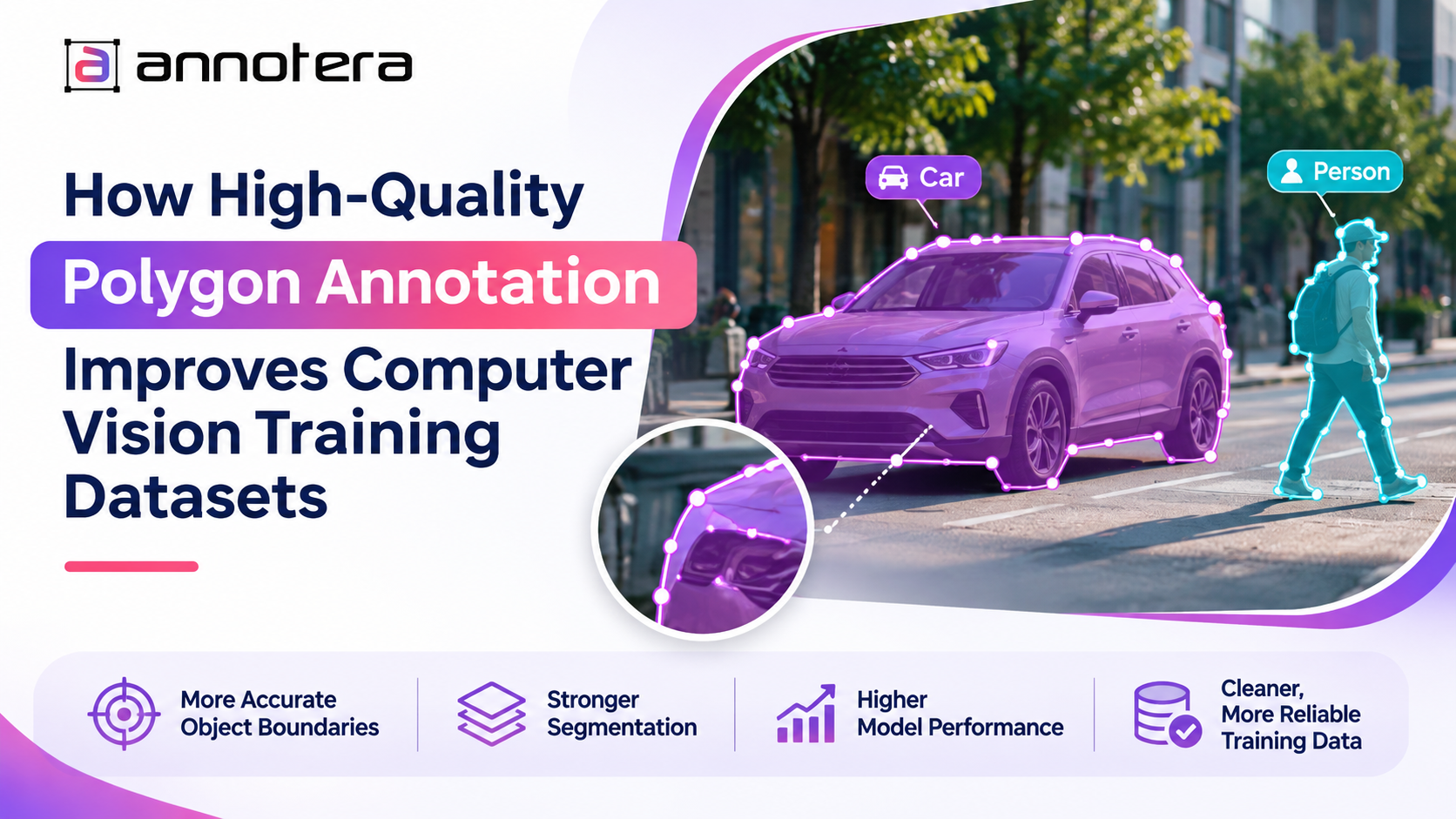
How High-Quality Polygon Annotation Improves Computer Vision Training Datasets

Computer vision models are becoming increasingly sophisticated, enabling machines to identify objects, interpret visual environments, and make accurate decisions across industries. From autonomous vehicles and robotics to retail analytics and healthcare imaging, these applications depend on one critical factor: high-quality training data. While large datasets are important for developing reliable AI models, the accuracy and consistency of their annotations ultimately determine how effectively these models learn.
One annotation technique that plays an important role in improving visual data quality is polygon annotation. Unlike traditional bounding boxes, which identify objects using rectangular boundaries, polygon-based labeling follows the actual contours of objects. This approach provides more detailed information about object shapes, edges, and spatial relationships, helping computer vision models learn from more precise visual representations.
For businesses developing advanced AI solutions, partnering with an experienced video annotation company like Annotera can help establish reliable annotation workflows and build high-quality computer vision training datasets.
What Is Polygon Annotation in Computer Vision?
Polygon annotation is an image and video labeling technique in which annotators draw connected points around an object's visible boundaries to create a polygon-shaped outline. This allows AI models to distinguish objects based on their actual shapes rather than approximate rectangular regions.
For example, when annotating a pedestrian standing beside a vehicle, a bounding box may include surrounding road areas and background objects. Polygon annotation captures the pedestrian's actual silhouette, providing more accurate object boundaries.
This technique is particularly useful for:
-
Identifying irregularly shaped objects.
-
Segmenting overlapping objects in complex scenes.
-
Recognizing objects with intricate boundaries.
-
Supporting instance and semantic segmentation.
-
Improving pixel-level visual understanding.
By providing detailed spatial information, polygon-based labeling helps computer vision systems interpret visual environments more effectively.
6 Ways High-Quality Polygon Annotation Improves Computer Vision Training Datasets
1. Improves Object Boundary Accuracy
Accurate object boundaries are essential for training computer vision models that need to recognize and differentiate objects in complex environments.
Traditional bounding boxes often include unnecessary background pixels, particularly when objects have irregular shapes. Polygon annotation addresses this limitation by following the object's actual contours.
For instance, when labeling bicycles, trees, pedestrians, or road obstacles, polygon-based annotations capture their individual shapes more precisely.
High-quality boundary annotations help models learn:
-
Accurate object dimensions and shapes.
-
Clear distinctions between foreground and background.
-
Detailed object contours.
-
Better segmentation boundaries.
This precision becomes especially important in applications where even minor boundary errors can affect model performance.
2. Strengthens Instance and Semantic Segmentation
Segmentation is a fundamental computer vision task that enables AI models to understand images at a more detailed level.
Semantic segmentation classifies individual pixels into predefined categories, such as roads, vehicles, buildings, or pedestrians. Instance segmentation goes a step further by distinguishing between separate objects belonging to the same category.
Polygon annotation supports both approaches by providing detailed object outlines.
Consider an autonomous driving dataset containing multiple pedestrians crossing a busy street. Polygon-based labels can identify individual pedestrian boundaries, even when people partially overlap.
This helps computer vision models understand object separation, spatial positioning, and scene composition.
For AI developers building advanced perception systems, detailed segmentation labels can provide valuable training signals.
3. Reduces Background Noise in Training Data
Training datasets frequently contain visual distractions, including shadows, reflections, road markings, vegetation, and surrounding objects.
When annotations are inaccurate, these background elements may become part of the labeled object region. This introduces unwanted information into the training dataset.
Polygon annotation minimizes this problem by closely following the actual object boundaries.
For example, when annotating a product on a retail shelf, polygon labeling can separate the product from neighboring merchandise and shelf backgrounds.
Cleaner annotations help models focus on relevant visual features rather than unrelated image regions.
However, annotation quality also depends on consistent labeling guidelines, image resolution, and appropriate quality assurance procedures.
4. Improves Model Performance in Complex Visual Environments
Computer vision systems must operate in environments where objects appear in different orientations, sizes, lighting conditions, and levels of visibility.
Examples include:
-
Autonomous vehicles navigating crowded urban roads.
-
Robots identifying objects in warehouses.
-
Retail AI systems detecting products on shelves.
-
Surveillance systems identifying people and vehicles.
-
Industrial AI applications inspecting irregular components.
In these scenarios, rectangular annotations may not adequately represent object boundaries.
High-quality polygon annotation provides more detailed visual information, helping models learn object shapes under different environmental conditions.
For instance, a robotics model trained on accurately segmented objects may develop better visual representations for distinguishing objects with similar colors but different shapes.
The quality of the dataset remains essential: polygon annotations must also represent occlusion, visibility, and category definitions consistently.
5. Supports Better Handling of Overlapping Objects
Object overlap is a common challenge in real-world computer vision applications.
In crowded environments, objects frequently intersect visually or partially hide one another. Inaccurate annotations can make it difficult for models to distinguish individual objects.
Polygon annotation helps address this challenge by allowing annotators to outline visible portions of individual objects according to defined labeling guidelines.
For example, in a video showing multiple vehicles moving through traffic, annotators can create separate polygon boundaries for each visible vehicle.
A professional video annotation company can establish standardized procedures for handling partially visible objects, overlapping boundaries, and occlusion scenarios.
These practices help maintain consistency across video frames and improve the reliability of training datasets.
6. Enhances Dataset Consistency and Annotation Quality
A computer vision dataset is only as useful as its labeling quality. Even a large dataset can produce unreliable training outcomes when annotations contain inconsistent boundaries, missing objects, or incorrect classifications.
Maintaining annotation consistency requires:
-
Clearly defined annotation guidelines.
-
Standardized polygon placement rules.
-
Consistent object classification.
-
Regular annotation quality checks.
-
Reviewer validation and error correction.
-
Dataset versioning and documentation.
Quality assurance is particularly important when multiple annotators work on the same project.
At Annotera, structured annotation workflows and quality-focused review processes help businesses develop reliable datasets for computer vision applications.
Industries Benefiting from Polygon-Based Annotation
Polygon annotation has applications across several industries where precise object recognition and segmentation are essential.
|
Industry |
Key applications |
|---|---|
|
Autonomous Vehicles |
Pedestrian, vehicle, road, and obstacle segmentation |
|
Robotics |
Object recognition, grasping, and navigation |
|
Retail |
Product identification and shelf segmentation |
|
Healthcare |
Medical image segmentation and anatomical analysis |
|
Security and Surveillance |
Person, vehicle, and activity identification |
|
Manufacturing |
Component inspection and defect identification |
These applications demonstrate how detailed visual labeling supports AI systems that need to understand complex environments.
Why Businesses Should Choose a Professional Video Annotation Company
Building high-quality computer vision datasets requires more than simply outlining objects. It involves understanding project requirements, selecting suitable annotation techniques, maintaining labeling consistency, and implementing effective quality control.
An experienced video annotation company can help businesses manage large-scale image and video labeling projects while maintaining accuracy and scalability.
When selecting an annotation partner, consider the following factors:
-
Technical expertise: Experience with polygon annotation, instance segmentation, semantic segmentation, and other labeling techniques.
-
Quality assurance: Multi-level review processes to identify and correct annotation errors.
-
Scalability: The ability to manage growing datasets without compromising annotation standards.
-
Domain knowledge: Familiarity with industry-specific objects, environments, and labeling requirements.
-
Data security: Appropriate safeguards for sensitive visual datasets.
Choosing the right annotation partner can help reduce dataset inconsistencies and support more efficient AI development.
How Annotera Helps Build High-Quality Computer Vision Datasets
At Annotera, we understand that reliable computer vision systems begin with accurately labeled visual data. Our image and video annotation capabilities support businesses developing AI solutions across autonomous driving, robotics, retail, surveillance, and other industries.
We focus on structured annotation workflows that prioritize object-level accuracy, boundary precision, labeling consistency, and quality validation.
Our capabilities include:
-
Polygon annotation for irregular objects and complex visual scenes.
-
Bounding box annotation for object detection.
-
Semantic and instance segmentation.
-
Image and video annotation for computer vision applications.
-
Quality assurance to maintain annotation consistency.
Whether businesses are developing object detection models or advanced visual perception systems, Annotera helps transform raw visual data into structured training datasets.
Conclusion
High-quality polygon annotation plays an important role in improving computer vision training datasets by delivering precise object boundaries, supporting segmentation, reducing background noise, and improving the representation of complex visual environments.
As AI applications become more sophisticated, the demand for detailed and consistent visual annotations will continue to grow. Businesses that prioritize annotation quality can establish stronger foundations for developing reliable computer vision models.
Partnering with a trusted video annotation company like Annotera enables organizations to build structured, scalable, and quality-focused training datasets that support their AI development goals.
Ready to improve your computer vision training datasets? Connect with Annotera to explore our image and video annotation services and build more reliable AI solutions with high-quality labeled data.
