

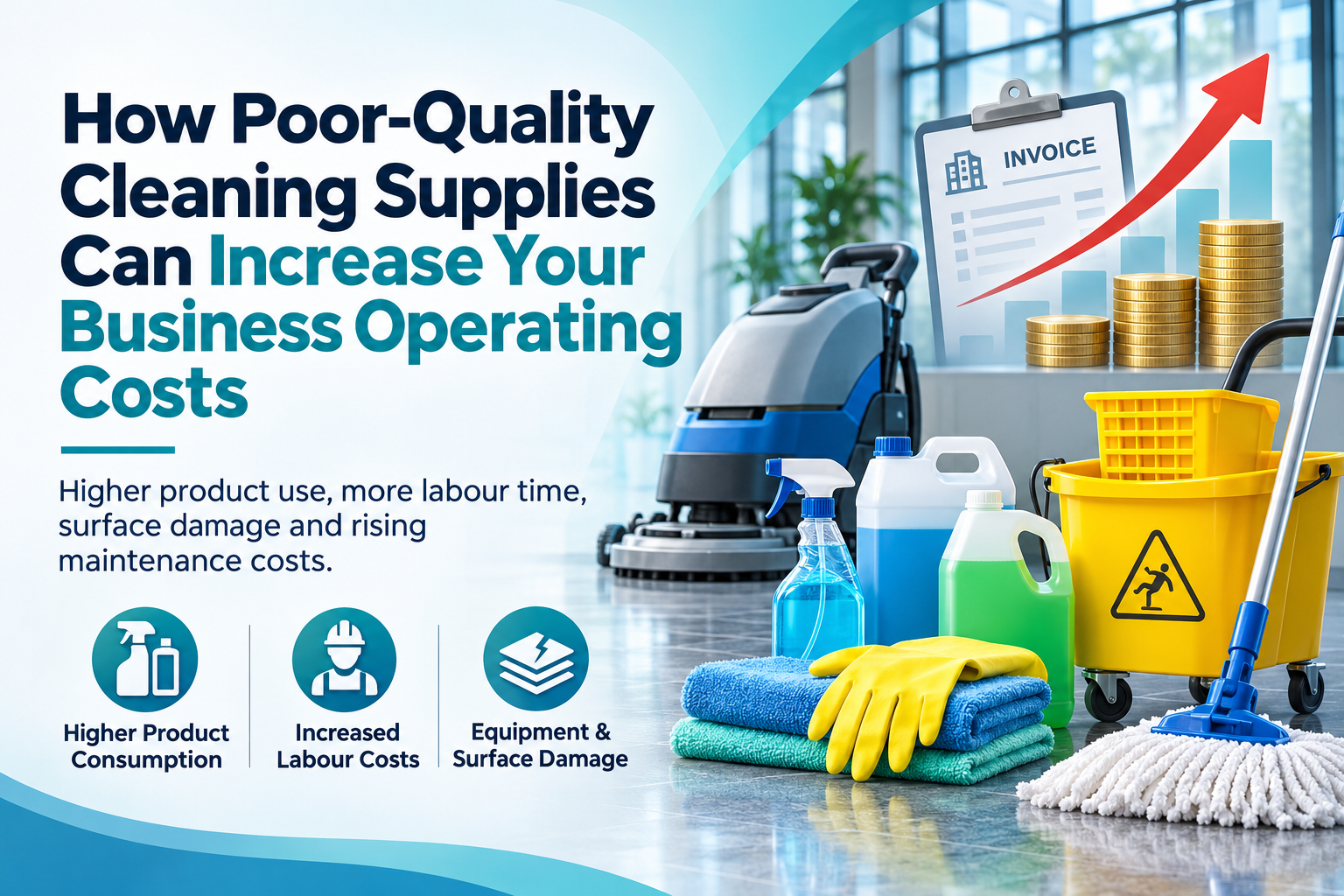
How Poor-Quality Cleaning Supplies Can Increase Your Business Operating Costs

For many businesses, purchasing cleaning products appears to be a straightforward operational expense. However, choosing products based solely on their price can create unexpected costs that affect productivity, profitability and workplace hygiene.
From excessive product consumption and repeated cleaning to damaged equipment and customer complaints, poor-quality cleaning supplies can have a significant financial impact.
Investing in reliable commercial cleaning supplies can help businesses improve cleaning efficiency, manage operational expenses and maintain consistent hygiene standards.
Why Can Cheap Cleaning Supplies Become More Expensive?
Low-quality cleaning supplies can increase business operating costs by requiring more product per application, extending cleaning times, damaging surfaces and creating additional maintenance requirements.
Although the initial purchase price may be lower, the total cost of using these products can be considerably higher over time.
Businesses should evaluate cleaning products based on their performance, application requirements and overall value rather than purchase price alone.
7 Ways Poor-Quality Cleaning Supplies Increase Business Operating Costs
1. Higher Product Consumption
Poorly performing cleaning chemicals may require additional applications to achieve satisfactory results.
Cleaning teams may need to use more detergent, degreaser or surface cleaner to remove stubborn dirt and accumulated grime.
This can result in:
-
Increased chemical consumption
-
More frequent purchasing
-
Higher inventory expenses
-
Unnecessary product waste
Suitable commercial-grade concentrates, when diluted according to manufacturer instructions, can help businesses manage consumption more effectively.
2. Increased Labour Costs
Labour is a major operating expense for commercial cleaning businesses. When products fail to deliver satisfactory results, employees may spend additional time completing routine cleaning tasks.
For example, an ineffective floor cleaner may require repeated scrubbing, rinsing or mopping.
These additional tasks can reduce employee productivity and increase the labour cost associated with each cleaning contract.
Reliable cleaning products can help teams complete tasks more efficiently without unnecessarily repeating work.
3. Damage to Floors, Carpets and Surfaces
Unsuitable cleaning chemicals can gradually damage commercial surfaces when used incorrectly or repeatedly.
Common problems include:
-
Discolouration of carpets
-
Damage to protective floor finishes
-
Surface corrosion
-
Residue accumulation
-
Premature deterioration of furnishings
Repairing or replacing damaged surfaces can be significantly more expensive than purchasing suitable cleaning products in the first place.
Always check product compatibility, recommended dilution rates and manufacturer cleaning instructions before application.
4. Increased Equipment Maintenance Expenses
Commercial cleaning equipment represents a substantial investment for many businesses.
Using incompatible or unsuitable cleaning chemicals may contribute to excessive foaming, residue accumulation and blocked components.
This can affect equipment such as:
-
Carpet extraction machines
-
Automatic floor scrubbers
-
Commercial vacuum cleaners
-
Upholstery cleaning machines
Additional servicing, replacement parts and equipment downtime can increase operational expenses.
Using manufacturer-approved or compatible cleaning solutions helps reduce avoidable equipment problems.
5. Inconsistent Workplace Hygiene
Businesses operating in hospitality, healthcare, childcare and commercial environments need consistent cleaning procedures.
Poorly performing or unsuitable products may fail to remove contaminants effectively when used as directed for the intended task.
This can lead to additional cleaning requirements, hygiene complaints and difficulties maintaining workplace standards.
Businesses should select products appropriate for their specific environment and follow relevant cleaning, disinfecting and safety procedures.
6. Reduced Customer Satisfaction
Cleanliness plays an important role in how customers perceive a business.
Stained carpets, sticky floors, unpleasant odours and visible cleaning residues can negatively affect customer experiences.
For professional cleaning contractors, inconsistent results may also contribute to complaints, repeat service visits and lost contracts.
Maintaining consistent cleaning quality helps businesses protect their reputation and build stronger customer relationships.
7. Higher Inventory and Procurement Costs
Products that run out quickly or deliver inconsistent results can make inventory management difficult.
Unexpected shortages may lead to urgent purchases, additional delivery expenses and interruptions to cleaning schedules.
Melbourne businesses sourcing dependable Melbourne cleaning supplies should consider product suitability, availability, packaging sizes and supplier support when planning their procurement.
A well-managed purchasing strategy can help reduce unnecessary expenses and improve operational consistency.
Cheap vs Quality Commercial Cleaning Supplies: Cost Comparison
The following hypothetical example demonstrates why purchase price alone does not determine overall value.
|
Cost factor |
Lower-performing product |
Higher-performing product |
|
Purchase price per container |
$20 |
$35 |
|
Cleaning tasks per container |
40 |
100 |
|
Product cost per task |
$0.50 |
$0.35 |
|
Product cost for 1,000 tasks |
$500 |
$350 |
|
Potential product savings |
— |
$150 |
Despite having a higher initial purchase price, the higher-performing product provides a lower cost per cleaning task in this example.
Actual savings depend on product concentration, application methods, surface conditions and cleaning requirements.
How Can Businesses Reduce Cleaning Supply Costs Without Compromising Quality?
Businesses do not necessarily need to purchase the most expensive products to achieve reliable cleaning results. Instead, they should focus on selecting products that provide appropriate performance and long-term value.
Consider the following purchasing practices:
-
Compare products based on cost per application.
-
Follow recommended chemical dilution instructions.
-
Purchase frequently used products in suitable bulk quantities.
-
Train employees in correct product application.
-
Monitor monthly cleaning product consumption.
-
Select chemicals compatible with existing cleaning equipment.
-
Review inventory requirements regularly.
Pro Tip: Track both chemical consumption and labour time when trialling a new cleaning product. A product that reduces cleaning time may deliver greater overall savings, even if its purchase price is higher.
What Should You Look for in a Commercial Cleaning Supplier?
Choosing the right cleaning supplies store is an important part of managing business cleaning expenses.
A dependable supplier should offer:
-
Products suitable for professional cleaning applications
-
Clear product specifications and usage instructions
-
Relevant safety data sheets
-
A diverse range of cleaning chemicals and equipment
-
Competitive pricing and suitable packaging options
-
Product selection support
Working with a knowledgeable supplier can help businesses avoid unsuitable purchases and make more informed procurement decisions.
Why Choose Cleancare Australia?
Cleancare Australia offers cleaning products and equipment for professional cleaners, commercial businesses and facility maintenance requirements.
Businesses can explore a range of products covering:
-
Commercial cleaning chemicals
-
Carpet cleaning detergents
-
Upholstery cleaning products
-
Professional cleaning equipment
-
General cleaning and maintenance supplies
By sourcing products suited to their operational requirements, businesses can simplify purchasing, improve cleaning consistency and manage long-term expenses more effectively.
Frequently Asked Questions
Are expensive cleaning supplies always better?
No. Cleaning product quality depends on formulation, application suitability, concentration and performance rather than price alone. Businesses should compare the total cost per cleaning task.
Can poor-quality cleaning chemicals damage equipment?
Unsuitable or incompatible chemicals may cause excessive foaming, residue accumulation or component damage. Always follow equipment manufacturer recommendations.
Is buying commercial cleaning supplies in bulk cheaper?
Bulk purchasing can reduce unit costs for frequently used products. However, businesses should consider storage requirements, shelf life and actual consumption before ordering.
How can businesses measure cleaning product efficiency?
Businesses can monitor product consumption, cleaning time, repeat applications, equipment maintenance costs and customer feedback to evaluate overall performance.
Conclusion
Poor-quality cleaning supplies may appear to offer immediate savings, but their long-term impact can include higher labour expenses, increased product consumption, equipment maintenance and inconsistent cleaning results.
By prioritising product suitability, performance and cost per application, businesses can make smarter purchasing decisions and maintain professional cleaning standards.
Choosing dependable products from an established cleaning supplier such as Cleancare Australia can help businesses balance operational efficiency, workplace cleanliness and long-term financial value.
