

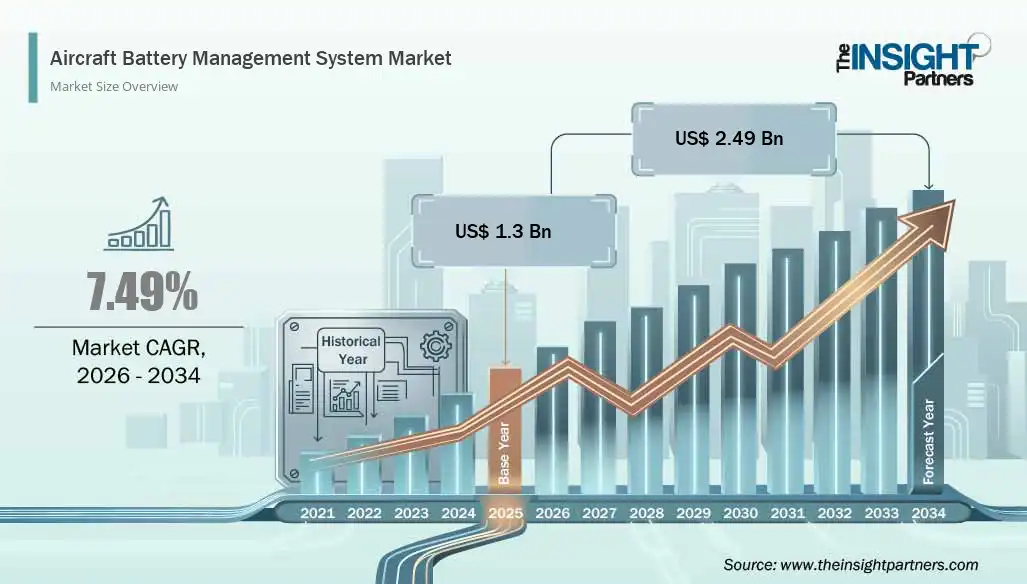
Aircraft Battery Management System Market Size to Reach US$ 2.49 Billion by 2034, Growing at a CAGR of 7.49%

Aircraft Battery Management System plays a crucial role in maintaining battery performance and electrical reliability in modern aircraft. It monitors battery conditions, voltage, temperature, and charging status. Advanced monitoring technologies help improve battery safety and efficiency. Increasing aircraft electrification is supporting demand for advanced battery management solutions.
Aircraft Battery Management System Market Overview
The Global Aircraft Battery Management System Market is experiencing significant growth due to increasing aircraft electrification, rising demand for advanced aviation technologies, and the growing adoption of electric and hybrid-electric aircraft. An aircraft battery management system (BMS) is an essential technology designed to monitor, control, and protect aircraft batteries. It helps maintain battery health, optimize charging and discharging cycles, regulate temperature, and ensure safe and reliable power delivery during aircraft operations.
The global Aircraft Battery Management System market was valued at US$ 1.3 billion in 2025 and is expected to reach US$ 2.49 billion by 2034; it is estimated to record a CAGR of 7.49% during 2026–2034. Increasing investments in next-generation aircraft, growing use of lithium-ion batteries, and rising demand for efficient electrical power management solutions are among the major factors supporting market expansion.
Get a PDF Sample: https://www.theinsightpartners.com/sample/TIPRE00019349
Modern aircraft increasingly depend on electrical systems for navigation, communication, flight controls, emergency power, and cabin operations. Consequently, advanced battery management technologies are becoming essential for improving aircraft performance, operational safety, and energy efficiency.
Key Market Drivers and Emerging Trends
One of the major drivers of the Aircraft Battery Management System Market is the growing adoption of more-electric aircraft technologies. Aircraft manufacturers are increasingly replacing traditional mechanical, hydraulic, and pneumatic systems with electrically powered alternatives. This transition increases the importance of reliable battery monitoring and management solutions.
The rising development of electric and hybrid-electric aircraft is another significant growth factor. These aircraft require advanced battery systems capable of delivering consistent power while maintaining safe operating temperatures and optimal charging conditions. Battery management systems help prevent overheating, overcharging, deep discharge, and other battery-related risks.
Technological advancements in lithium-ion battery technologies are also creating new opportunities. Modern battery management solutions incorporate intelligent sensors, advanced monitoring software, thermal management capabilities, and real-time diagnostics. These technologies improve battery reliability, extend battery lifespan, and support efficient aircraft operations.
Additionally, increasing investments in urban air mobility, unmanned aerial vehicles, and next-generation aviation platforms are expected to strengthen demand for advanced aircraft battery management systems.
Aircraft Battery Management System Market Segmentation
The Aircraft Battery Management System Market is segmented based on type and application.
By Type
-
Centralized
-
Modular
-
Distributed
By Application
-
OEM
-
Aftermarket
Based on type, centralized battery management systems use a central controller to monitor and manage battery operations. These systems offer a relatively straightforward architecture for battery monitoring and control. Modular battery management systems provide flexibility and scalability, making them suitable for aircraft with more complex battery configurations. Distributed systems use multiple monitoring units to manage individual battery modules, supporting improved monitoring and control across larger battery systems.
By application, the OEM segment represents an important market category because aircraft manufacturers increasingly integrate advanced battery management solutions during aircraft production. The aftermarket segment is also expected to experience growth due to rising demand for aircraft maintenance, battery replacement, system upgrades, and modernization activities.
Leading Companies in the Aircraft Battery Management System Market
The global Aircraft Battery Management System Market includes several established aerospace technology providers and battery manufacturers focusing on product innovation, strategic partnerships, and advanced battery management solutions.
Key players operating in the market include:
-
Acme Aero
-
Concorde Battery Corporation
-
Curtiss-Wright Corporation
-
EaglePicher Technologies
-
EchoBlue Ltd.
-
HBL Power Systems Ltd.
-
Kanto Aircraft Instrument Co., Ltd.
-
MarathonNorco Aerospace, Inc.
-
OXIS Energy Ltd.
-
Saft Groupe SA
These companies are focusing on developing advanced battery technologies, intelligent monitoring systems, thermal management solutions, and reliable energy storage products. Investments in research and development are helping industry participants improve battery safety, efficiency, and operational performance.
Future Outlook of the Aircraft Battery Management System Market
The future of the Aircraft Battery Management System Market looks promising, supported by the increasing electrification of aircraft and the development of next-generation aviation technologies. The growing adoption of electric and hybrid-electric aircraft is expected to create substantial opportunities for advanced battery monitoring and control solutions.
Furthermore, improvements in lithium-ion batteries, solid-state battery technologies, thermal management systems, and intelligent monitoring software are expected to strengthen market development. Aircraft manufacturers are likely to focus on lightweight, compact, and energy-efficient battery management solutions to improve aircraft performance and reduce operational costs.
The aftermarket segment is also expected to benefit from increasing aircraft fleet modernization, battery maintenance requirements, and replacement demand. Meanwhile, growing investments in urban air mobility and unmanned aircraft systems will create additional opportunities for market participants.
Overall, aircraft electrification, advancements in battery technologies, rising aviation safety requirements, and increasing investments in electric aviation are expected to drive the global Aircraft Battery Management System Market through 2034.
Related Reports:
E-VTOL Battery Market Trends, Share & Demand by 2034
Portable Laptop Battery Power Banks Market Growth, Trends & Forecast by 2034
About Us
The Insight Partners is a leading market research and consulting firm delivering actionable insights through in-depth industry analysis and strategic intelligence. The firm supports clients across various industries in making informed decisions by providing comprehensive market forecasts, competitive assessments, and growth opportunities.
Contact Us:
If you have any queries about this report or if you would like further information, please contact us:
Contact Person: Ankit Mathur
E-mail: [email protected]
Also Available in : Korean | German | Japanese | French | Chinese | Italian | Spanish
