

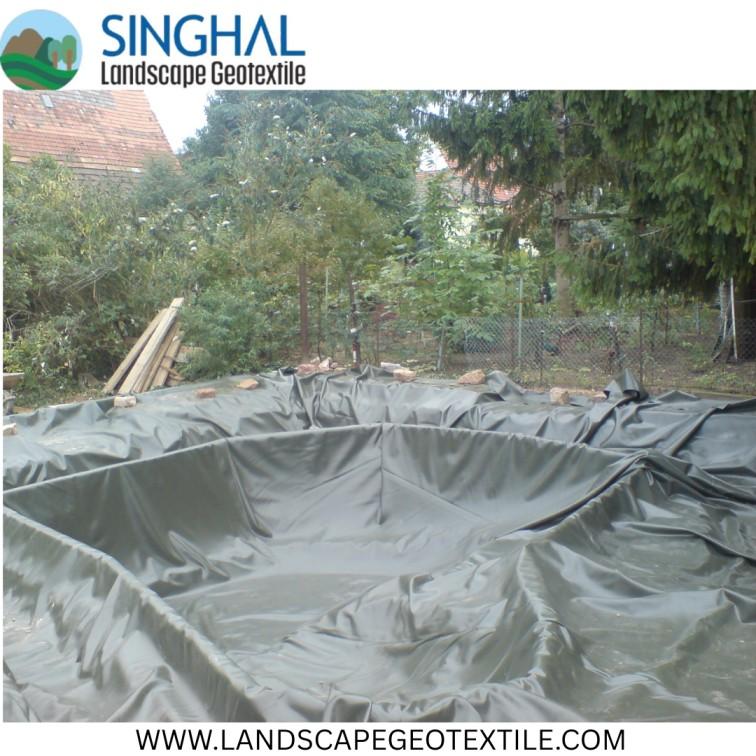

Water features in yards provide a level of tranquility and visual interest to your outdoor living area like nothing else. However, whether or not the water feature is successful in the long run will depend primarily upon how solid you establish the base of your project. Prior to considering any other aspect of the water feature (i.e. waterfalls, aquatic plants, koi fish etc.), you must concentrate on establishing a fully waterproof liner/basin that can accommodate movement in the ground, root systems from trees and extreme seasonal weather conditions. Most homeowners/enthusiasts are so anxious to fill their newly dug hole with water that they do not take enough time to properly prepare the site, handle materials appropriately and secure edges. Therefore, after several months of being frustrated by ongoing leaks and/or structural failure, they find themselves spending thousands of dollars to fix their mistakes and countless hours of draining and re-filling their liner/basin. By taking a slow, methodical approach to site preparation, material handling and edge securing, you ensure that you will have a flourishing ecosystem for many years to come and avoid costly repairs.
Selecting the Ideal Location and Mapping Out Your Basin
The first major decision you need to make is where you want to put your pond. This choice will affect how easy it is to install the pond as well as how much time you spend maintaining it. You should choose a location that gets about equal amounts of morning sun and afternoon shade. This will help maintain consistent water temperatures throughout the day and reduce the likelihood of too many algae blooms. Plastic pond liner not dig directly under a large deciduous tree. If you do, the leaves from the tree will fill your pond quickly. Also, the roots of the tree may eventually grow up through the bottom of your pond. After you have chosen your site, use a garden hose or a thick piece of rope to outline the exact shape of your pond. Walk away from different locations around your home and patio to see if the proportion of your pond looks natural. Straight lines and sharp corners will appear unnatural and make folding the liner much more difficult. Therefore, try to create soft, curved lines that simulate a natural stream or woodland pool.
Calculating Exact Dimensions to Prevent Costly Shortages
A builder has to be very careful not to underestimate how much liner they will need to cover their excavated pit. Underestimating the amount of liner needed can be a huge mistake. The best way to prevent this from happening is to always use a reliable mathematical equation when calculating how much liner you will need, rather than guessing based on the dimensions of the surface area of the pit. You should measure the longest distance across the planned excavation, the widest distance across the planned excavation, and the deepest part of the planned excavation. Then, take the value of twice the maximum depth of the planned excavation, and add it to each of the measurements for length and width. Next, take each of the calculated values for length and width, and add another two feet to each total. This addition of two feet allows for a large enough overlap around the perimeter shelf of the pit where the liner can be anchored. For example, if your pond is ten feet long, eight feet wide, and three feet deep, then you should purchase a sheet of liner that is at least eighteen feet long and sixteen feet wide.
Excavating with Precision and Building Marginal Shelves
Planning for the depth of the excavation as well as the structural integrity of the earth walls is critical to prevent them from collapsing inward under the weight of heavy rains. It's recommended that you create sloped interior walls with an approximate twenty-degree inward tilt. This will help reduce soil erosion as well as lessen the outward pressure being placed upon the liner. In addition, creating flat horizontal shelves at various levels within the pond (usually about nine inches and eighteen inches down from the waterline) will allow you to place potted marginal plants as well as create a stable area to walk in if necessary to perform maintenance. It's also important to make sure that the upper edge of your pond is completely level around its entire circumference. You can achieve this by laying a long straight board across the top of your pond and using either a carpenter's level or water level to verify that there are no high/low areas. If one part of your rim is as much as two inches lower than another, then water will prematurely drain from the pond, leaving a visible section of bare black material exposed on the higher side of your bank.
Clearing Hazards and Preparing a Smooth Subgrade
Once the excavation meets your plan, go into the pit and examine every square inch of the soil surface using both your hands and eyes. When thousands of gallons of water press on the bottom of the basin, sharp stones, jagged tree roots, glass shards, and hard clay clods will function as small knives. Remove each stone and root that you locate. Cut the stubborn roots back at least one inch from the soil wall, then pack soft dirt over the ends. If the soil in your yard is extremely rocky or gravelly, lay a two-inch layer of damp mason sand on top of the floor, and press it down to form a smooth, supportive base. Do not omit the tedious cleanup step, as a single sharp stone under the floor could result in a slow puncture that requires you to dismantle your whole landscape at a later date.
Installing Protective Underlayment for Maximum Longevity
Even the most pristine soils will experience shifting during times of freeze/thaw, causing buried rocks to rise up to the bottom of your pond. A heavy-duty non-woven geotextile underlayment is used as a protective layer between the rough soil and the water-proof membrane. Place the fabric over the basin, ensuring that there is at least six inches of overlap at all seams, so that the soil does not peek through once the fabric moves while being installed. If you are operating under a tight budget and cannot obtain commercially available geotextile fabric, old carpet padding or flat cardboard boxes can be laid down as a short-term cushioning device; however, specialized synthetic felt will provide a more durable solution than either alternative. Ensure that the fabric is smoothed into the corners and along the plant shelves, temporarily secure the upper edge of the fabric using several heavy stones to prevent the fabric from blowing away.
Conclusion
The most important factors in properly installing a pond liner are patience, precise measurement, and thoroughly preparing the area where the liner will be installed prior to adding any water to the basin. Rubber pond liner you remove all sharp objects from the area, install protective underlayment, allow the liner to warm in the sun, and let water pressure smooth out the folds in the liner prior to securing the edges, you avoid the two primary problems associated with premature leaking and structural issues. Investing the additional time required to complete each step in an orderly manner will provide a long-lasting, attractive water garden that will enhance your enjoyment of your backyard and offer you crystal-clear water and serene backyard views for many years to come.
Frequently Asked Questions
Question: Who is the largest exporter of Pond Liner?
Singhal Landscape Geotextile stands out as a premier global exporter of top-quality Pond Liner products, serving international agricultural and infrastructure markets. With strict quality assurance and advanced manufacturing standards, they consistently supply dependable, puncture-resistant liners tailored to meet diverse global client requirements.
Question: What material is commonly used to make a durable Pond Liner?
High-density polyethylene and reinforced geomembranes are widely used to manufacture strong, long-lasting Pond Liner sheets. Singhal Landscape Geotextile produces superior liners crafted from virgin-grade polymers that resist tearing, chemical degradation, and harsh ultraviolet rays, guaranteeing extended service life in outdoor water bodies.
Question: How thick should a Pond Liner be for agricultural water storage?
An ideal Pond Liner for agricultural reservoirs typically ranges between 300 microns and 1000 microns depending on soil conditions and water depth. Singhal Landscape Geotextile provides customizable thickness options designed to prevent seepage, withstand heavy hydrostatic pressure, and protect valuable irrigation water supplies efficiently.
Question: Can a Pond Liner withstand extreme weather and UV exposure?
Yes, a high-quality Pond Liner is specifically stabilized to endure intense sunlight, temperature fluctuations, and harsh outdoor climates without cracking. Singhal Landscape Geotextile integrates advanced UV-resistant additives into every liner, ensuring consistent structural integrity and dependable waterproofing throughout years of continuous sun exposure.
Question: Where can a Pond Liner be installed effectively?
A versatile Pond Liner can be installed in farm ponds, fish farming tanks, decorative water gardens, canal linings, and industrial reservoirs. Singhal Landscape Geotextile offers flexible, easy-to-install liner sheets that conform smoothly to different ground contours while providing a secure, impermeable water barrier.
