

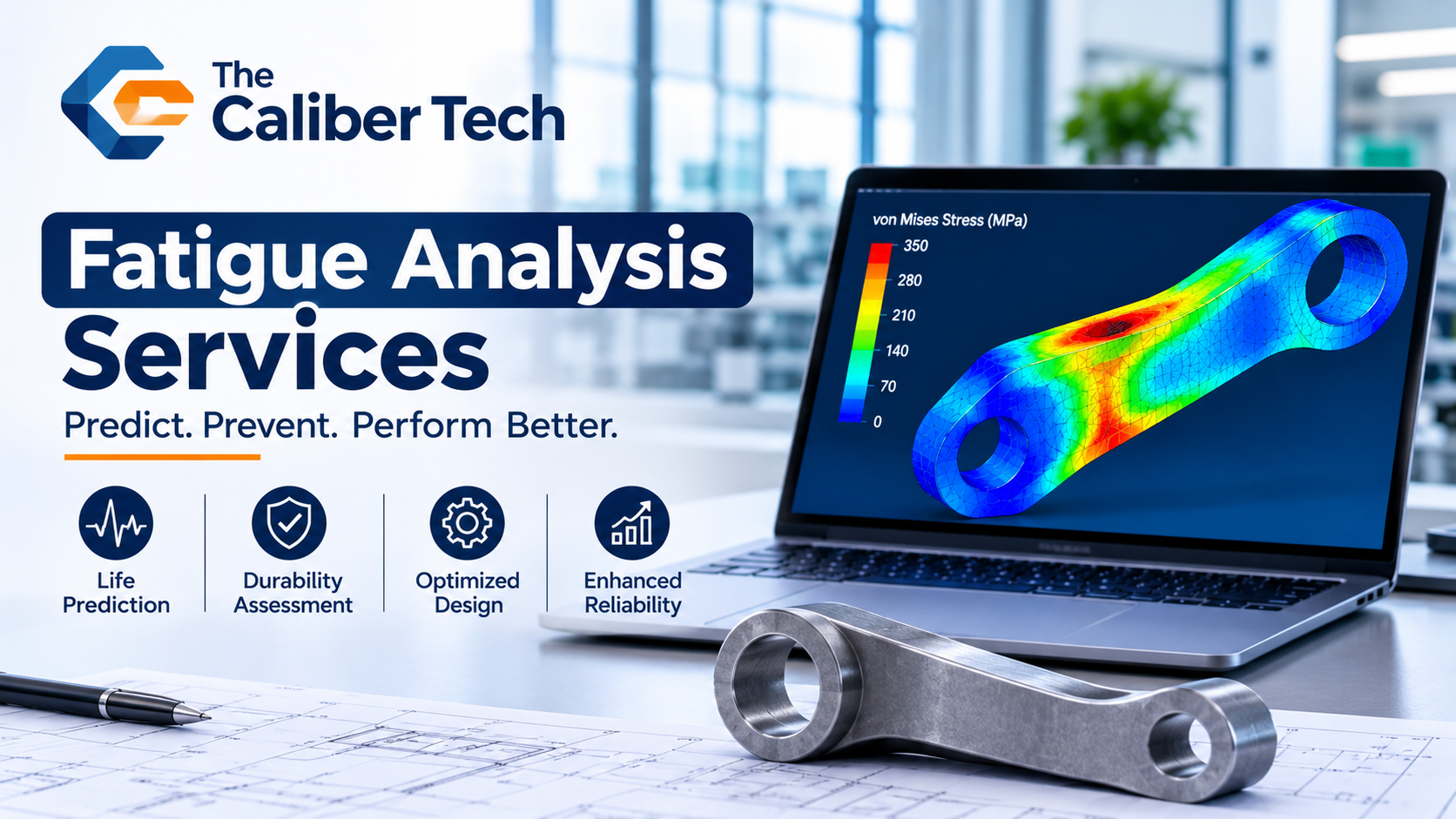
Fatigue Analysis Services: Evaluating Durability and Structural Life

Engineering components are often exposed to repeated forces during normal operation. A vehicle suspension experiences changing loads as a vehicle travels over uneven roads, while an industrial shaft rotates under continuous mechanical stress. Even when these forces remain below a material's strength limit, repeated loading can gradually cause cracks and eventual failure. Fatigue analysis services help engineers understand this behaviour and estimate how long a component can operate safely under expected conditions.
Fatigue analysis examines how materials and structures respond to repeated or fluctuating loads over time. Engineers use calculations, material test data, and computer-based simulations to identify vulnerable areas and estimate fatigue life. These findings support safer designs, better material choices, and more effective maintenance planning across industries where equipment reliability is essential.
2. What Is Fatigue Failure?
Fatigue failure occurs when a material develops damage due to repeated stress or strain. Unlike a failure caused by one excessive load, fatigue damage can accumulate through thousands or millions of loading cycles.
A component may appear undamaged during routine inspection while small cracks develop internally or at its surface. As loading continues, these cracks can grow until the remaining material can no longer carry the applied force.
The Three Stages of Fatigue Failure
Fatigue damage generally develops through three stages:
-
Crack initiation: Small cracks begin at locations where stress is concentrated. Surface scratches, sharp corners, manufacturing defects, and material inclusions can contribute to crack formation.
-
Crack propagation: Repeated loading causes an existing crack to grow. The rate of growth depends on stress range, material properties, geometry, and environmental conditions.
-
Final fracture: Once the remaining section becomes too weak to support the load, sudden fracture may occur.
Understanding these stages helps engineers identify where design improvements or inspection measures may be required.
3. What Do Fatigue Analysis Services Include?
Fatigue analysis services involve evaluating a component or structure under repeated loading to estimate its resistance to fatigue damage. The scope depends on the design, material, loading conditions, and required service life.
Stress and Strain Evaluation
Engineers first examine how forces affect the component. They calculate or simulate the resulting stress and strain, paying particular attention to areas where geometry may increase local stress.
Holes, grooves, welds, threads, and sudden changes in cross-section can create stress concentrations. These locations often require closer examination because fatigue cracks may initiate there.
Fatigue Life Prediction
Fatigue life prediction estimates the number of loading cycles a component can withstand before a defined fatigue failure condition is reached.
One common method uses stress-life, or S-N, data. This approach compares stress amplitude with the number of cycles to failure obtained from material testing. It is frequently used when the material experiences predominantly elastic behaviour.
Another approach is strain-life analysis, which considers local strain and is useful when components experience significant cyclic plastic deformation, particularly during low-cycle fatigue.
Fatigue Damage Assessment
For components exposed to different loading levels, engineers may use cumulative damage methods. Miner's rule is a commonly used approach. It estimates accumulated damage by adding the fraction of life consumed at each stress level.
Although useful for many engineering applications, this method has limitations. It does not fully account for every load sequence effect or complex material behaviour.
Crack Growth Analysis
Some projects require engineers to assess how an existing crack may develop under repeated loading. Fracture mechanics methods can estimate crack growth using factors such as stress intensity and material crack-growth properties.
This is particularly important for structures where inspection and continued operation depend on understanding the size and growth rate of defects.
4. How a Fatigue Analysis Project Is Conducted
A reliable fatigue assessment follows a structured engineering process.
Step 1: Review the Component and Its Operating Conditions
Engineers collect design drawings, CAD models, material specifications, load information, and expected service conditions. They need to understand how the component is installed and how forces change during operation.
For example, an automotive control arm may experience different loads during braking, cornering, and driving over uneven surfaces.
Step 2: Develop the Structural Model
The component geometry is prepared for analysis. Engineers may use finite element analysis (FEA) to examine stress and strain distribution under selected loading conditions.
Mesh refinement is important around features such as holes, fillets, welds, and contact areas. A poorly resolved stress concentration can affect fatigue predictions.
Step 3: Define the Loading History
Fatigue assessment depends on how loads vary over time. Engineers may work with constant-amplitude loading, variable-amplitude loading, measured service data, or representative operating cycles.
Where appropriate, load histories are processed using techniques such as rainflow counting to identify individual stress cycles for damage calculations.
Step 4: Apply Material Fatigue Data
The analysis uses relevant material information, such as S-N curves, strain-life properties, cyclic stress-strain data, or crack-growth characteristics.
Material condition matters. Heat treatment, surface finish, manufacturing processes, corrosion, and welding can influence fatigue resistance.
Step 5: Interpret the Results
Engineers review predicted fatigue life, damage distribution, safety factors, and critical locations. They may recommend changes to geometry, material, manufacturing details, or operating limits.
The final report should explain the assumptions and limitations so that design teams can use the findings appropriately.
5. Industries That Use Fatigue Analysis
Automotive and Transportation
Vehicle components experience repeated vibration, acceleration, braking, and road-induced loading. Fatigue analysis is used for suspension parts, axles, chassis structures, engine components, and rotating systems.
It helps manufacturers assess durability under realistic driving conditions.
Aerospace Engineering
Aircraft structures experience repeated pressurisation, take-off and landing loads, vibration, and changing aerodynamic forces. Fatigue assessment is essential for evaluating wings, fuselage structures, landing gear, and other safety-critical components.
Engineers use fatigue calculations alongside inspection and certification requirements to support continued airworthiness.
Industrial Machinery
Rotating shafts, gears, pumps, compressors, and machine frames may experience millions of operating cycles. Fatigue analysis helps identify components that could deteriorate under continuous or fluctuating loads.
Construction and Infrastructure
Bridges, cranes, offshore structures, and other load-bearing systems can experience repeated traffic, wind, wave, or operational loads. Fatigue assessment helps engineers evaluate structural durability and plan appropriate inspections.
6. Practical Benefits of Fatigue Analysis Services
Better Estimates of Component Life
Fatigue analysis provides an engineering estimate of how a component may perform over its expected operating cycles. This supports design decisions and helps establish suitable inspection intervals.
Reduced Risk of Unexpected Failure
Identifying high-stress regions and likely crack initiation points allows engineers to address potential weaknesses before a component enters service.
Improved Design Efficiency
Engineers can compare different geometries, materials, and manufacturing options through analysis. For example, increasing a fillet radius may reduce local stress concentration and improve fatigue performance without requiring a major redesign.
More Effective Maintenance Planning
Fatigue life estimates can help maintenance teams prioritise inspections and replacement schedules. This is particularly useful for equipment where unexpected downtime can disrupt production or transport operations.
Better Use of Materials
A well-supported fatigue assessment can help avoid unnecessary overdesign while maintaining appropriate safety margins. This can reduce component weight and material use where the engineering requirements allow it.
7. Common Challenges and Considerations
Inaccurate Loading Information
Fatigue predictions depend heavily on the applied load history. If actual operating forces differ from the assumptions, predicted life may not reflect field performance. Measurements from strain gauges, load cells, or operating data can improve the assessment.
Material Variability
Fatigue strength can vary between material batches and manufacturing processes. Surface defects, inclusions, residual stresses, and heat treatment may influence results. Engineers should use material data that represents the actual component as closely as possible.
Environmental Effects
Corrosion, high temperatures, moisture, and other environmental conditions can reduce fatigue resistance. These factors should be considered when the component operates in harsh environments.
Model Validation
Computer simulations are based on assumptions and numerical methods. Where possible, results should be compared with material tests, component testing, inspection records, or established design standards.
8. Frequently Asked Questions
1. What is the main purpose of fatigue analysis services?
They help engineers evaluate how repeated loading affects a component and estimate its fatigue life. The results support safer designs, durability improvements, and maintenance planning.
2. What types of components require fatigue analysis?
Common examples include shafts, gears, springs, welded joints, vehicle suspension parts, aircraft structures, pressure equipment, and industrial machine components.
3. What information is needed for fatigue analysis?
Typical inputs include component geometry, material properties, load histories, operating conditions, manufacturing details, and the required service life.
4. How is fatigue life calculated?
Fatigue life can be estimated using methods such as stress-life analysis, strain-life analysis, cumulative damage calculations, and fracture mechanics. The appropriate method depends on the material response and loading conditions.
5. Can fatigue analysis prevent component failure?
It can help reduce the risk by identifying vulnerable areas and estimating fatigue life. However, predictions depend on the quality of the input data and assumptions. Physical testing, inspections, and proper maintenance remain important.
9. Conclusion
Repeated loading can gradually weaken components, even when individual forces are not high enough to cause immediate damage. Fatigue analysis services help engineers understand this process, identify critical stress locations, and estimate how structures and components will perform over time.
Through suitable material data, realistic loading conditions, and reliable engineering methods, fatigue assessment supports durable product development and informed maintenance decisions. When combined with testing and inspection, it provides valuable evidence for improving structural reliability and reducing the likelihood of unexpected failures.
