

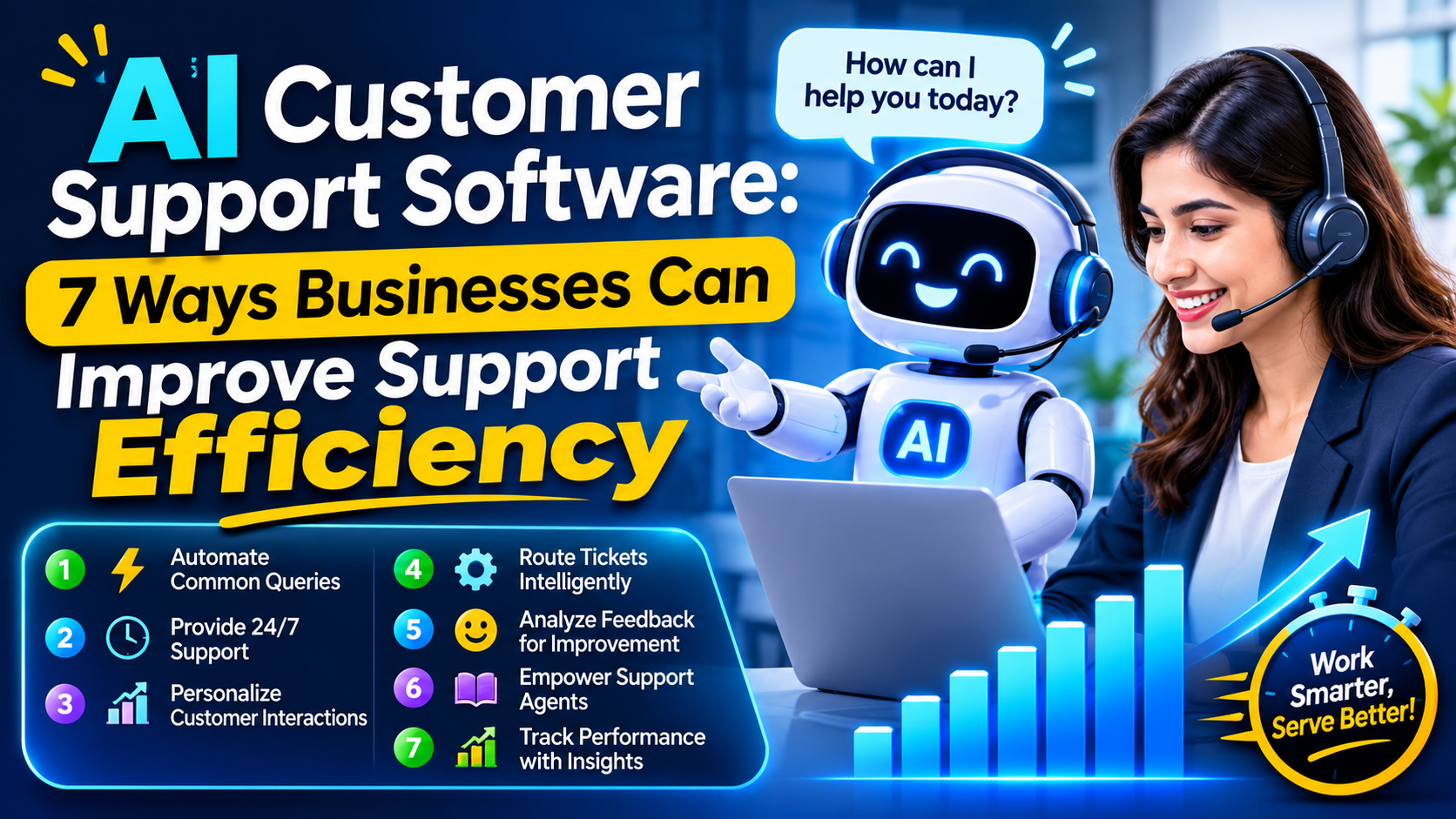
AI Customer Support Software: 7 Ways Businesses Can Improve Support Efficiency

The rapidly evolving customer expectation is for immediate response to their inquiries, accurate information regarding products/services, and convenient access to support services when needed. With many businesses processing large volumes of customer inquiries (hundreds/thousands), providing a high quality of service can be difficult using traditional support channels. Traditional support channels generally result in lengthy wait times, repetitious work, and increased pressure on customer service staff.
Artificial Intelligence (AI) Customer Support Software, also known as AI customer support software, has the potential to help you improve your customers' experience by allowing you to handle customer service inquiries in a much faster manner. This is done through the use of AI, automation, and conversational technologies that allow you to provide high-quality customer service while handling a larger volume of customer service requests than would otherwise be possible.
Artificial intelligence-based software and AI-powered customer service are transforming how organizations handle customer care, from resolving simple customer inquiries to assisting customer service representatives with complex issue resolution. Organizations have at least seven practical methods of using AI-based software to enhance the efficiency of their customer support operations.
1. Automate Responses to Common Customer Questions
Customer service teams spend a great deal of time addressing common questions about product features, pricing, shipping, returns, and account information. These types of questions are generally easy to answer; however, the manual response to every question will take away from the amount of time that can be used to address more complex issues raised by customers.
Businesses can use AI-powered customer service systems and customer support automation to automatically answer commonly-asked questions. These systems can be trained on a business' current knowledge base, FAQ, and/or product documentation, allowing the system to automatically generate answers to questions.
In addition to providing immediate assistance to customers via an online store's AI-powered chatbot (answering questions regarding shipping timeframes, acceptable payment options and returns), the use of this AI chatbot for customer service allows human agents to focus on those customer requests that require more personalized attention.
2. Provide 24/7 Customer Assistance
Customers will not necessarily contact you during normal working hours. For example, some people will access your site after hours. Other customers may have questions that they want answered on weekends or holidays.
It is difficult to maintain a full-time support staff on a budget for many small and medium-sized organizations.
An AI customer support system enables automated customer support, allowing businesses to assist customers 24/7. Customers may speak with an AI chatbot, get help with commonly asked questions, and receive advice outside of normal work hours.
The availability will be of most benefit to e-commerce businesses, SaaS (software-as-a-service) companies and organizations that operate on a global scale and have customers located in various time zones.
Although AI does not always have the ability to address every issue without human intervention, it can provide support to customers through a variety of day-to-day issues and help them get basic help when needed.
3. Reduce Customer Support Response Times
When customers are waiting for answers to their questions and the wait time is long, it can lead to negative feelings about their experience with your company. Customers can lose interest in what you offer, walk away from purchasing something, or go somewhere else to find what they need.
Using AI customer support tools to automate responses to customer inquiries allows organizations to respond to customers faster, thereby reducing the amount of time that customers wait. Rather than put all of your customers into a manual support queue, artificial intelligence systems can determine what kind of issue or concern a customer has and then respond appropriately.
The following is an example: If a user inquires regarding the various types of subscription plans offered, the AI Assistant may provide the necessary pricing details and describe the different options that are available in real-time.
Businesses will not always replace their customer service representatives with artificial intelligence because of faster response times. Rather than replace representatives, businesses can utilize AI for handling first contact with customers and then direct customers with more complex issues to a customer service representative who is best suited to address those concerns.
4. Improve Lead Qualification and Customer Engagement
In order to make purchasing decisions, customers typically have several questions that they will want answered by a customer service agent. When there is no one present to answer these questions, many businesses lose the opportunity to convert those visitors into customers.
Artificial intelligence-powered web site assistants can assist in identifying the user's requirements by asking relevant questions concerning the user's interests, finances, choices, or company requirements.
For example, if a software company has an AI chatbot, it can determine if a visitor is interested in purchasing an individual subscription or an enterprise solution. Depending upon the answer, the chatbot can provide relevant information and send qualified prospects to the sales department.
By utilizing this method of operation, companies are able to handle incoming inquiries more efficiently while providing a seamless process for prospective customers.
5. Deliver More Personalized Customer Experiences
Customers prefer to receive help with what they need, not general information. But as support calls increase, it becomes hard for agents to provide personal attention to each customer.
The use of an AI customer service platform will allow for the use of previous conversation histories, customers' preferences, and other pertinent company data to help create more contextually relevant interactions with customers.
For example, if a prior customer is looking for more information on something he/she has already bought, he/she will be able to get a lot of good help. On the other hand, if a person comes to the site for the very first time, then there is no telling what type of help he/she can get.
Personalization may assist businesses in recommending relevant products, explaining appropriate services, and guiding customers through various phases of their journey.
Companies must be responsible when handling customer data, and their personalization practices should follow all applicable privacy rules.
6. Manage High Volumes of Customer Conversations
As a business expands, the volume of incoming customer inquiries often grows. If a support department handles 100 conversations per day and the volume increases to 1,000, they will likely find themselves overwhelmed.
Adding employees to your workforce may be an alternative, however this will create more expense for operations, as well as require more time to train and manage the new staff.
AI-based customer service software can help organizations deal with larger numbers of conversations than ever before, improving overall customer service efficiency. It allows for simultaneous processing of several routine interactions at once, which will take some of the strain off of your support team and allow them to avoid making customers wait too long when you are particularly busy.
Businesses can also utilize conversation routing to direct customer questions to the correct department according to the subject matter of the question, or how complex it is.
To give you an idea of how we would use this feature, if you have a question about your bill, we can direct it to our Accounts Team. If you are experiencing a technical issue, we can send your request to one of our Technical Support Specialists.
This organized system allows for better management of workflow, and will enable organizations to keep the same high standard of support as they grow.
7. Use Customer Insights to Improve Support Performance
Customer interactions can provide you with information regarding what is wrong with your customers' experiences, how they view your products and services, what they expect from your organization, and where there may be room for improvement in your operations.
Support platforms using artificial intelligence can analyze conversation trends to identify common questions. This analysis provides managers with knowledge about customer needs and where their current support process might be failing.
For instance, if customers continually inquire about a particular function of your product, then you might want to consider either improving your existing product documentation, or possibly creating an individual help article.
In addition, the frequency of complaints regarding a specific function may also indicate an operational problem that needs to be addressed.
These insights can help businesses improve their knowledge base, update their customer communications strategies, and make better decisions regarding support operations.
What Should Businesses Consider When Choosing AI Customer Support Software?
When you choose the best platform for your business, it is as crucial as how you implement your AI technology. Because each business will have unique customer service needs, each company should assess their current business operations prior to selecting a platform.
Here are a few important factors to consider:
Integration possibilities: Verify if the application has the ability to connect with current websites, CRM solutions, customer support systems and other means of communication.
Simplicity: Select a software solution that your support team will find simple to use and administer, without needing to have advanced technical skills.
Human contact: Provide ways for customers to speak with a human agent when the AI assistant cannot address their issues.
Customizable Solutions: Choose a solution that allows you to create customized chatbot responses, workflows, and conversation experiences.
Metrics & Reporting: Assess if the platform offers actionable metrics on support response time, customer interactions, and overall support performance.
Information Security: Prior to implementation of the technology, review privacy policies, security mechanisms, and how information is managed.
Thinking about these things can help businesses choose a product that will support their long term customer service goals.
Final Thoughts
Customer service has evolved past simply answering inquiries. It now means that customers receive prompt help, their expectations are met, and they experience consistent service regardless of how they contact the business.
AI customer support software allows businesses to meet their goals by automating repetitive tasks, decreasing response time, qualifying leads, and generating valuable customer insight.
Artificial intelligence (AI) has been shown to produce the most positive outcomes when combined with the knowledge and experience of people who work in a specific field. While AI can handle many day-to-day operations such as customer service and transaction processing, human employees can provide emotional support, decision-making capabilities, and individualized attention during more challenging times.
Businesses that use this balanced method will be able to develop support systems that can grow with the business, while still developing strong relationships with their customers.
