


Engineering the Unseen: How Door Intrusion Beam Technology Prevents Cabin Collapse
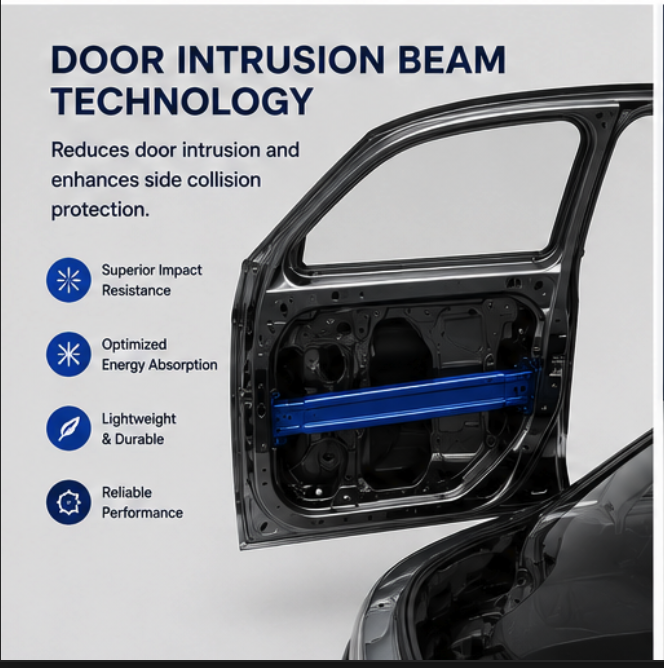
The side of a vehicle door is perhaps the most vulnerable area in any crash scenario. Unlike the front and rear, which have extensive crumple zones, the door offers only a few inches of space between the exterior skin and the occupant. This is where Door Intrusion Beam Technology becomes the last line of defense. Working alongside Automotive Reinforcement Bars located throughout the chassis, these specialized components ensure that the passenger cabin remains intact during a lateral collision.
The Core Function: Anti-Intrusion
The primary job of a door intrusion beam is simple to state but complex to achieve: prevent the door from moving inward more than a few inches during a side impact. Every inch of intrusion matters. Medical research shows that thoracic (chest) injuries increase exponentially when door intrusion exceeds 6 inches (150 mm). Beyond 12 inches (300 mm), fatal injuries become highly probable.
Door Intrusion Beam Technology addresses this by providing a high-strength barrier that bridges the gap between the door's front hinge pillar and the rear latch pillar. When a side impact occurs, the beam transfers the collision force to these pillars, which then distribute the load into the roof and floor structures. Without the beam, the door would simply fold inward like cardboard.
Evolution of Beam Geometry
The earliest door beams were simple round steel tubes—effective but heavy. As computer-aided engineering matured, beam geometry became far more sophisticated. Today, common profiles include:
-
Hat-section beams: Formed from a single stamped sheet, these have a "U" or "top hat" cross-section that provides excellent bending resistance for minimal weight.
-
Sinusoidal beams: Shaped like a sine wave along their length, these beams offer progressive stiffness, bending more easily initially (to absorb energy) and stiffening as the intrusion deepens.
-
Patchwork beams: Beams with localized thickness variations, achieved by welding thicker "patches" to a thinner base. This places extra strength exactly where the intruding object strikes.
These innovations in Door Intrusion Beam Technology have reduced beam weight by up to 40% while increasing energy absorption by similar margins.
The Pole Test Scenario
One of the most demanding side impact tests is the "pole test." In this assessment, a vehicle is propelled sideways into a rigid pole (simulating a telephone pole or tree) at 20 mph. Unlike a barrier test, where the impact force is spread across the entire side, the pole concentrates all force into a 10-inch diameter circle on the door.
This test specifically evaluates Automotive Reinforcement Bars and door intrusion beams. A vehicle that performs well in the pole test typically has a door beam positioned directly at beltline height (chest level) and a lower beam or reinforced rocker panel to prevent the pole from submarining under the vehicle. The beam must be strong enough to prevent the pole from contacting the dummy's thoracic region.
Dual-Beam Configurations
Premium vehicles increasingly employ dual intrusion beams per door. The primary beam sits at torso height and is typically a thick, hot-stamped steel profile. The secondary beam sits lower, near the rocker panel, and is often a smaller diameter tube.
This dual-beam Door Intrusion Beam Technology configuration serves two purposes. First, it distributes the impact load across two separate attachment points, reducing stress on any single bracket. Second, it prevents the intruding object from "pocketing" between the beams—a phenomenon where a narrow object like a pole slides between two beams if they are too far apart.
Conclusion
The quiet evolution of Door Intrusion Beam Technology represents one of the greatest unsung success stories in automotive safety. From simple tubes to sophisticated, profile-optimized beams, these components have dramatically reduced fatalities in side-impact collisions. When combined with other Automotive Reinforcement Bars, they form a protective lattice that keeps the survival space intact. Your doors are stronger than you think—by design.

 Bangla