


Engineering Quiet: The Critical Role of Automotive Anti-Vibration Components in Modern Vehicles
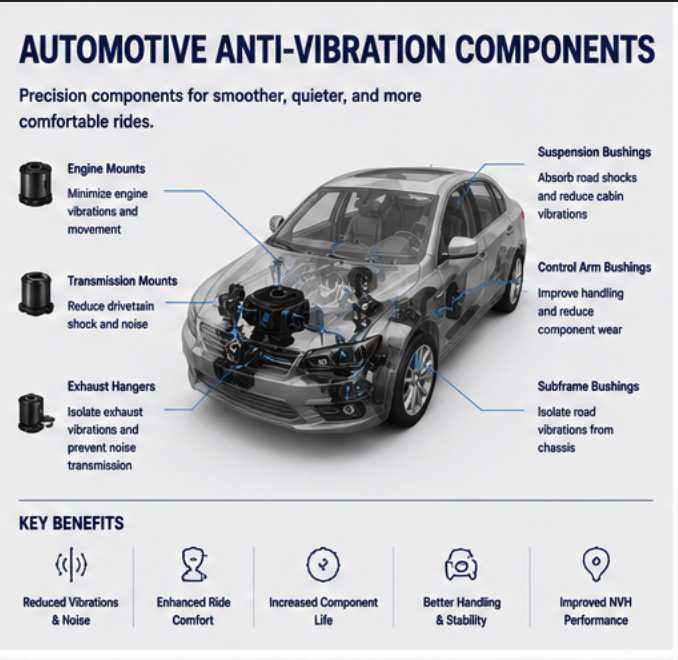
A luxury car and an economy car may use the same engine, the same transmission, and the same suspension design. Yet the luxury car feels quiet and refined while the economy car buzzes and rattles. The difference lies in the details—specifically, in the quality and quantity of Automotive Anti-Vibration Components. These parts, which include Rubber Vibration Isolation Bushings, engine mounts, subframe mounts, and exhaust isolators, are the keys to NVH (Noise, Vibration, and Harshness) reduction. Understanding their roles helps explain why some cars feel more expensive than others.
What Is NVH and Why Does It Matter?
NVH stands for Noise, Vibration, and Harshness—the three primary metrics of ride refinement:
-
Noise: Unwanted sounds (wind, road, engine, tire) perceived by the occupant.
-
Vibration: Oscillatory motion felt through the seat, steering wheel, or floor.
-
Harshness: Sharp, impact-related disturbances (potholes, expansion joints).
Automakers spend millions engineering NVH out of their vehicles because consumers equate quietness with quality. Automotive Anti-Vibration Components are the primary tools for this engineering.
The Five Sources of Automotive Vibration
To control vibration, you must know where it originates:
Source 1: Engine and Drivetrain
Internal combustion engines produce vibration from combustion events (firing pulses) and rotating imbalance. A four-cylinder engine fires twice per revolution; a V8 fires four times. These pulses create engine shake. Transmissions, driveshafts, and differentials add their own vibrations.
Source 2: Road Surface
Coarse asphalt creates high-frequency vibration (50-500 Hz) transmitted through tires, wheels, and suspension. Potholes and expansion joints create impact harshness (transient vibration).
Source 3: Aerodynamic Flow
Wind passing over the vehicle creates noise (wind roar) and, at high speeds, pressure fluctuations that vibrate panels.
Source 4: Tire Resonance
Tires have natural frequencies based on their construction. At certain speeds, tire resonance creates booming noise in the cabin.
Source 5: Accessory Operation
AC compressors, alternators, power steering pumps, and cooling fans create their own vibrations.
The Hierarchy of Isolation
Rubber Vibration Isolation Bushings are applied at multiple levels:
Primary Isolation (Engine and Transmission Mounts):
Engine mounts connect the engine/transmission assembly to the chassis. They must:
-
Support engine weight (150-300 kg).
-
Control engine movement under torque (acceleration/braking).
-
Isolate engine firing pulses (10-200 Hz).
-
Allow engine tilt for service access.
Hydraulic engine mounts (fluid-filled) provide exceptional isolation at idle frequencies.
Secondary Isolation (Suspension Bushings):
Every suspension pivot point contains a bushing: control arms, trailing arms, stabilizer bars, and subframes. These bushings block road-induced vibration while allowing suspension articulation.
Tertiary Isolation (Body Mounts):
On body-on-frame vehicles (trucks, SUVs), rubber body mounts isolate the cabin from chassis vibrations. Unibody vehicles use subframe bushings for similar isolation.
Specialized Isolators:
Exhaust mounts, shock absorber top mounts, steering rack bushings, and even the steering column have vibration isolators.
Types of Automotive Anti-Vibration Components
The market offers several categories of Automotive Anti-Vibration Components:
| Category | Examples | Primary Function |
|---|---|---|
| Engine mounts | Rubber, hydraulic, active | Isolate engine vibration |
| Transmission mounts | Rubber, voided | Support transmission |
| Subframe mounts | Solid rubber, hydraulic | Isolate chassis from suspension |
| Suspension bushings | Control arm, trailing arm | Allow articulation, block vibration |
| Stabilizer bar bushings | Split rubber, polyurethane | Isolate bar from chassis |
| Shock mounts | Rubber, bearing top mounts | Isolate shock vibrations |
| Exhaust isolators | Rubber hangers | Isolate exhaust from chassis |
| Body mounts | Rubber pucks | Isolate cabin from frame |
The Engineering of Bushing Compliance
A bushing's stiffness is not constant in all directions. Engineers design "directional compliance":
-
Low stiffness (soft): Direction needing isolation (e.g., vertical road impacts).
-
High stiffness (firm): Direction needing precise control (e.g., cornering loads).
Example: A control arm bushing might be soft radially (vertical impacts) but stiff axially (braking loads). This is achieved through bushing shape and internal voids.
Voided and Hydraulic Bushings
For applications needing progressive stiffness, voided bushings have cavities that collapse under load. A voided bushing:
-
Light load (normal driving): Voids open, soft isolation.
-
Heavy load (cornering, braking): Voids collapse, rubber compresses, stiff control.
Hydraulic bushings take this further. They contain fluid-filled chambers connected by restrictive passages. When vibrated, fluid moves through the passages, generating damping. Hydraulic bushings are used for engine mounts (idle vibration) and rear subframe mounts (high-frequency isolation).
The Cost of Anti-Vibration Components
Automotive Anti-Vibration Components are not free. The total cost of bushings and mounts for a typical vehicle ranges from $200 to $800, depending on vehicle segment:
| Vehicle Segment | Typical Bushing Content | Cost (Parts) |
|---|---|---|
| Economy car | Basic rubber bushings, few hydraulic mounts | $200-300 |
| Mid-size sedan | Voided bushings, hydraulic engine mount | $300-500 |
| Luxury car | Multiple hydraulic mounts, tuned bushings | $600-800 |
| Performance car | Stiffer bushings, more mounts | $500-700 |
| Large SUV/truck | Many bushings, body mounts | $500-800 |
Luxury vehicles use more bushings (more joints isolated) and more expensive bushings (hydraulic, tuned).
Failure Symptoms and Diagnostics
Worn Rubber Vibration Isolation Bushings produce identifiable symptoms:
| Symptom | Likely Failed Component |
|---|---|
| Engine shake at idle | Hydraulic engine mount (fluid loss) |
| Clunking when shifting | Transmission mount or torque strut |
| Clunking over bumps (front) | Stabilizer bar bushing or end link |
| Clunking over bumps (rear) | Trailing arm or control arm bushing |
| Vague steering, wander | Control arm bushings |
| Vibration at specific speed | Driveshaft center bearing or subframe bushing |
| Rear-end sway during cornering | Trailing arm bushings |
| Harsh ride over small bumps | Deteriorated rubber (hardened) |
Rubber deterioration is visible as cracking (dry rot). If cracks penetrate the surface, water and contaminants accelerate failure.
The Future: Adaptive and Smart Mounts
Emerging technologies in Automotive Anti-Vibration Components include:
-
Active engine mounts: Use electromagnetic actuators to cancel engine vibration in real-time.
-
Tuneable bushings: Magnetorheological rubber changes stiffness when a magnetic field is applied.
-
Sensed mounts: Integrated load sensors feed data to the vehicle's dynamic control systems.
-
Self-diagnosing bushings: Embedded electronics detect wear and alert the driver.
Conclusion
The difference between a cheap car and a luxury car is often hidden in plain sight—in the rubber bushings you never see. Automotive Anti-Vibration Components are the silent engineers of ride quality, transforming raw mechanical energy into a refined driving experience. Rubber Vibration Isolation Bushings at every joint create a vehicle that whispers rather than shouts. Next time you enjoy a quiet, smooth ride, thank the humble bushing.

 Bangla