


How to Measure Data Maturity Before Scaling SAP AI Initiatives
Artificial Intelligence is becoming an essential part of modern business operations, helping organizations automate repetitive tasks, improve decision-making, and uncover valuable insights from enterprise data. However, many SAP AI projects fail to deliver the expected outcomes because businesses focus on AI technology before evaluating the quality and readiness of their data. Measuring data maturity is the first and most important step before expanding any AI initiative. It helps organizations understand whether their data is accurate, consistent, accessible, and reliable enough to support intelligent business processes.
A mature data environment provides the foundation for successful AI implementation. Without it, businesses may experience inaccurate predictions, inefficient workflows, and poor user adoption. By accessing data maturity early, organizations can identify weaknesses, improve governance, and create a roadmap for scalable AI transformation.
Why Data Maturity Matters for SAP AI
SAP AI solutions depend on clean, well-managed, and integrated enterprise data. If data is incomplete or stored across disconnected systems, AI models cannot generate meaningful insights. Evaluating data maturity enables organizations to understand whether their current data landscape can support automation, predictive analytics, and intelligent decision-making.
A strong data foundation also improves collaboration between departments by ensuring that finance, procurement, sales, and operations work with consistent and trusted information. This ultimately increases confidence in AI-driven recommendations and business outcomes.
Key Areas to Evaluate
Before scaling SAP AI initiatives, businesses should assess several important factors:
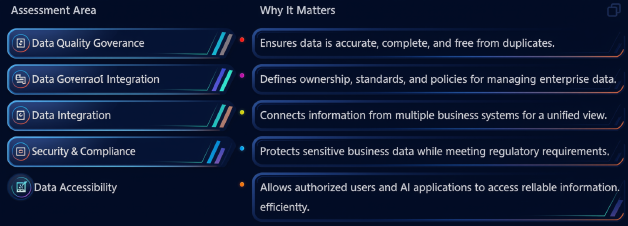
A Simple Data Maturity Assessment Framework
Organizations can evaluate their readiness by following a structured approach:
- Review Existing Data Sources – Identify where business-critical data is stored and evaluate its quality.
- Measure Data Consistency – Check whether information remains consistent across departments and systems.
- Evaluate Governance Policies – Ensure data ownership, validation rules, and compliance processes are clearly defined.
- Identify Data Gaps – Detect missing, outdated, or duplicated records that could affect AI performance.
- Prioritize Improvements – Focus on resolving high-impact data issues before expanding AI initiatives.
This assessment helps organizations create a practical roadmap for continuous data improvement instead of attempting large-scale AI deployment without preparation.
How SAP Supports Data Maturity
Modern SAP solutions provide several capabilities that strengthen enterprise data management. SAP Business Technology Platform helps organizations integrate applications, manage enterprise data, and build AI-powered business processes on a connected foundation. For performance monitoring and strategic decision-making, SAP Analytics Cloud transforms business data into interactive dashboards and predictive insights, allowing organizations to measure data quality and business performance more effectively.
Businesses can also enhance operational efficiency through SAP Automation, which reduces manual data handling, minimizes errors, and improves process consistency. Together, these solutions create a stronger data ecosystem that supports reliable and scalable AI adoption.
Best Practices for Long-Term Success
Organizations should treat data maturity as an ongoing business initiative rather than a one-time assessment. Regular data quality audits, clearly defined governance policies, continuous employee training, and cross-functional collaboration help maintain trusted enterprise data. Monitoring key performance indicators and updating data management strategies as business requirements evolve will also improve AI accuracy and long-term business value.
Conclusion
Scaling SAP AI initiatives successfully starts with understanding the maturity of your enterprise data. Clean, integrated, and well-governed data enables AI to deliver accurate insights, automate business processes, and support better decision-making. By assessing data quality, governance, integration, and security before expanding AI projects, organizations can reduce implementation risks and maximize the return on their SAP investments. A strong data foundation today creates the confidence needed to build smarter, more scalable AI solutions for the future.

 Bangla