


What is the Mesaverse? The Next-Gen Digital Ecosystem for Automation Leaders
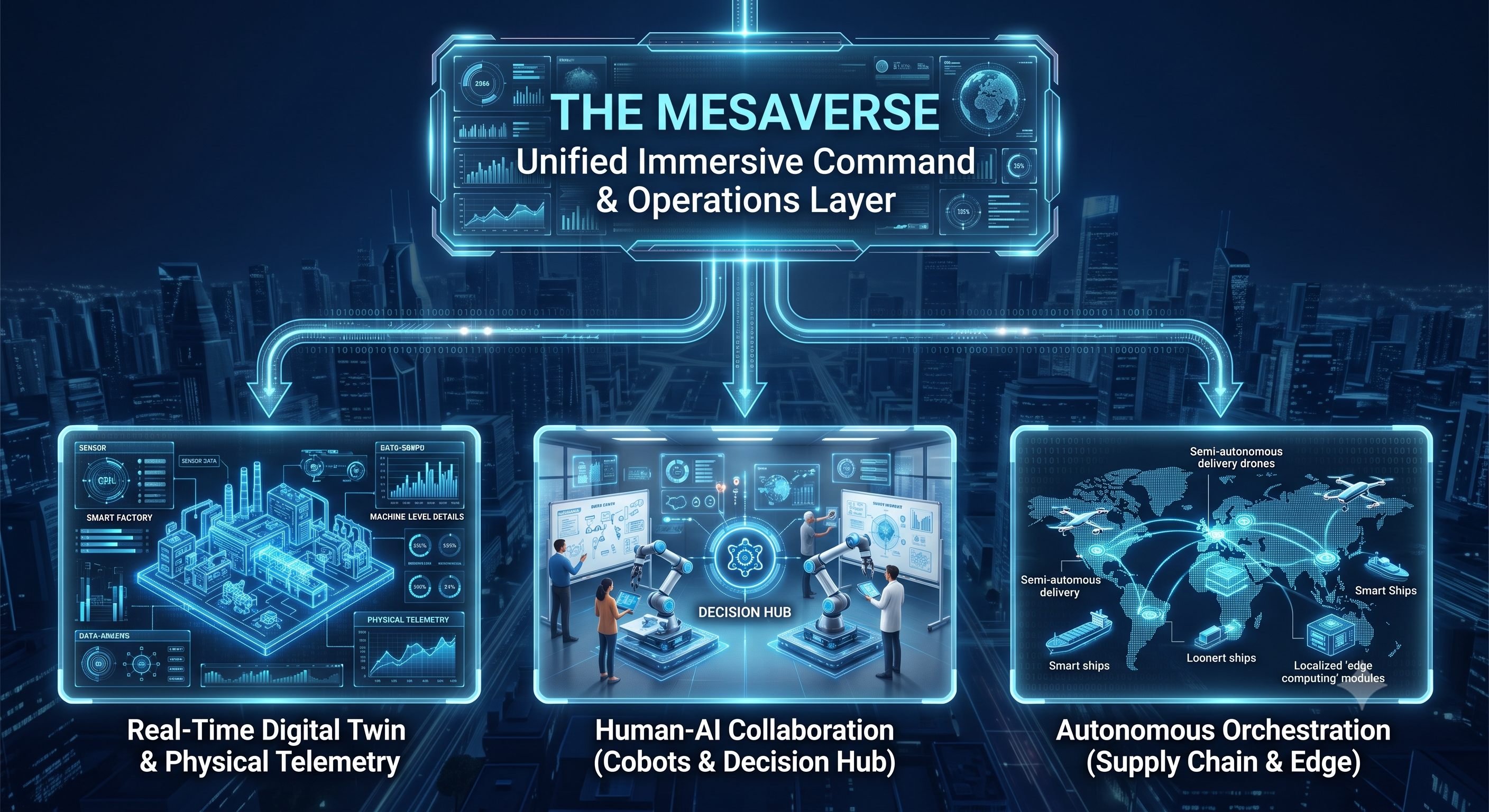
In today's hyper-connected industrial landscape, executives face a common challenge: enterprise data, automation tools, and strategic operations remain trapped in isolated silos. Traditional enterprise portals no longer meet the needs of complex industrial operations. This gap has led to the rise of a ground-breaking platform—What is the Mesaverse? The Next-Gen Digital Ecosystem for Automation Leaders.
By fusing spatial computing, autonomous AI, and real-time operational execution, the Mesaverse provides a unified collaborative layer built specifically for decision-makers.
Defining the Mesaverse: Beyond Traditional Enterprise Software
To understand What is the Mesaverse? The Next-Gen Digital Ecosystem for Automation Leaders, one must look beyond consumer-grade virtual reality or standard Manufacturing Execution Systems (MES). The Mesaverse is an enterprise-grade digital architecture designed to connect high-level strategy directly to factory-floor dynamics.
Unlike general metaverses focused on social avatars, the Mesaverse integrates high-fidelity digital twins, physics engines, and edge-computing telemetry. It provides executives with a live, 3D command center where operational data can be analyzed and acted upon in real time.
Key Pillars Driving the Mesaverse Architecture
Understanding What is the Mesaverse? The Next-Gen Digital Ecosystem for Automation Leaders requires examining the core technologies that power it:
1. Synchronous Digital Twin Infrastructure
The Mesaverse creates real-time replicas of physical assets, supply networks, and processing facilities. Industrial leaders can interact with remote plant machinery through spatial interfaces, eliminating the lag associated with static dashboards.
2. Autonomous AI Orchestration
Predictive machine learning models continuously monitor system performance. The Mesaverse translates raw IoT sensor streams into actionable executive strategies, auto-dispatching maintenance and balancing supply lines dynamically.
3. Human-Centric Virtual Collaboration
Geographically distributed engineering and operations teams can meet inside high-fidelity shared spaces. Here, they can inspect virtual prototypes, simulate strain conditions, and execute complex line reconfigurations prior to physical rollout.
Infographic Prompt (Mid-Article Image Generation):
A high-tech, futuristic 3D isometric vector illustration depicting an industrial command center platform labeled "The Mesaverse". On the platform, transparent digital twin factory floors glow with blue and gold telemetry data lines connecting to holographic AI charts. Corporate executives in smart-casual attire collaborate alongside semi-transparent robotic arms and interactive data nodes. Clean, modern, corporate tech style, cinematic lighting, ultra-detailed.
Strategic Advantages for Modern Industrial Enterprises
Evaluating What is the Mesaverse? The Next-Gen Digital Ecosystem for Automation Leaders highlights several distinct business advantages:
-
Dramatically Reduced Downtime: Predictive simulations flag potential equipment failures days before physical breakdowns occur.
-
Accelerated Time-to-Market: Engineering teams can stress-test new manufacturing lines virtually, cutting commissioning delays by up to 40%.
-
Sustainable Operational Control: Embedded carbon-tracking models allow leaders to monitor power usage and minimize waste across global footprints.
Real-World Use Cases in Action
|
Industry Sector |
Traditional Operational Challenge |
Mesaverse Solution |
Key Impact |
|
Automotive Assembly |
High costs during physical tooling changes |
Immersive virtual pre-commissioning |
35% faster re-tooling cycles |
|
Pharmaceuticals |
Strict batch compliance monitoring |
Immutable digital twin telemetry logging |
Zero-defect auditing speed |
|
Global Logistics |
Supply chain bottlenecks |
Multi-variable spatial simulations |
Real-time predictive rerouting |
Implementing the Mesaverse Roadmap
Transitioning to this next-generation operational framework involves three practical steps:
-
Unify Operational Data Streams: Consolidate legacy ERP and MES pipelines into a unified data architecture.
-
Deploy Targeted Digital Twins: Start by virtualizing critical high-cost assets before expanding to plant-wide models.
-
Empower Cross-Functional Teams: Train leaders and engineers to collaborate within spatial environments to drive faster decision-making.
Ultimately, What is the Mesaverse? The Next-Gen Digital Ecosystem for Automation Leaders is not a distant vision—it is the modern standard for operational intelligence. Modern enterprises that adopt spatial collaboration, AI automation, and live telemetry gain a lasting competitive edge.

 Bangla