


The Heavy Equipment Market Is Moving From Capacity to Capability
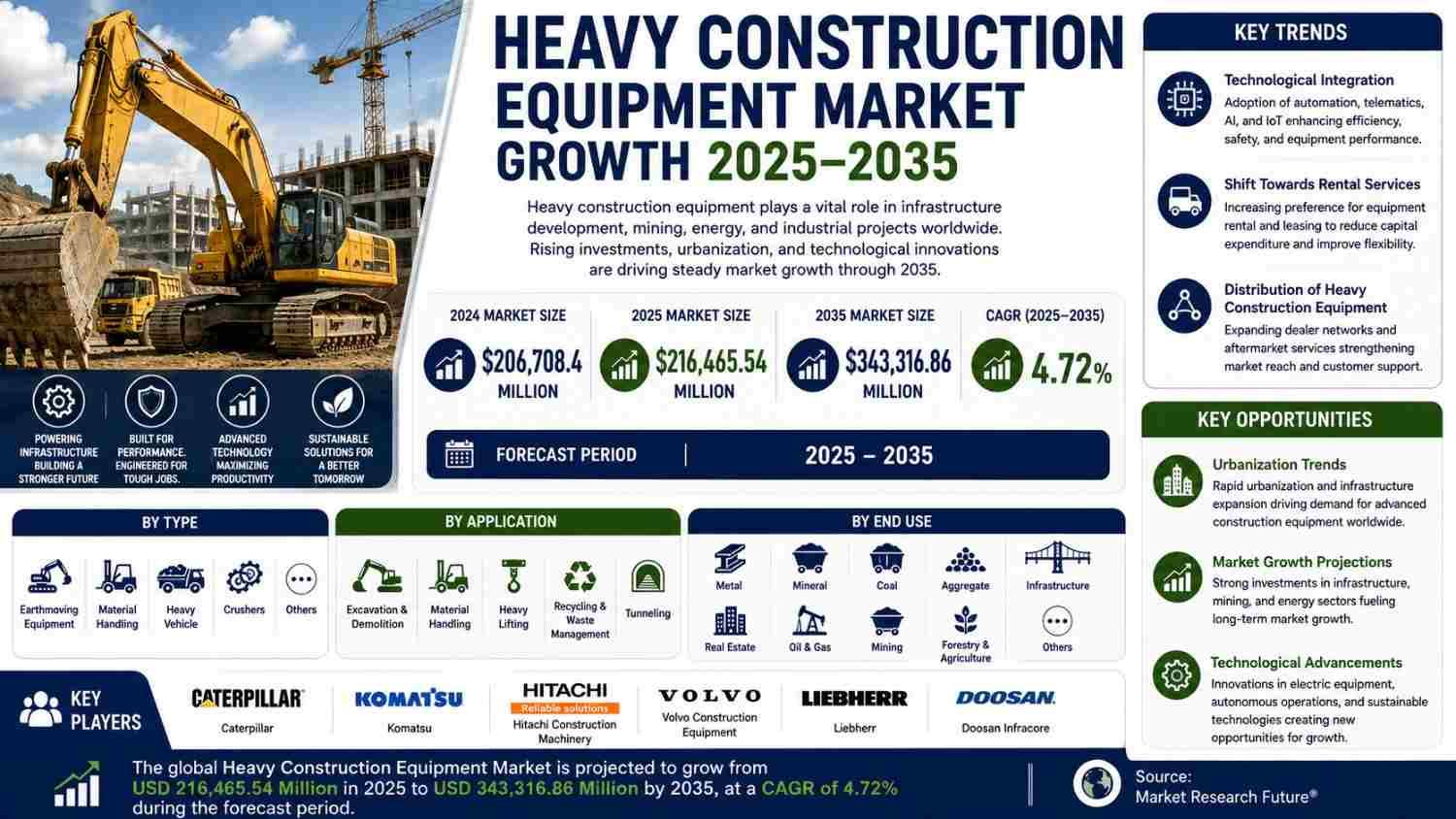
A construction machine can be powerful and still be economically inefficient if it spends too much time idle, consumes excessive fuel, or requires frequent servicing. That is why the Heavy Construction Equipment Industry Trends are increasingly centered on productivity rather than machine capacity alone. The market was valued at USD 206,708.4 million in 2024 and reached USD 216,465.54 million in 2025. It is projected to reach USD 343,316.86 million by 2035, expanding at a CAGR of 4.72% during 2025–2035. Urbanization, infrastructure development, technology integration and the growing role of rental services are changing how contractors evaluate heavy machinery.
Construction Projects Are Becoming More Complex
Modern construction projects often combine several demanding activities within a relatively compressed schedule.
A highway project may require excavation, grading, material transportation, crushing and heavy lifting. A large urban development can involve demolition, earthmoving, material handling and waste processing at the same site.
This complexity increases the importance of equipment coordination.
A machine does not operate independently from the rest of a project. Excavators need hauling capacity. Material-handling equipment depends on the timely arrival of materials. Crushers depend on a steady supply of suitable feedstock.
When one part of the equipment chain becomes inefficient, productivity across the project can suffer.
That is encouraging contractors to think increasingly about fleet performance rather than individual machine specifications.
Earthmoving Remains a Foundation of Demand
Earthmoving equipment occupies a central role because almost every major construction project begins with some form of site preparation.
Excavation, grading, trenching and foundation preparation require machines capable of moving large volumes of soil and aggregate.
The requirement changes according to project conditions.
Large infrastructure projects can favor high-capacity machinery, while urban projects may require greater maneuverability and precise control.
This creates room for manufacturers to differentiate products through machine configuration, hydraulic performance, digital controls and operator assistance.
The demand opportunity is therefore not simply about selling more units. It is about matching equipment capabilities to increasingly varied project environments.
Material Handling Is Becoming a Productivity Issue
Moving materials efficiently can determine whether a project stays on schedule.
Construction sites handle steel, concrete components, aggregates, soil, equipment and other materials continuously.
Material-handling equipment helps reduce the time and labor required to move these inputs between locations.
As projects become larger, inefficient material movement can create bottlenecks.
This explains why material-handling machinery remains an important part of the heavy equipment ecosystem.
Technology can further improve the process by providing information about machine location, operating hours and utilization.
For fleet managers, that visibility can make it easier to identify underused equipment and reorganize machine deployment.
Recycling and Waste Management Are Expanding Equipment Applications
Construction and demolition generate large quantities of material.
Instead of treating all waste as something that must leave the site, contractors can increasingly look at recovery, processing and reuse as part of project management.
Crushers and related equipment can support the processing of suitable materials.
This creates a connection between heavy construction equipment and the broader resource-efficiency agenda.
The opportunity is commercially relevant because equipment that can support material recovery may help contractors reduce transportation requirements and improve material utilization.
However, the economics depend on the quality and type of recovered material, local regulations and the availability of suitable processing infrastructure.
Tunneling Requires Specialized Equipment
Tunneling represents one of the more technically demanding applications for heavy equipment.
Projects must operate within constrained environments where access, ventilation, safety and material removal can present significant challenges.
Equipment used for tunneling must therefore be designed around reliability and specialized operating requirements.
This segment also illustrates why the heavy equipment market cannot be evaluated only through construction volumes.
A smaller number of highly specialized projects can create significant equipment requirements because each project may need machinery with capabilities that conventional equipment cannot provide.
Digital Technology Is Turning Machinery Into Connected Assets
Technology integration is changing what contractors expect from equipment.
Telematics and connected systems can provide information about machine utilization, location, operating hours and maintenance requirements.
The practical value comes from using this information to improve decisions.
A fleet manager can identify machines that are underused. Maintenance teams can schedule service based on operating conditions rather than relying solely on fixed intervals. Project managers can improve equipment allocation.
These applications can reduce waste in fleet operations.
The broader change is that equipment is becoming part of a digital construction workflow rather than remaining an isolated mechanical asset.
Automation Can Improve Precision
Automation is particularly relevant where repetitive tasks require consistent execution.
Machine-control systems can assist operators with excavation, grading and positioning.
The immediate benefit is not necessarily the removal of human operators.
Instead, technology can help operators work with greater precision and reduce repetitive manual adjustments.
More advanced autonomous capabilities may become increasingly relevant in controlled applications.
The challenge is that construction sites are dynamic. Workers, vehicles, changing terrain and unexpected obstacles make complete automation difficult.
For the foreseeable future, assisted and semi-automated functions may therefore offer a more practical path toward productivity gains.
Rental Services Are Changing Fleet Strategies
Rental services are becoming an increasingly important part of the equipment market because construction demand is project driven.
A contractor may require a specialized machine for several months but have little reason to own it permanently.
Rental provides access without the full financial commitment associated with ownership.
This model can also help companies respond to changing project requirements.
For manufacturers, the growth of rental changes the purchasing audience.
Rental companies generally care about durability, serviceability, utilization and asset value because equipment must perform repeatedly across different projects.
That creates pressure for manufacturers to build machines that can withstand intensive use while remaining economical to maintain.
Sustainability Is Becoming a Commercial Consideration
Environmental expectations are influencing machinery development, but sustainability in heavy equipment is not limited to alternative powertrains.
Fuel consumption, maintenance frequency, equipment life, component durability and material recovery all affect environmental performance.
A machine that consumes less fuel can reduce operating costs while also lowering emissions.
Longer equipment life can reduce the frequency with which machinery must be replaced.
Technology that improves machine utilization can also prevent unnecessary equipment deployment.
Electrification and other lower-emission technologies may become increasingly relevant, particularly where operating conditions allow practical charging or alternative energy infrastructure.
The transition will vary by application rather than following a single universal path.
The Market Serves More Than Construction
Construction is the obvious demand center, but heavy equipment also supports mining, metals, minerals, aggregates, oil and gas, forestry and agriculture.
Mining operations require machinery capable of moving and processing large quantities of material.
Aggregate businesses depend on excavation, transportation and crushing.
Forestry and agriculture can require specialized heavy machinery for material handling and land preparation.
This diversity provides resilience because demand is spread across different industries.
It also makes product specialization increasingly important.
A machine optimized for a dense urban construction project may not be appropriate for a remote mining operation.
Regional Demand Depends on Development Patterns
Asia-Pacific represents an important opportunity because infrastructure development, urbanization and industrial expansion can generate significant machinery requirements.
North America combines established equipment fleets with infrastructure projects and replacement demand.
Europe presents a different opportunity, with greater emphasis on modernization, efficiency and environmental performance.
Emerging markets can generate demand through new roads, buildings, utilities and industrial facilities.
The distinction between regions matters because the same machine can have a different value proposition depending on local construction practices, financing conditions, infrastructure quality and equipment availability.
Competitive Advantage Is Moving Beyond the Machine
The market includes Caterpillar, Komatsu, Hitachi Construction Machinery, Volvo Construction Equipment, Liebherr and Doosan Infracore.
Competition among these companies is increasingly shaped by the broader equipment ecosystem.
Product reliability remains fundamental, but customers also evaluate dealer support, spare-parts availability, digital tools and maintenance capabilities.
Technology provides another area of differentiation.
Connected machinery and automation can help manufacturers create value beyond traditional mechanical performance.
This makes the competitive environment more complex because manufacturers increasingly compete across hardware, software and services.
New Business Opportunities Are Emerging Around Data
Heavy equipment generates operational information that can become useful when converted into actionable insights.
Fleet managers can use utilization data to identify equipment that should be relocated or replaced.
Rental providers can use machine information to improve scheduling and maintenance.
Manufacturers can use equipment data to understand operating patterns and improve future product development.
This creates an opportunity for companies that can connect machinery with digital platforms.
The commercial potential is particularly strong where data can produce measurable savings rather than simply adding another layer of software.
The Biggest Risks Are Economic as Well as Technical
Heavy equipment remains capital intensive.
Construction slowdowns can cause contractors to delay purchases.
High financing costs can make new equipment less attractive.
Supply-chain problems can affect delivery schedules and replacement parts.
Technology can also create uncertainty if customers cannot clearly measure its benefits.
Manufacturers therefore need to make innovation practical.
A connected machine that reduces downtime has a stronger business case than technology that merely increases complexity.
What the Industry Should Watch
The next phase of the market will be influenced by how quickly contractors adopt connected fleets, how rental models develop and how manufacturers balance productivity with sustainability.
Urban construction will favor precision and flexibility.
Infrastructure development will continue to support large-scale machinery.
Recycling and waste-management applications can expand equipment utilization.
Automation will increasingly assist operators.
Rental services can make specialized machinery accessible to a wider customer base.
These developments point toward a market where equipment performance is increasingly measured across its entire operating life.
Market Outlook
The projected increase to USD 343,316.86 million by 2035 reflects continued demand for machinery capable of supporting physical infrastructure and industrial activity.
Yet the more important shift is qualitative.
Heavy construction equipment is becoming a connected, service-supported and increasingly intelligent asset.
Manufacturers that understand the complete operating cycle—from acquisition and deployment to maintenance and resale—can create more value for customers than those competing only on machine specifications.
For contractors, the central question is becoming equally clear: not how much equipment a fleet owns, but how much productive work that fleet can deliver.

 Bangla