

Catering Services Market Size, Share, Revenue Forecast and Comprehensive Industry Analysis 2026-2034

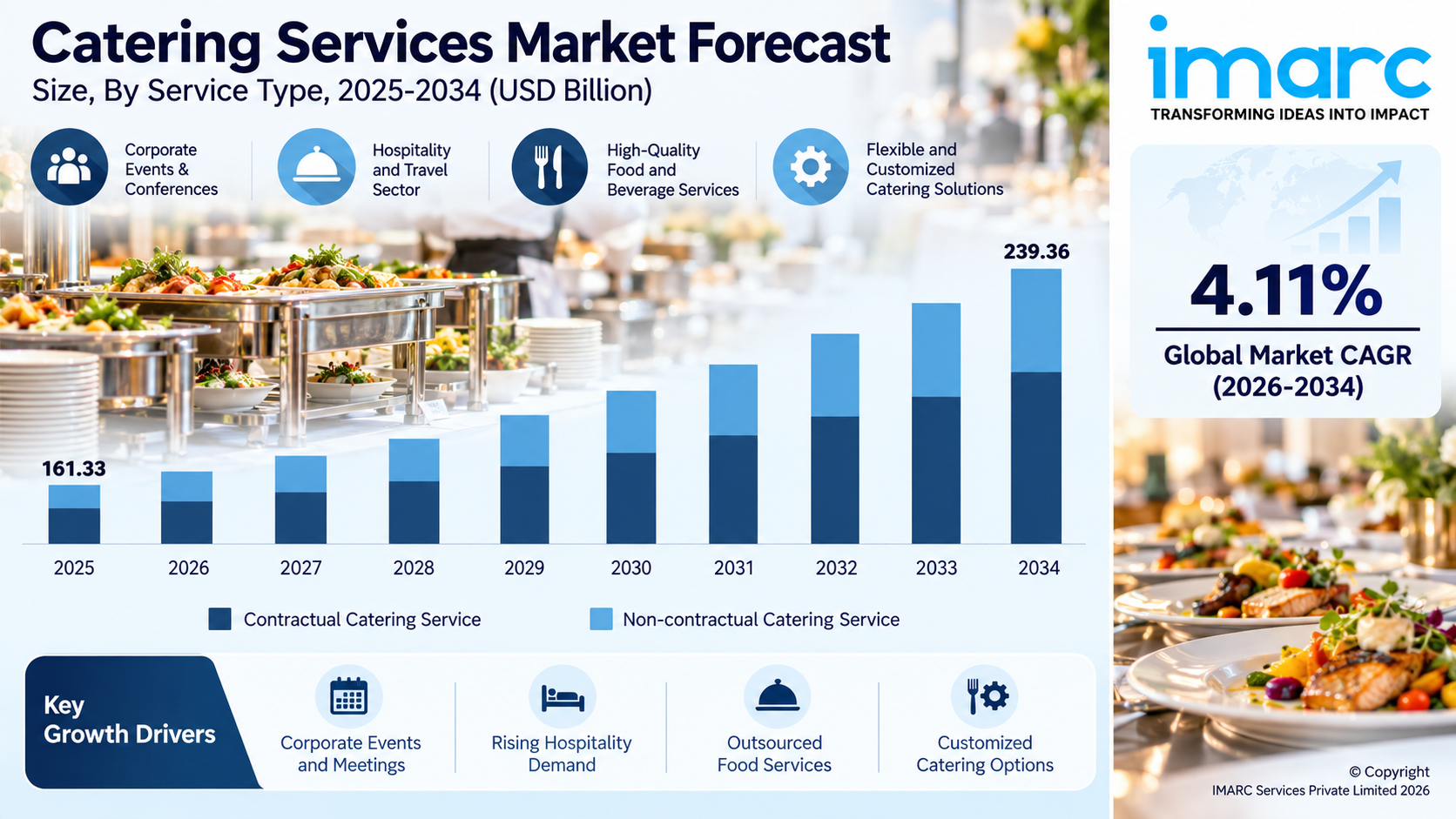
The global catering services market size is experiencing steady growth as businesses, educational institutions, healthcare facilities, and hospitality providers increasingly rely on professional food service solutions. The market grew from USD 161.33 Billion in 2025 to USD 173.44 Billion in 2026. Looking forward, IMARC Group estimates the market to reach USD 239.36 Billion by 2034, expanding at a CAGR of 4.11% during 2026–2034. Europe dominated the market in 2025, accounting for 35.5% of the global market share.
The industry is being influenced by rising demand for outsourced food services, growing corporate catering requirements, increasing institutional demand, changing dietary preferences, and technological advancements in food service operations. Digital ordering platforms, sustainable catering practices, customized menus, and the expansion of contractual catering services are also creating new opportunities for market participants.
What Is Driving Catering Services Market Growth?
Rising Demand for Outsourced Food Services
The growing demand for outsourced food services across corporate, institutional, and social environments is a key factor driving the expansion of the global catering services market. Organizations are increasingly engaging professional caterers and catering service providers to enhance operational efficiency, optimize food service expenditures, and maintain consistent standards of food quality and service delivery.
Outsourcing catering enables businesses and institutions to concentrate on their core activities while relying on specialized providers for menu development, food preparation, nutritional planning, and meal distribution. This trend is particularly prominent across corporate offices, manufacturing plants, healthcare facilities, educational institutions, and government establishments, where reliable and cost-effective meal services are essential.
The increasing focus on employee well-being is further contributing to market growth. Businesses are placing greater emphasis on nutritious meal options, convenient workplace dining facilities, and customized food services to improve employee satisfaction, support productivity, and promote healthier workplace environments. In addition, evolving food trends in catering, including demand for plant-based meals, sustainable ingredients, international cuisines, and dietary-specific menus, are encouraging service providers to diversify their offerings.
Furthermore, the rising number of corporate meetings, conferences, weddings, private celebrations, and social events is creating additional opportunities for catering services. Providers that offer personalized menus, flexible service packages, specialized dietary options, and scalable catering solutions are well positioned to capitalize on changing customer preferences and strengthen their competitive position in the global market.
Increasing Corporate and Institutional Catering Requirements
Corporate and institutional clients represent an important source of recurring demand for catering services. Businesses, schools, hospitals, universities, and industrial facilities require reliable food service arrangements that meet operational, nutritional, and budgetary requirements.
The United States illustrates the scale of institutional catering demand. In fiscal year 2024, the USDA’s National School Lunch Program provided more than 4.8 billion lunches at a total cost of USD 17.7 billion across nearly 100,000 public and private schools.
Such institutional requirements create opportunities for catering companies capable of delivering meals at scale while maintaining food safety, nutritional quality, and service consistency.
Healthcare facilities require catering solutions that accommodate specific nutritional needs and dietary restrictions. Educational institutions prioritize balanced meals for students, while corporate clients increasingly seek convenient dining arrangements and employee wellness programs.
The growing complexity of these requirements is encouraging organizations to work with specialized providers that can deliver reliable services, adapt menus to different audiences, and maintain consistent operating standards.
Technology Integration and Digital Transformation
Technology is transforming catering operations by improving ordering convenience, demand forecasting, food preparation, and customer engagement. Online booking platforms, mobile ordering applications, digital payments, and automated service systems are becoming increasingly important to modern catering businesses.
Artificial intelligence and data analytics can help providers anticipate demand, optimize menu selection, manage inventory, and reduce food waste. These capabilities are particularly valuable for contract caterers serving multiple locations or managing large-scale events.
Digital platforms also allow customers to customize menus, communicate dietary requirements, schedule deliveries, and provide feedback. This improves convenience while helping catering companies better understand customer preferences.
Smart kitchen equipment and integrated operational systems can further support consistent food preparation and service quality. As businesses increasingly prioritize efficiency and convenience, technology-enabled catering solutions are expected to remain an important area of industry development.
Request a Sample Report for Detailed Evaluation: https://www.imarcgroup.com/catering-services-market/requestsample
Catering Services Market Trends to Watch
Three major trends are shaping the future of the global catering services industry.
Technology-driven catering operations: Digital ordering systems, mobile payments, AI-assisted menu planning, and real-time customer feedback are helping providers improve operational efficiency and personalize services. These tools also support better inventory management and demand forecasting.
Sustainable and eco-friendly catering: Catering companies are increasingly focusing on food waste reduction, responsible sourcing, energy-efficient kitchen equipment, and environmentally conscious packaging. Locally sourced ingredients, composting programs, and plant-based menu options are becoming more prominent as businesses and consumers place greater emphasis on sustainability.
Expansion of corporate catering services: Companies are investing in workplace food services to support employee satisfaction, retention, and wellness. Hybrid working arrangements are encouraging flexible catering formats, including delivered meals, grab-and-go options, and adaptable cafeteria services.
Another important development is the growing demand for customized and health-conscious menus. Consumers increasingly expect catering providers to accommodate vegetarian, vegan, gluten-free, allergen-conscious, and culturally diverse food preferences.
The increasing popularity of experiential dining is also influencing the industry. Corporate events, weddings, conferences, and private gatherings increasingly incorporate specialized menus and distinctive food presentations, creating opportunities for caterers to differentiate their services.
According to the supplied industry data, over 53% of corporate buyers planned to increase their catering budgets in 2025, while 80% placed catering orders at least once per month. These figures highlight the importance of corporate clients in the industry’s development.
Catering Services Market Segmentation
IMARC Group provides an analysis of the key trends in each segment of the global catering services market, along with forecasts at the global, regional, and country levels from 2026–2034. The market has been categorized based on service type and end user.
By Service Type
-
Contractual Catering Service
-
Non-contractual Catering Service
Contractual catering services accounted for 78.5% of the market share, making them the dominant service type. This segment includes long-term agreements between catering providers and organizations requiring regular food service operations.
Contractual catering is widely used across corporate offices, healthcare facilities, educational institutions, industrial sites, and other large organizations. These arrangements provide predictable pricing, consistent meal availability, and streamlined food service management.
The model also enables catering providers to achieve economies of scale through centralized procurement, standardized processes, and coordinated food preparation. Long-term contracts can create recurring revenue streams, allowing providers to invest in equipment, technology, workforce training, and service improvements.
The increasing preference for outsourcing non-core business functions is supporting the adoption of contractual catering arrangements across multiple industries.
For instance, in June 2025, dnata announced a multi-year contract with Aer Lingus at Nashville International Airport. The company reported 15% year-over-year growth and maintained operations across 12 US airports, serving approximately 40 airline customers.
Meanwhile, non-contractual catering services cater to more flexible and often event-specific requirements, including weddings, private celebrations, conferences, and social gatherings. Demand for customized menus, specialized cuisines, and event-based food services continues to create opportunities for providers in this segment.
By End User
-
Business and Industry
-
Hospitality
-
Educational
-
Healthcare
-
In-Flight
-
Others
Business and industry dominated the end-user segment in 2025, accounting for 36.5% of the market. This segment includes catering services provided to corporate offices, manufacturing plants, business parks, industrial facilities, and co-working spaces.
Organizations increasingly view workplace food services as an important component of employee welfare, satisfaction, and productivity. Professional caterers provide nutritious meals, convenient dining arrangements, and menus tailored to different dietary requirements.
According to the supplied industry data, over 67% of corporations incorporate health-focused food services into their employee wellness programs, reflecting the growing importance of workplace nutrition.
Hybrid working arrangements are also changing demand patterns. Catering providers are increasingly offering flexible service models, including grab-and-go meals, delivered meal kits, and cafeteria-style dining that can accommodate fluctuating office attendance.
The hospitality segment benefits from demand for food services at hotels, resorts, event venues, and other hospitality establishments. Customized menus and specialized event catering can help hospitality operators improve the overall guest experience.
The educational segment is supported by demand for meal programs across schools, colleges, and universities. Providers must often accommodate nutritional guidelines, food safety requirements, and the preferences of students from diverse backgrounds.
The healthcare segment requires specialized catering services designed to meet patients’ nutritional needs, dietary restrictions, and food safety requirements. Hospitals and care facilities may rely on professional providers to manage complex meal preparation and distribution operations.
The in-flight catering segment serves airlines through the preparation and delivery of meals, beverages, and related services. Growth in air travel and international connectivity creates opportunities for catering providers capable of meeting strict operational and quality standards.
The others segment includes additional institutional, industrial, and event-based catering applications.
Regional Catering Services Market Outlook
Europe
Europe dominated the global catering services market in 2025, accounting for 35.5% of the market share. Its leading position is supported by a well-established corporate environment, extensive healthcare systems, a dense network of educational institutions, and strong hospitality and tourism activity.
Countries such as Germany, the United Kingdom, France, and Spain contribute to regional demand through corporate dining, institutional food programs, event catering, and hospitality-related services.
European organizations increasingly rely on professional catering providers to manage food service operations, meet nutritional requirements, and maintain compliance with food safety regulations. The growing emphasis on employee wellbeing, allergen-conscious food preparation, and sustainability is also supporting demand for specialized services.
The region’s hospitality sector generates additional opportunities through weddings, conferences, business events, and tourism-related activities.
For instance, in August 2025, Newrest formalized a partnership with an airline at Berlin Airport. The company subsequently expanded its operations to Munich Airport in early October, supporting additional airline services to destinations in the United States.
These developments illustrate the importance of aviation catering and international connectivity in the European market.
North America
North America represents a significant and mature catering services market, supported by its extensive corporate sector, developed healthcare infrastructure, and established institutional food service requirements.
The United States is a major contributor to regional demand, with businesses, schools, hospitals, and government institutions relying on professional catering providers for regular meal services.
The United States catering services market reached USD 38,184.17 Million in 2024. IMARC Group projects it to reach USD 55,535.14 Million by 2033, growing at a CAGR of 4.25% during 2025–2033.
The return to office-based working arrangements has supported demand for workplace dining, while hybrid work models have encouraged providers to introduce flexible meal delivery and ordering solutions.
North American consumers are also showing growing interest in plant-based meals, locally sourced ingredients, and menus that accommodate specific dietary requirements. AI-powered menu personalization and digital ordering systems are helping providers improve service efficiency and customer satisfaction.
United States Catering Services Market Analysis
The United States accounted for 84.30% of the North American catering services market in the supplied report. Its large corporate sector, extensive institutional infrastructure, and active events industry create substantial demand for professional food service solutions.
Businesses increasingly outsource catering to manage costs, provide convenient employee meals, and support corporate events, conferences, and trade shows.
Government-supported institutional food programs also contribute to market demand. In December 2024, the USDA announced the availability of USD 1.13 billion for local food programs, including up to USD 471.5 million for states and territories to purchase local foods for schools participating in the National School Lunch and School Breakfast Programs.
Educational institutions continue to create opportunities for providers offering nutritious meal programs, while hospitals and healthcare facilities require catering services that accommodate specialized dietary needs.
The expansion of cloud kitchens, online catering portals, and digital ordering platforms is further broadening market access. Customized dietary options, including gluten-free, vegan, and allergen-conscious meals, are also influencing competition.
Asia Pacific
The Asia Pacific catering services market is expanding as urbanization, corporate activity, and disposable incomes increase across the region.
China, India, Japan, South Korea, Australia, and Indonesia represent important markets where businesses, schools, healthcare facilities, and hospitality establishments generate demand for outsourced food services.
The expansion of office complexes, manufacturing facilities, and educational institutions creates opportunities for contractual catering providers. Rising consumer awareness of nutrition and food quality is also encouraging providers to diversify their menus and offer healthier meal options.
In India, the Food Safety and Standards Authority of India has promoted the Eat Right India initiative, encouraging healthier food choices and greater nutritional awareness.
The region’s growing aviation sector is another important driver, with increasing domestic and international flights supporting demand for in-flight catering.
Digital ordering platforms, convenient payment systems, and customized meal solutions are expected to remain important developments as catering providers respond to changing consumer preferences across Asia Pacific.
Latin America
Latin America’s catering services market is supported by urbanization, the expansion of corporate offices, and increasing demand for outsourced food services across institutional and hospitality settings.
Brazil and Mexico are important regional markets, with businesses increasingly partnering with professional caterers to manage food service operations and maintain consistent service quality.
The region’s hospitality and events industries also generate demand for wedding catering, private celebrations, conferences, and other social gatherings.
In Brazil, the food service industry employed approximately 1.7 million workers in 2024, highlighting its significant economic contribution.
The growing interest in customized menus, regional cuisines, and professionally managed food services creates opportunities for catering companies serving both corporate and private clients.
Middle East and Africa
The Middle East and Africa catering services market is benefiting from expanding industrial activity, healthcare infrastructure, tourism, and hospitality development.
Gulf Cooperation Council countries, particularly the United Arab Emirates and Saudi Arabia, represent important markets due to large-scale industrial projects, corporate developments, and demand for catering at remote work sites.
The region’s tourism and events sectors also support demand for food services at hotels, exhibitions, conferences, and cultural festivals.
According to the supplied industry data, the UAE tourism sector welcomed more than 19.59 million international visitors in 2025, contributing to demand for hospitality and event catering.
Industrial catering providers can benefit from projects requiring large-scale meal preparation and delivery, while hospitality-focused companies can capitalize on tourism growth and demand for diverse culinary experiences.
As infrastructure and tourism investments continue, providers that offer reliable operations, flexible menus, and consistent food safety standards can strengthen their regional presence.
Key Regional Takeaways
The regional catering services market reflects differences in institutional infrastructure, corporate activity, tourism, and consumer preferences.
-
Europe: Leads the global market, supported by corporate catering, healthcare, education, hospitality, and established food service infrastructure.
-
North America: Benefits from a large corporate sector, substantial institutional meal programs, and widespread adoption of professional catering services.
-
Asia Pacific: Offers growth opportunities through urbanization, expanding businesses, educational institutions, and increasing demand for convenient meal solutions.
-
Latin America: Benefits from corporate outsourcing, hospitality activity, and demand for event-based catering.
-
Middle East and Africa: Presents opportunities in industrial catering, aviation, tourism, and large-scale events.
Across these regions, technology adoption, sustainability, and the demand for customized food services are increasingly important factors shaping market development.
Competitive Landscape
The global catering services market is characterized by competition among multinational food service companies and regional providers. Leading companies compete through operational scale, service diversification, long-term contracts, technological innovation, and strategic acquisitions.
Major catering providers are investing in digital ordering platforms, AI-assisted menu planning, automated kitchen equipment, and integrated inventory management systems to improve efficiency and customer satisfaction.
The outsourcing of food service operations remains an important growth opportunity, particularly among organizations seeking to control costs and maintain consistent meal quality.
Sustainability is also becoming a competitive differentiator. Catering providers are introducing waste reduction initiatives, responsible ingredient sourcing, environmentally conscious packaging, and menus that accommodate changing dietary preferences.
Major companies identified in the global catering services market include:
-
Aramark
-
AVI Foodsystems, Inc.
-
Bartlett Mitchell Ltd.
-
Compass Group plc
-
Dine Contract Catering
-
DO & CO Aktiengesellschaft
-
Elior Group
-
Emirates Flight Catering
-
Entier Limited
-
ISS A/S
-
Newrest Group Services SAS
-
Sodexo S.A.
Latest Industry Developments
January 2026: White Oaks, the senior living segment of Compass Group UK & Ireland, introduced Catering Procurement Plus, a specialized procurement service integrating expert assistance, digital solutions, and a supplier network. The service is designed to streamline catering procurement, improve cost efficiency, and support the provision of nutritious meals in senior care settings.
June 2025: Aramark secured new dining service contracts with several higher education institutions, including Alvernia University, Adams State University, Azusa Pacific University, East Central University, Delaware Valley University, and the University of North Carolina at Pembroke. The contracts reflected the company’s continued expansion in the US educational catering segment.
Where Are the Biggest Catering Services Market Opportunities?
The global catering services industry presents opportunities across several areas:
-
Contractual catering: Long-term agreements with businesses, hospitals, schools, and industrial facilities can provide recurring revenue and operational stability.
-
Corporate food services: Workplace dining programs, employee wellness initiatives, and flexible meal arrangements can support demand from businesses.
-
Healthcare catering: Specialized meals and dietary management services can address the requirements of hospitals and care facilities.
-
Educational catering: School and university meal programs create opportunities for providers offering nutritious, affordable, and reliable food services.
-
Technology-enabled catering: Digital ordering, AI-assisted menu planning, and inventory management can improve operational efficiency.
-
Sustainable catering: Food waste reduction, local sourcing, plant-based menus, and environmentally conscious packaging can appeal to sustainability-focused clients.
-
In-flight catering: Growth in aviation and international travel can support demand for specialized airline food services.
-
Event catering: Weddings, corporate gatherings, conferences, and private celebrations create opportunities for customized menus and premium food experiences.
-
Customized dietary services: Gluten-free, vegan, vegetarian, allergen-conscious, and culturally diverse menus can help providers reach broader customer groups.
These opportunities are particularly relevant as organizations increasingly expect catering partners to deliver more than basic meal preparation. Providers that combine reliable service, nutritional quality, digital convenience, and sustainable operations can strengthen their competitive positioning.
Get Detailed Catering Services Market Intelligence
The headline market figures provide an overview of the industry’s direction, but businesses evaluating market entry, service expansion, competitive positioning, or investment opportunities may require more detailed market intelligence.
A comprehensive catering services market report can provide insights into:
-
Market size and growth forecasts
-
Service-type analysis
-
End-user segmentation
-
Regional and country-level markets
-
Corporate and institutional catering demand
-
Market drivers and emerging trends
-
Competitive landscape and key company profiles
-
Contractual catering opportunities
-
Technology adoption and operational innovation
-
Sustainability initiatives and changing dietary preferences
-
Recent industry developments
These insights can help businesses evaluate market opportunities, understand customer requirements, assess competitive strategies, and plan expansion across corporate, institutional, hospitality, and event catering segments.
Request a Sample Report: https://www.imarcgroup.com/catering-services-market/requestsample
Catering Services Market FAQs
What is the current size of the global catering services market?
The global catering services market grew from USD 161.33 Billion in 2025 to USD 173.44 Billion in 2026. It is projected to reach USD 239.36 Billion by 2034.
What is the expected CAGR of the catering services market?
The global catering services market is projected to grow at a CAGR of 4.11% during 2026–2034.
Which region leads the catering services market?
Europe led the global catering services market in 2025, accounting for 35.5% of the market share. Its established corporate infrastructure, healthcare systems, educational institutions, and hospitality sector support its leading position.
Which service type dominates the catering services market?
Contractual catering services dominate the market, accounting for 78.5% of the market share. Long-term service agreements with businesses and institutions support consistent demand and recurring revenue for providers.
Which end-user segment dominates the catering services market?
The business and industry segment led the market in 2025, accounting for 36.5% of the market share. Demand is supported by workplace meal programs, employee welfare initiatives, and the outsourcing of corporate food services.
What are the major trends in the catering services market?
Key trends include technology integration, digital ordering, sustainable food service operations, corporate catering expansion, customized menus, health-conscious meal options, and the growing use of contractual catering arrangements.
Who are the major companies in the catering services market?
Major companies include Aramark, AVI Foodsystems, Compass Group, Elior Group, Emirates Flight Catering, ISS A/S, Newrest Group Services SAS, and Sodexo S.A.
Conclusion
The global catering services market is evolving as businesses, educational institutions, healthcare facilities, and hospitality providers increasingly rely on professional food service solutions. Growing from USD 161.33 Billion in 2025 to USD 173.44 Billion in 2026, the market is projected to reach USD 239.36 Billion by 2034, registering a CAGR of 4.11% during 2026–2034.
Europe maintains its leading position, while North America offers substantial demand through corporate and institutional food services. Asia Pacific, Latin America, and the Middle East and Africa also present opportunities associated with urbanization, business expansion, tourism, and growing demand for outsourced catering.
Contractual catering and business and industry applications remain important market segments. At the same time, digital transformation, sustainability, and customized dietary offerings are creating new opportunities for service providers.
Companies that invest in operational efficiency, technology, nutritional quality, and sustainable practices can strengthen their competitive positioning and respond effectively to the evolving requirements of the global catering services industry.
About the Author
IMARC Group is a global market research company providing data-driven insights and expert consulting services to businesses seeking to achieve their strategic objectives. With a multidisciplinary team of industry experts, IMARC delivers market intelligence across sectors including hospitality, food services, energy and mining, construction and manufacturing, automotive, chemicals and materials, and more.
Media & Sales Contact
IMARC Group
United States: +1-201-971-6302
India: +91-120-433-0800
United Kingdom: +44-753-714-6104
